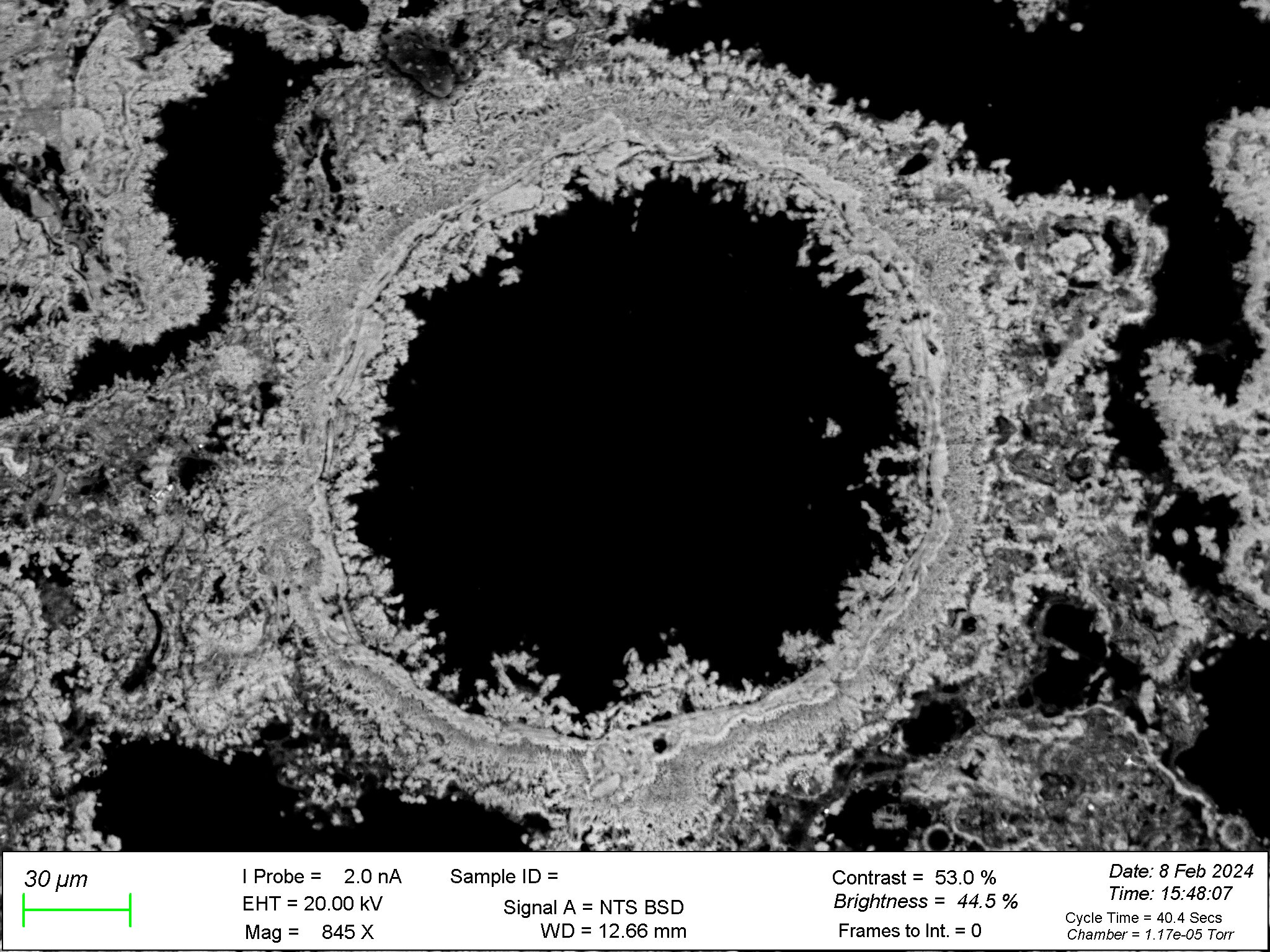
Nearly 1,900-year-old Roman concrete from Emperor Hadrian’s villa has revealed that its remarkable durability was not driven solely by reactions involving volcanic ash and lime. New research shows that carbonation—a slow process that produces calcite over time—also played a major role by sealing cracks, densifying the material, and enhancing its long-term resilience.
Some of the most enduring monuments of the Roman world have survived for nearly two millennia, while many modern concrete structures show signs of deterioration after only a few decades. That striking contrast has long intrigued scientists seeking to understand what made Roman concrete so exceptionally durable.
New research published in Science Advances suggests the answer is more nuanced than previously believed. While the well-known chemical reactions between volcanic ash and lime remain central to Roman concrete’s strength, researchers now conclude that carbonation also made a substantial contribution to the material’s longevity by gradually strengthening and repairing it over time.
The findings come from an unusually detailed analysis of an ancient concrete sample recovered from a communal latrine at Emperor Hadrian’s countryside villa near Rome.
Ancient concrete preserved beneath a Roman latrine
Rather than studying a monumental temple or aqueduct, researchers examined a slab taken from the waste collector beneath the toilet seats of a communal latrine within Hadrian’s villa complex. The concrete, estimated to be about 1,900 years old, was made from volcanic rock fragments, volcanic ash, and lime.
To uncover how the material changed over centuries, the team combined several advanced analytical techniques. They used 3D X-ray scans, high-powered electron microscopes, and a wide range of chemical and mineral analyses.
These methods allowed the scientists to build a detailed picture of the concrete’s internal structure. They mapped pores, cracks, volcanic rock fragments, and tiny mineral deposits at scales ranging from millimeters down to nanometers, revealing processes that unfolded over hundreds of years.
Calcite slowly transformed the concrete
The investigation showed that calcite, a mineral form of calcium carbonate, became the primary substance binding the ancient concrete together.
According to the researchers, calcite formed gradually through carbonation, a process in which lime reacts with moisture and carbon dioxide from the surrounding air. Rather than occurring rapidly, this reaction continued over long periods, steadily changing the concrete’s internal structure.
As calcite accumulated, it filled microscopic cracks and pores throughout the material. This made the concrete denser and created a tighter internal seal that reduced pathways through which water and harmful chemicals could penetrate.
By closing these tiny openings, the mineral growth helped protect the concrete from processes that would otherwise contribute to its gradual breakdown.
Volcanic rock played an active role
The study also found that the volcanic fragments mixed into the concrete were far more than inert aggregate.
Their surfaces chemically interacted with the surrounding lime, producing small quantities of another cement-like material where the rock and lime met. These localized reactions strengthened the interfaces between different components of the concrete, providing additional reinforcement throughout the structure.
Together, the gradual formation of calcite and the reactions involving volcanic fragments created a material that continued to evolve long after it had originally hardened.
Expanding the picture of Roman concrete
The new findings build on previous work investigating why Roman concrete has endured for centuries.
In 2023, an MIT study proposed that the bright white lime fragments commonly found in Roman concrete could help explain its apparent ability to repair itself. According to that research, when cracks developed, water could dissolve these lime fragments, allowing fresh mineral deposits to form and fill the damaged areas.
The new study agrees that reactions involving volcanic ash and lime remain fundamental to Roman concrete’s performance. However, it argues that carbonation should also be recognized as a major contributor to both the material’s durability and its capacity for self-repair.
As the researchers wrote in their paper, “Carbonation over a long period of time also substantially enhances the durability and potential self-healing properties of concrete.“
They added that “the overgrowth of calcite plays a critical role in enhancing the durability of Roman concrete by filling small cracks and voids within the matrix.“
These observations suggest that Roman concrete’s longevity was not the product of a single chemical mechanism but of several interacting processes that unfolded over centuries.
Lessons for modern construction
Although the research focused on ancient building materials, its implications extend to the future of concrete design.
The team hopes that understanding how Roman concrete naturally became denser and more resistant to damage could inspire the development of sustainable modern concrete with comparable self-healing characteristics.
Rather than relying solely on the original ingredients, the study highlights the importance of how concrete continues to change after construction. Slow mineral growth that seals microscopic defects may be just as significant as the initial chemical reactions that give concrete its strength.
By revealing carbonation as another key ingredient in Roman concrete’s extraordinary durability, the research offers a more complete explanation for why structures built nearly two thousand years ago continue to stand today—and why they remain an important source of inspiration for developing longer-lasting construction materials.