Wall inscriptions discovered at the ancient Maya city of Xultun in Guatemala have revealed the identity of the first known Classic Maya mathematician-astronomer. By reconstructing more than 50 mathematical and astronomical microtexts, researchers identified an eighth-century scholar named Sak Tahn Waax and uncovered a previously unknown mathematical formula linking multiple celestial and calendar cycles.
For centuries, the intellectual achievements of the ancient Maya have been evident in their sophisticated calendars, monumental architecture, and remarkably precise astronomical observations. Yet one important question has remained unanswered: Who created the complex calculations that shaped Maya society?
New research published in Antiquity now provides the first direct answer. By reconstructing faint inscriptions preserved on the walls of a small building at the ancient city of Xultun in Guatemala, researchers have identified the first known Classic Maya mathematician-astronomer by name, offering an unprecedented glimpse into the people behind one of the ancient world’s most advanced scientific traditions.
Hidden calculations preserved on ancient walls
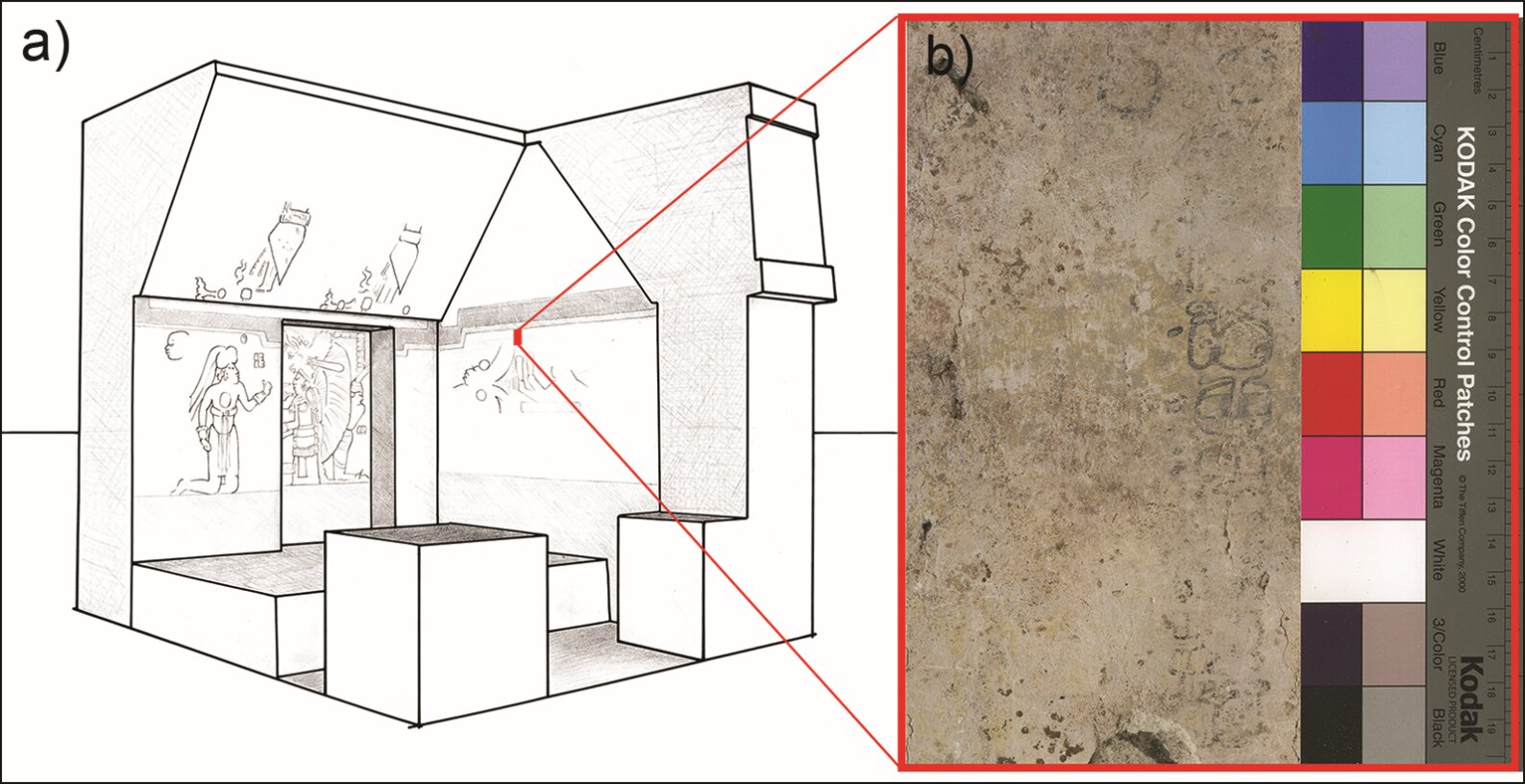
The discovery centers on more than 50 mathematical and astronomical microtexts written on the interior walls of a structure dating to the Classic Maya period, between 250 and 900 CE. Rather than polished public inscriptions, the markings resemble working notes, drafts, and calculations created during the development of more formal astronomical records.
According to the researchers, these inscriptions provide an unusually intimate look at how Maya scholars performed mathematical and calendrical calculations.
Co-author Heather Hurst, director of the San Bartolo-Xultun Project, described the inscriptions as “rough draft” calculations comparable to finding an early manuscript or an artist’s preliminary sketch.
“This fills out an important dimension of Classic Maya life that had typically been reconstructed through ethnohistories and Spanish accounts written centuries later,” Hurst explained.
A name emerges from centuries of anonymity
Although many Maya artists and sculptors signed painted ceramics and carved monuments, the scholars responsible for the civilization’s mathematical and astronomical work had remained anonymous.
Lead author Franco D. Rossi of the Massachusetts Institute of Technology noted that while signatures from artists have long been recognized, no surviving evidence had previously linked mathematical or calendrical work to a named individual.
To recover the faded inscriptions, the research team combined detailed scale drawings, photography, digital scans, and image enhancement techniques. Their analysis revealed 11 hieroglyphs that could be deciphered.
Among them was an attribution identifying the author as Sak Tahn Waax, meaning “White-chested Fox.” According to the researchers, this represents the only known example of a Classic Maya mathematical text being credited to an individual mathematician-astronomer.
The finding transforms what was once an anonymous scientific tradition into one connected with a real person who lived and worked during the eighth century.
An unexpected mathematical formula
The inscriptions contained more than a personal signature. Researchers also reconstructed a mathematical formula unlike any previously documented in surviving Maya texts.
While the calculation draws on familiar Maya units used for astronomy and calendrical timekeeping, the relationships among those units are unique.
Project epigrapher and co-author David Stuart of the University of Texas at Austin said the mathematics reflects Sak Tahn Waax’s distinctive way of connecting several repeating cycles of time.
“The math involves his unique understanding of connections and patterns between several cycles of time, including the 260-day ritual day-count, the solar year, as well as the cycles of Venus and Mars,” Stuart said.
The researchers say this represents a creative mathematical interpretation rather than a simple repetition of established formulas, revealing individual scientific reasoning within Maya astronomy.
Mathematics at the center of Maya society
During the Classic Maya period, astronomy and mathematics were woven into nearly every aspect of political and ceremonial life.
Complex calculations based on calendar dates and observations of celestial bodies influenced decisions ranging from the construction of monuments to the inauguration of kings and queens. Maintaining these systems required specialists capable of tracking multiple recurring cycles with remarkable precision.
The newly reconstructed inscriptions provide rare evidence of how those specialists worked, capturing calculations that appear to have been part of an active scholarly process rather than finished public records.
Instead of revealing only the final products of Maya science, the Xultun texts expose some of the thinking that produced them.
A broader view of ancient scientific traditions
The discovery also reshapes how historians understand the place of Indigenous American scholarship within the broader history of science.
Rossi noted that scholars in ancient India, Iraq, China, and Greece are often remembered as individual thinkers who calculated planetary motions, predicted eclipses, and studied celestial cycles.
“Contemporaries of the ancient world in India, Iraq, China and Greece were similarly calculating solar and planetary cycles, predicting eclipses, and charting star progressions, their achievements often ascribed to individual thinkers,” Rossi said.
“We can now add Sak Tahn Waax to such thinkers, highlighting the great Indigenous astronomy and calendrical traditions of the Americas.”
By attaching a name to a sophisticated mathematical system, the Xultun inscriptions shift the historical narrative from anonymous achievement to individual intellectual accomplishment.
The work offers a rare window into the scientific creativity of an eighth-century Maya scholar whose ideas survived for more than a thousand years, hidden in faint markings on a plaster wall until modern imaging techniques brought them back into view.