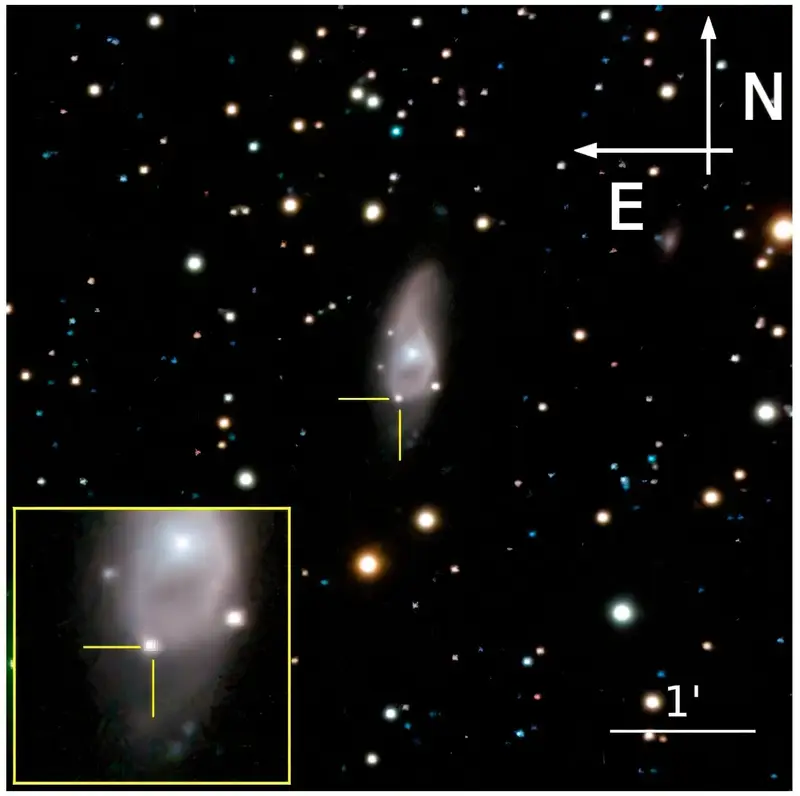
On a June night in 2022, something subtle changed in a distant spiral galaxy. There was no flash bright enough for human eyes, no cosmic alarm bell ringing across the universe. Instead, a faint point of light quietly announced itself to automated eyes scanning the sky. The Asteroid Terrestrial-impact Last Alert System, known as ATLAS, noticed it first. The object would later be named SN 2022ngb, also called ATLAS22res, and it had appeared in the galaxy UGC 11380, about 105 million light years away, glowing at a discovery magnitude of 18.88.
At first glance, SN 2022ngb did not stand out. Supernovae are famous for their brilliance, for briefly rivaling entire galaxies in brightness. This one was different. It was dimmer. Slower. Less dramatic in its outward appearance. Yet it was precisely this quiet nature that drew astronomers in, because sometimes the most restrained explosions tell the most revealing stories.
Now, after months of careful observation and analysis, an international team of astronomers believes they understand what kind of cosmic event this was. Their findings, presented on Dec. 10 on the arXiv preprint server, paint a picture of a rare and revealing stellar death.
Watching a Star Fade Instead of Blaze
Supernovae are among the most powerful and luminous events in the universe. They mark the violent end of a star’s life and scatter material into space, shaping the evolution of galaxies. Astronomers divide them into two broad families based on what their light reveals. Type I supernovae show no hydrogen in their spectra, while Type II supernovae clearly display hydrogen lines.
SN 2022ngb was initially suspected to belong to a special subclass known as Type IIb. These supernovae are transitional objects, showing hydrogen early on but losing those signatures as time passes. They hint at stars that were once wrapped in hydrogen but somehow shed most of it before exploding.
Early observations in 2022 pointed in this direction, but suspicion is not certainty. To truly understand what SN 2022ngb was, astronomers needed more data and more patience.
A team led by Jiewei Zhao of Yunnan University in China set out to do just that. They gathered optical and near-infrared observations and carefully tracked how the light from SN 2022ngb changed over time. In astronomy, light curves and spectra are not just measurements; they are narratives, revealing how an explosion unfolds moment by moment.
“We analyzed photometric and spectroscopic data of SN 2022ngb. By constructing and modeling the bolometric light curve with semianalytic models, we estimate the primary explosion parameters,” the researchers write.
This approach allowed them to reconstruct the story of the explosion long after its light had begun to fade.
The Signature of a Slow and Subtle Explosion
One of the first clues came from the early behavior of the supernova’s light. SN 2022ngb showed a rapid initial decline in brightness shortly after it was first observed. This feature is known as shock breakout cooling emission, a phenomenon frequently seen in Type IIb supernovae. It occurs when the shock wave from the explosion reaches the surface of the star and then cools as it expands outward.
This brief flicker told astronomers that SN 2022ngb fit the expected pattern of a Type IIb event. But the story did not stop there.
The team compared the V-band absolute light curve of SN 2022ngb with those of other well-studied Type IIb supernovae, including SN 1993J, SN 2011fu, SN 2015as and SN 2024abfo. The comparison revealed something striking. SN 2022ngb was significantly less luminous than SN 1993J and SN 2011fu, two well-known examples of this class. Instead, its brightness more closely matched the fainter SN 2015as and SN 2024abfo.
The numbers confirmed what the eye suggested. The peak bolometric luminosity of SN 2022ngb was measured to be 776 duodecillion erg per second, lower than most Type IIb supernovae. Its rise to that peak was also slower. It took approximately 28.5 days to reach maximum brightness, slightly longer than what astronomers typically see in this category.
Together, these traits defined SN 2022ngb as faint and slow-evolving, a supernova that unfolded with restraint rather than fireworks.
Tracing the Ghost of the Star That Was
Every supernova carries within it the memory of the star that exploded. By modeling the light and spectra, astronomers can infer the properties of that long-gone progenitor.
In the case of SN 2022ngb, the data point toward a star that had already lost most of its outer layers before it died. The team estimates that the ejecta mass, the material thrown outward by the explosion, was between 2.8 and 3.3 times the mass of the Sun. Despite this relatively modest mass, the explosion itself was energetic, releasing around 1.4 sexdecillion ergs.
Perhaps the most revealing detail lies in what little remained of the star’s hydrogen envelope. The researchers conclude that the progenitor had a hydrogen-rich envelope weighing only 0.03 to 0.08 solar masses, with a radius smaller than four times that of the Sun. In stellar terms, this is remarkably compact.
Such a star could not have shed its hydrogen alone. The evidence points toward a binary system, where a companion star siphoned off much of the hydrogen over time, leaving behind a stripped, compact object poised on the edge of collapse.
“Our analysis suggests that SN 2022ngb originated from the explosion of a moderate-mass relatively compact, stripped-envelope star in a binary system. The asymmetries inferred from the nebular phase spectral line features suggest a non-spherical explosion,” the authors conclude.
This final detail adds texture to the story. The explosion was not perfectly symmetrical. It was uneven, shaped by complex internal dynamics that left their mark on the expanding debris.
Why This Faint Supernova Matters
At first glance, SN 2022ngb might seem unremarkable. It was faint, distant, and easily overshadowed by brighter cosmic events. But in astronomy, quiet objects often speak the loudest.
This supernova adds an important data point to the small but growing group of faint Type IIb explosions. By showing that such events can evolve slowly, shine less brightly, and still release substantial energy, SN 2022ngb broadens scientists’ understanding of how massive stars die.
It also reinforces the idea that binary systems play a crucial role in shaping stellar evolution. The stripped hydrogen envelope inferred here offers direct evidence of how companion stars can dramatically alter a star’s fate long before it explodes.
Finally, the hints of asymmetry remind researchers that stellar explosions are not simple, uniform blasts. They are complex, three-dimensional events whose details matter when piecing together the life cycles of stars and galaxies.
SN 2022ngb may never become famous outside astronomical circles, but its quiet light has carried a powerful message across 105 million years of space. By listening carefully, astronomers have learned that even the faintest supernova can illuminate deep truths about the universe and the hidden lives of stars.
More information: J. -W. Zhao et al, SN 2022ngb: a faint, slow-evolving Type IIb Supernova with a low-mass envelope, arXiv (2025). DOI: 10.48550/arxiv.2512.09384