Every animal begins as a single cell. From that humble starting point emerges a body made of many kinds of cells, each with its own job, shape, and behavior. Neurons send electrical signals. Muscle cells contract. Skin cells protect. Yet hidden inside all of them is the same DNA, the same complete genetic instruction manual.
This paradox has long haunted biology. How can identical genomes produce such radically different cell types? Why does a neuron not behave like a muscle cell if both read from the same genetic book?
For decades, scientists have suspected the answer lies not in the genes themselves, but in how cells decide which parts of the genome to read and which to ignore. That decision-making happens through regulatory elements, stretches of DNA that act like switches, turning genes on or off. These elements control when, where, and how genes are used.
Until now, detailed maps of these regulatory switches have existed for only a few familiar animals, mostly classic laboratory species like mice and fruit flies. But a new study pushes this understanding much further back in evolutionary time, into the ancient seas where some of the earliest animals first appeared.
Enter the Sea Anemone
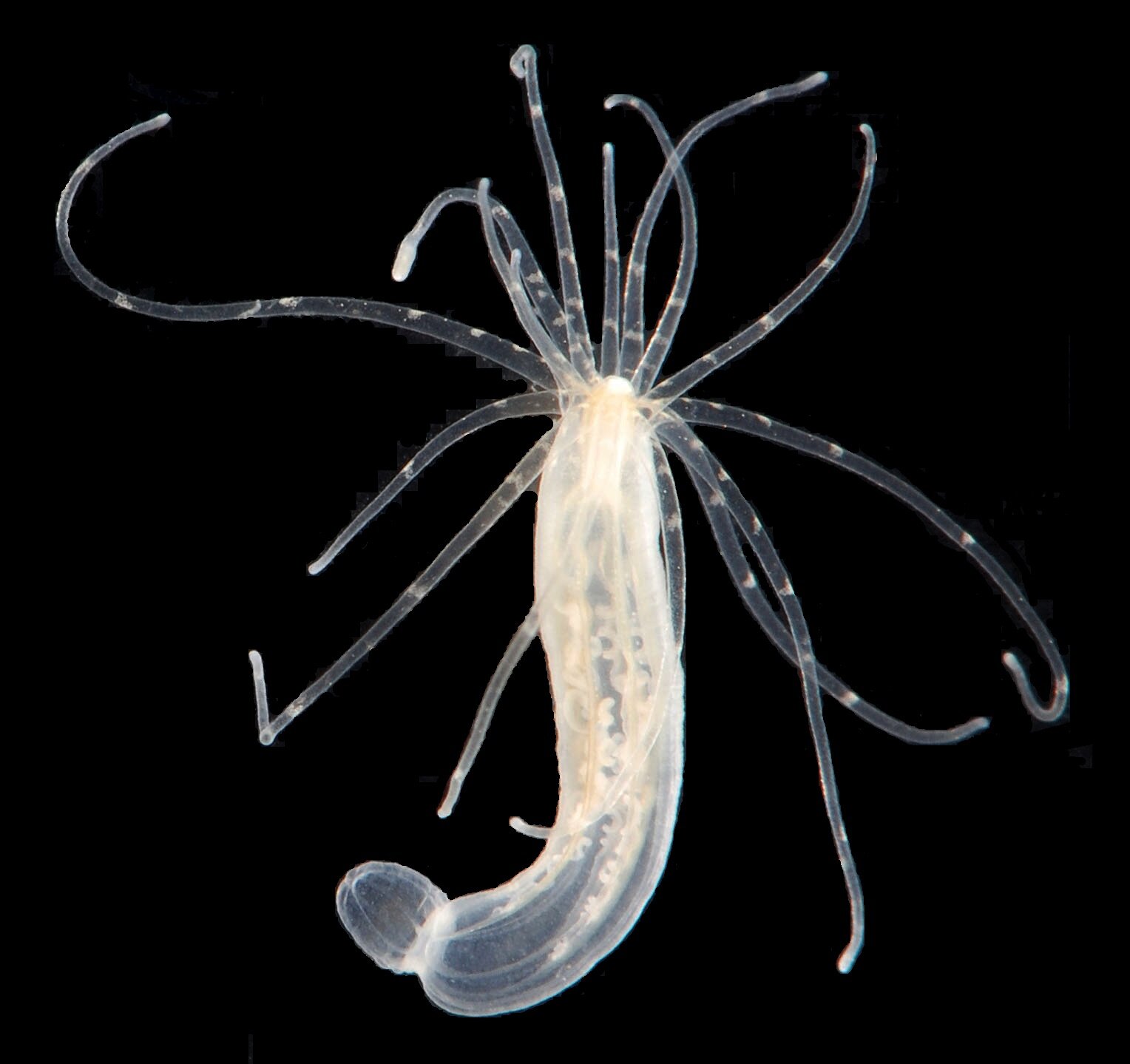
The starlet sea anemone, Nematostella vectensis, does not look like a typical scientific celebrity. It lacks bones, limbs, or a brain like ours. But it belongs to a remarkable group of animals called cnidarians, which also includes jellyfish and corals. These creatures emerged roughly half a billion years ago, making them some of the earliest animals in Earth’s history.
Despite their simplicity, cnidarians possess neurons and muscle cells, and they also carry a unique weapon: cnidocytes. These specialized cells contain tiny, harpoon-like structures used to capture prey and defend against predators. They are responsible for the sting we feel when we brush against a jellyfish or sea anemone.
Because cnidarians sit so close to the base of the animal family tree, understanding how their cells are built offers a rare window into the early evolution of animal life. For the first time, researchers have now created a comprehensive map showing how the genome of Nematostella gives rise to its diverse cell types.
Reading the Genome in a New Way
Instead of focusing on which genes are active in each cell, the researchers took a different approach. They mapped the regulatory elements that control those genes. In other words, they looked not at the actors on stage, but at the directors behind the scenes.
The study systematically dissects what scientists call the “regulatory logic” that defines cell identity in the sea anemone. Rather than describing cells by the genes they express, the new atlas describes the regulatory DNA that builds and maintains those cells.
This shift in perspective reveals something remarkable. When cells are grouped by which genes are active, they cluster by function. Muscle cells group with muscle cells because they contract. Neurons group with neurons because they send signals.
But when cells are grouped by their regulatory elements, a different story emerges. Suddenly, the cells sort themselves by developmental history. The regulatory DNA reveals which embryonic germ layer each cell came from, tracing their lineage back to the earliest stages of development when the body plan is first established.
This insight allows scientists to ask new questions about how cells form and evolve. It shows not just what cells do, but where they come from.
When Similar Cells Have Different Origins
One of the most striking discoveries comes from studying muscle cells. The researchers examined two types of muscle cells in the sea anemone. These cells look similar. They contract in similar ways. They even use almost the same genes to do their work.
Yet they originate from different embryonic germ layers.
The new atlas revealed something unexpected. Even though these muscle cells behave similarly and use similar genes, those genes are controlled by completely different regulatory elements in each cell type. The same genetic tools are being operated by entirely different sets of switches.
This finding overturns a simple assumption that similar cells must share the same regulatory origins. Instead, it shows that evolution and development can arrive at similar solutions through different regulatory paths.
As Dr. Marta Iglesias, postdoctoral researcher at the Centre for Genomic Regulation and co-first author of the study, explains, “Expression tells us what cells do, but regulatory DNA tells us where they come from, how they develop, and which germ layer they originate from.”
In other words, genes describe function, but regulatory DNA tells a deeper story of identity and ancestry.
Decoding Ancient Cellular Instructions
To build this atlas, the researchers studied an astonishing 60,000 individual cells from the sea anemone’s body. About 52,000 came from whole adult animals. Another 7,000 came from gastrula-stage embryos, a very early developmental stage when the basic body plan is just beginning to take shape.
From this massive dataset, the team constructed a detailed catalog of 112,728 regulatory elements. This number is surprisingly large, especially given that Nematostella vectensis has a genome of about 269 million DNA letters.
The scale of regulatory complexity approaches that seen in the fruit fly Drosophila, which has a similar genome size of around 180 million DNA letters but belongs to a lineage that appeared hundreds of millions of years later.
This suggests something profound. The regulatory toolkit needed to generate complex cell types may have existed long before complex bodies themselves evolved.
Dr. Anamaria Elek, postdoctoral researcher at the Centre for Genomic Regulation and co-first author of the study, highlights how this was possible: “Our work highlights the power of combining single-cell genomic readouts with deep learning sequence models to decode the regulatory information contained in these genomes.”
By pairing cutting-edge computational tools with high-resolution cellular data, the researchers were able to read patterns in DNA that would otherwise remain hidden.
Evolution’s Creative Switchboard
Gene regulation is one of evolution’s most powerful tools. Instead of inventing entirely new genes, evolution can generate new cell types by rewiring regulatory switches. Changing when and where genes are turned on can produce new tissues, new behaviors, and new forms.
Cnidarians provide a vivid example of this creative flexibility. They are among the earliest animals to have neurons and muscle cells, and they also evolved cnidocytes, a cell type unlike anything else in the animal kingdom.
The new regulatory atlas lays the groundwork for understanding how such specialized cells emerged. By showing how regulatory networks define cell identity, the study opens the door to tracing the evolutionary origins of the stinging cells that give jellyfish and sea anemones their distinctive power.
As more atlases are built for other animals across the tree of life, including species that lack cnidocytes, researchers will be able to compare regulatory circuits. They can begin to ask which parts of these networks are ancient, which are new, and how changes in regulatory DNA gave rise to entirely new cell types.
Looking Back to Look Forward
This research does more than illuminate the biology of a sea anemone. It reframes how scientists think about animal evolution itself.
The findings suggest that the rules governing how cells become neurons, muscles, or specialized stinging cells were already present hundreds of millions of years ago. Long before complex organs and body plans evolved, the regulatory logic that makes them possible was already written into DNA.
As ICREA Research Professor Arnau Sebe-Pedrós at the Centre for Genomic Regulation in Barcelona puts it, “This study opens a whole new world of possibilities. Going forward, we will investigate animal cellular evolution by comparing genomic sequence information, and for the first time, we can do so systematically and at scale.”
By shifting attention from genes to the regulatory elements that control them, scientists now have a powerful new lens for understanding how life diversified.
Why This Research Matters
At its heart, this study addresses one of biology’s deepest questions: how complexity arises from simplicity. How a single genome can generate a living tapestry of cell types. How evolution builds novelty not by rewriting the entire genetic script, but by learning how to direct it differently.
The sea anemone atlas shows that the foundations of cellular diversity were laid astonishingly early in animal history. The regulatory rules that allow neurons to fire and muscles to contract today were already in place in ancient animals drifting through primordial oceans.
Understanding these rules does more than satisfy curiosity. It helps explain the deep unity of life, revealing how modern animals, including humans, are connected to their earliest ancestors not just by genes, but by shared regulatory logic.
In uncovering the hidden switches that shape cells, this research brings us closer to understanding how life learned to become complex, adaptable, and endlessly inventive.
More information: Decoding cnidarian cell type gene regulation, Nature Ecology & Evolution (2025). DOI: 10.1038/s41559-025-02906-1.