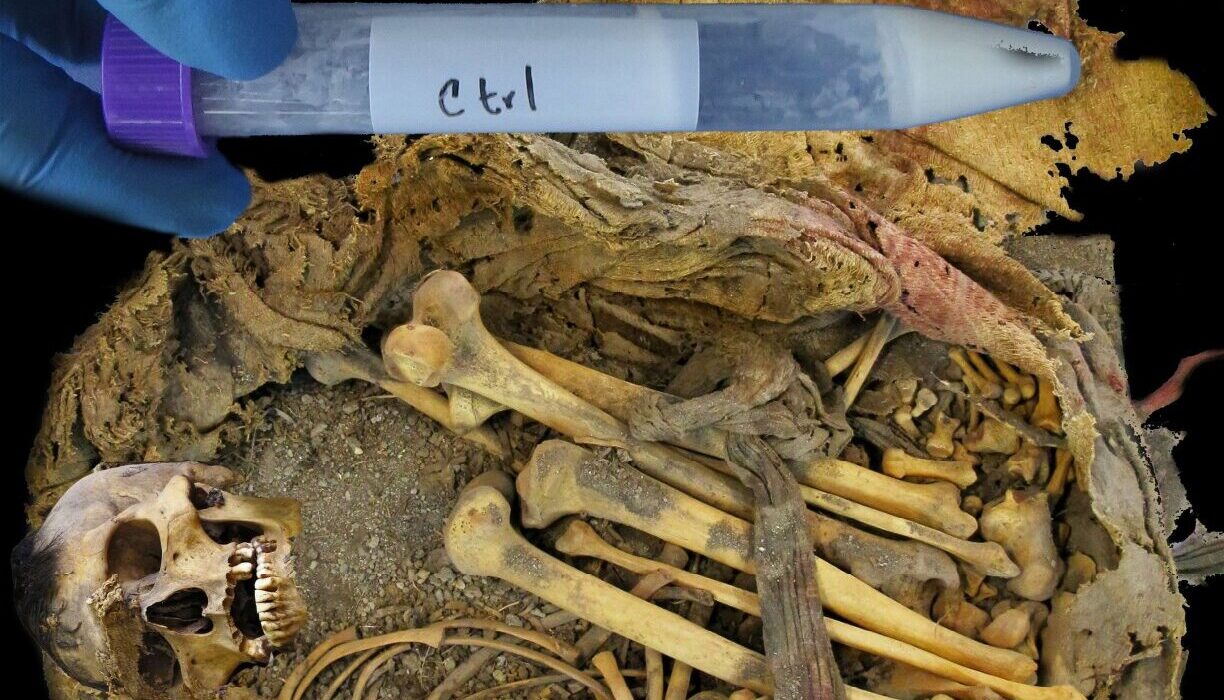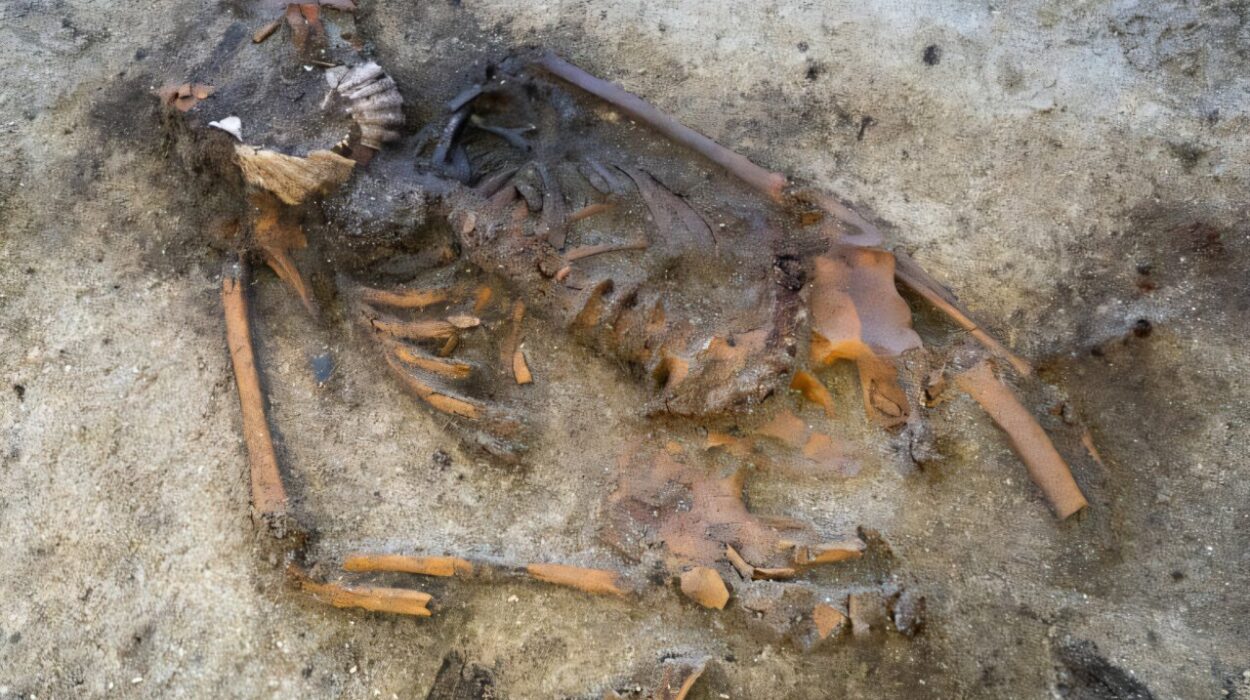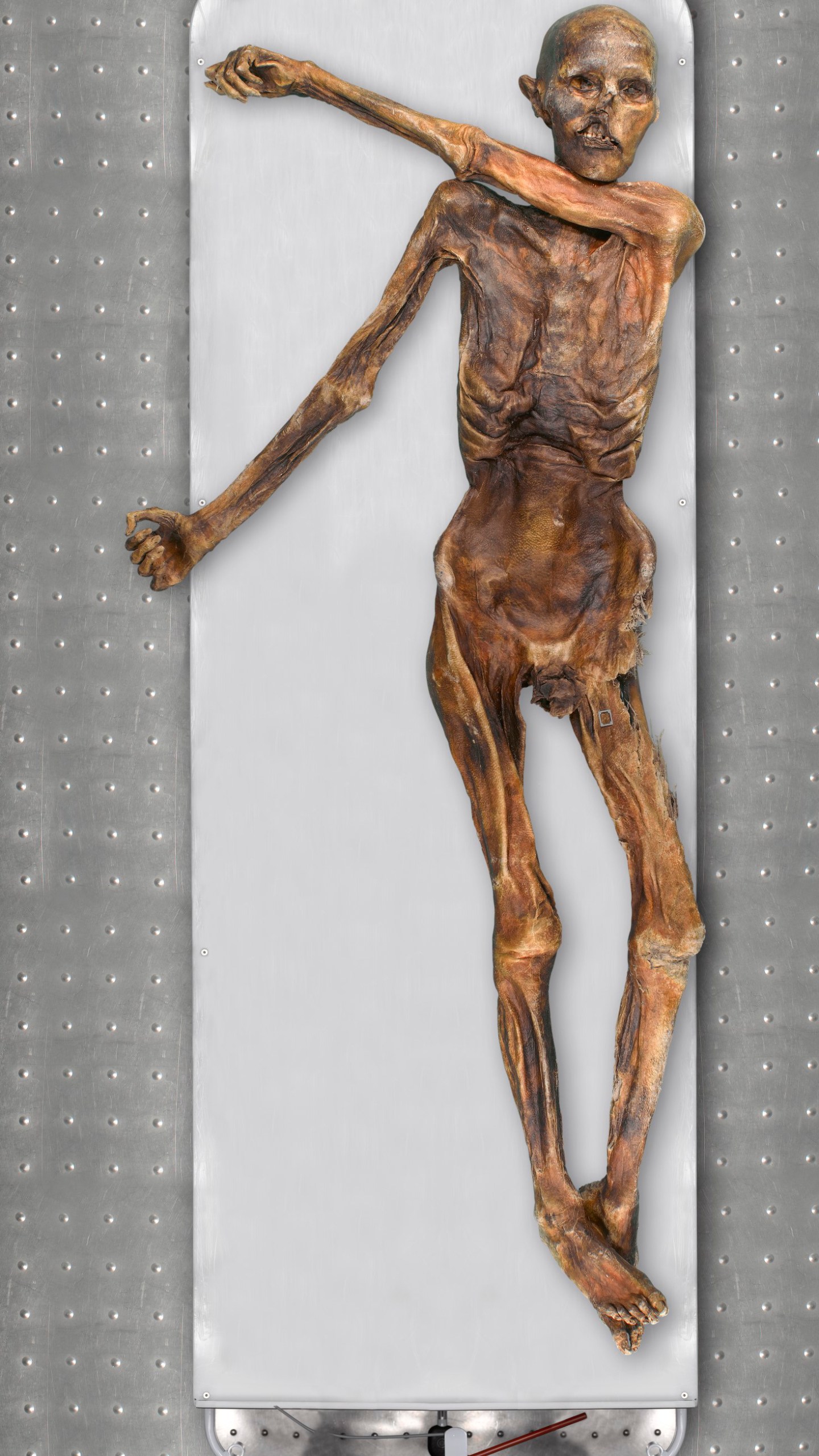
For more than five millennia, the body of the Copper Age man known as Ötzi the Iceman has rested in conditions cold enough to preserve tissues that would otherwise have disappeared long ago—but a new study suggests that freezing has not stopped his microbial world from changing. Scientists found evidence of an ancient gut microbiome preserved inside his body alongside modern microbes introduced during decades of museum conservation, including cold-loving yeasts that appear to have become more abundant in recent years. The finding turns Ötzi from a frozen archaeological object into something more biologically complicated: a preserved ecosystem in which ancient and modern microorganisms coexist.
Ötzi was discovered in 1991 in the Ötztal Alps near the modern border between Austria and Italy. His body had spent roughly 5,300 years in a glacier, where the cold environment dramatically slowed the biological processes that normally break down human tissue.
Today, however, Ötzi is no longer buried in a glacier.
He is kept inside a specialized refrigeration chamber at the South Tyrolean Museum of Archaeology in Bolzano, Italy, at a constant temperature of about −6 °C and relative humidity of 99%. Those conditions closely resemble the environment in which the mummy was naturally preserved, although the chamber has a higher oxygen concentration than the original glacier environment.
The cold suppresses most microorganisms involved in decomposition. But it does not necessarily create a completely lifeless environment.
At temperatures like these, specialized cold-adapted microorganisms—known as psychrophilic or psychrotolerant microbes—can persist. That raises an unusual conservation question: Are the microorganisms found on and inside Ötzi simply dead remnants of an ancient ecosystem, or can some of them still survive and potentially remain biologically active?
A team led by Mohamed S. Sarhan, Marco Samadelli, Albert Zink and Frank Maixner investigated that question by combining microbial DNA sequencing, genome reconstruction, cultivation experiments and comparisons with older samples from the Iceman.
Their study, published in Microbiome, reveals three overlapping microbial histories inside and around the mummy: ancient microorganisms associated with Ötzi and his burial environment, microbes introduced by modern conservation and human activity, and cold-adapted organisms that appear to have persisted under the museum’s freezing conditions.
The distinction is important because simply finding microbial DNA does not tell scientists whether the organism is alive, dead, dormant or newly introduced.
Inside the mummy, an ancient microbial world remains
One of the clearest patterns appeared when researchers compared microorganisms from internal tissues with those found on the mummy’s exterior.
The internal microbial communities were significantly different from the communities found on external surfaces and environmental samples. Internal samples were particularly enriched in anaerobic bacteria, including members of the genus Clostridium.
That separation matters because the inside of the mummy appears to retain a microbial signature that is fundamentally different from the modern environment surrounding it.
The researchers reconstructed dozens of microbial genomes from the samples and compared them with DNA recovered from earlier investigations of Ötzi. They ultimately retained 38 bacterial metagenome-assembled genomes, or MAGs, meeting their quality criteria, along with five fungal genomes, including four genomes from yeast isolates.
A metagenome-assembled genome is essentially a reconstructed microbial genome obtained from a mixture of DNA. Instead of growing an organism in the laboratory, researchers can use fragments of DNA recovered from a complex sample to reconstruct much of its genetic information.
That allowed the team to look beyond simply asking, “Which microbes are here?” They could also investigate how widespread particular organisms were across different parts of Ötzi’s body and across samples collected in different years.
The internal community included several bacteria associated with the intestinal tract, including Romboutsia hominis, Clostridium moniliforme, Ruminococcus bromii, Kineothrix sp., Treponema succinifaciens and Eubacterium sp.
The researchers interpreted these intestinally enriched organisms as remnants of Ötzi’s endogenous gut microbiome.
In other words, the frozen body still contains traces of the microbial community that lived inside him.
Ancient DNA helped separate the old from the new
But how can scientists tell whether microbial DNA is ancient?
One important clue comes from a characteristic chemical change that accumulates in ancient DNA. Over time, cytosine bases can undergo deamination, producing a sequence pattern in which cytosine is read as thymine. Researchers can measure the frequency of these changes near the ends of ancient DNA fragments.
The Iceman study found substantial C-to-T deamination in several of the core anaerobic microbial genomes. In some samples, the frequency exceeded 10% and reached about 20% for particular taxa.
The signal was especially pronounced in samples from 1992 and 2010.
That pattern supported the interpretation that several of the anaerobic bacterial lineages were genuinely ancient components of the Iceman’s microbial history rather than organisms recently introduced into the museum.
The gut-associated organisms showed similar evidence. Treponema succinifaciens and Kineothrix sp., for example, displayed clear DNA-damage profiles consistent with an ancient origin.
But the researchers also found something more complicated.
Not every microorganism associated with Ötzi had the same history.
The outside of the mummy tells a much more modern story
The exterior of the body was strongly influenced by the environment in which Ötzi has been conserved for the past several decades.
The researchers found bacteria commonly associated with environmental and skin-associated communities, including Pseudomonas, Staphylococcus and Acinetobacter.
One particularly striking source was not the museum air but the water used to regulate the mummy’s humidity.
That spray water was dominated by Methylobacterium, which accounted for about 61% of the bacterial community in the sample. Caulobacter represented about 26.5%, followed by Bradyrhizobium, Sphingomonas and Massilia.
These spray-water-associated organisms were also detected on the mummy’s exterior, and their abundance generally decreased as sampling moved from external surfaces toward internal tissues.
The result suggests that Ötzi’s modern surface microbiome is not simply a reflection of whatever microorganisms happen to float through the museum’s air. Conservation practices themselves have helped shape it.
That does not mean the conservation procedures have failed. The study instead shows that preserving an ancient body also creates a new ecological environment around it.
And some microorganisms appear to be particularly well suited to that environment.
Cold-loving yeasts were found living in cultures from the mummy
The most intriguing discovery came from cultivation experiments.
Researchers successfully isolated four cold-adapted yeasts from samples associated with Ötzi: Glaciozyma watsonii, Mrakia robertii, Phenoliferia glacialis and a Goffeauzyma species.
These are not ordinary indoor molds.
The researchers’ genomic comparisons placed the isolates within distinct lineages of cold-adapted yeasts, with close evolutionary relationships to organisms associated with environments such as Arctic and Antarctic regions, glaciers and high-altitude areas.
That geographic and ecological pattern was significant because it suggested that these microorganisms were not simply common contaminants introduced from food or human contact.
Some were also associated with environments resembling the alpine conditions in which Ötzi had originally been preserved.
The team therefore considered several possible histories for these yeasts. They could represent ancient organisms that survived in a dormant state. They could be descendants of microorganisms that entered the body after death and persisted for long periods. Or some may have remained capable of biological activity under favorable microenvironmental conditions.
The study does not definitively resolve which of those histories applies to every yeast.
But one organism produced a particularly striking temporal signal.
One yeast became much more prominent between 2010 and 2019
Researchers compared two skin samples collected nearly a decade apart: one from 2010 and another from 2019.
The yeast community had changed.
Glaciozyma, represented by the isolate recovered from Ötzi’s internal body water, increased dramatically in relative abundance. It represented about 85% of the yeast community in the 2010 sample and about 98% in the 2019 sample.
At the same time, the DNA associated with these yeasts showed changes that were difficult to reconcile with a simple accumulation of increasingly degraded ancient DNA.
In the 2010 sample, DNA fragments associated with the four yeasts were generally short, with a peak around 40 nucleotides, and showed C-to-T substitution frequencies of roughly 5%.
In the 2019 sample, the researchers observed longer average DNA fragments and reduced damage signatures, particularly for Glaciozyma.
That combination was important.
If the DNA were merely ancient genetic material gradually persisting in the mummy, researchers would not necessarily expect to see a growing representation of longer, less-damaged sequences alongside a major increase in relative abundance.
Instead, the pattern was interpreted as evidence suggesting recent or ongoing microbial activity, potentially including replication under the current conservation conditions.
The authors therefore concluded that Glaciozyma may be metabolically active—or at least capable of replication—at temperatures around −6 °C.
That is a significant distinction from saying that the organism has been proven to be actively growing inside the mummy.
The study itself emphasizes that genomic evidence cannot definitively distinguish active cells from dormant ones.
The microbes have genes that could matter for preservation
The researchers next asked what these microorganisms are genetically equipped to do.
The answer added another layer to the conservation puzzle.
Several microbial genomes contained genes associated with survival in cold environments, including mechanisms involving cryoprotectants and changes to membrane lipids.
Some also carried genes associated with breaking down complex biological materials.
For example, Clostridium algidicarnis contained a gene encoding a collagenase. Collagen is a major structural component of skin and connective tissue, so the researchers identified this as a potential concern for the physical integrity of the mummy.
Other Clostridium genomes and some of the yeast isolates carried genes associated with proteases and lipases, enzymes capable of breaking down proteins and fats.
The important word here is “potential.”
Finding a gene does not demonstrate that the enzyme is currently being produced or that it is actively damaging Ötzi’s tissues.
The researchers explicitly recognize this limitation. Their functional analysis demonstrates metabolic potential, not direct proof of active tissue degradation under the museum’s storage conditions.
Still, the genetic repertoire shows that some microorganisms associated with the mummy possess the biological tools that could, under suitable conditions, allow them to interact with organic material.
An old disinfectant may have helped shape the modern microbiome
Another unexpected clue came from Ötzi’s conservation history.
After his discovery in 1991, the mummy was treated with a phenol-containing solution to help prevent fungal growth.
The new study found that several microorganisms associated with Ötzi possess genes involved in phenol degradation, including Pseudomonas sp. 5C2 and several cold-adapted fungal isolates.
The researchers suggest that the historical presence of phenol may have created a selective environment favoring microorganisms capable of tolerating or using phenolic compounds.
That is an interpretation rather than a demonstrated cause-and-effect relationship.
Nevertheless, it offers a striking example of how conservation itself can become part of an ancient specimen’s microbial history. A chemical introduced to protect the mummy may have helped determine which microorganisms were best positioned to persist afterward.
The same principle appears in the mummy’s relationship with modern environmental microbes.
One bacterial strain appears to have colonized multiple parts of the body
Among the bacteria, Pseudomonas sp. 5C2 stood out.
The researchers detected this organism across many samples and years, with more than 80% breadth of genomic coverage in all samples examined, including soil from the location where Ötzi was originally found.
But detecting a species in multiple places does not necessarily mean that the same strain is present everywhere. Different strains of the same species can have substantially different genomes.
To investigate that question, the researchers performed strain-level genomic analysis.
The result suggested that Pseudomonas sp. 5C2 strains recovered from different tissues—including lung, stomach and skin—were extremely similar to one another. Their genetic divergence was significantly lower than the divergence between the Iceman-associated strains and the corresponding soil-derived or reference sequences.
The researchers interpreted this as evidence that a specific Pseudomonas strain successfully colonized the mummy and persisted across different anatomical sites.
Its similarity to a strain associated with cold environments also raised the possibility that it adapted to the unusual conditions surrounding Ötzi.
Again, however, the study does not establish exactly when the strain arrived or prove that it is actively damaging the mummy.
What it does show is that the microbial community has a history of persistence and movement that is considerably more complicated than simple contamination from the surrounding environment.
Ötzi’s microbiome has three different histories
Taken together, the evidence points toward three broad microbial forces operating on the Iceman.
The first is his original biological history. Ancient gut-associated bacteria survived as genetic traces inside the protected internal environment of the mummy.
The second is the environment in which his body was preserved after death. Cold-adapted microorganisms from the glacier and surrounding alpine environment became part of the mummy’s microbial history.
The third is the modern conservation environment. Over the past three decades, microorganisms associated with people, museum infrastructure and humidity-control water have reached the mummy’s exterior and, in some cases, persisted there.
These histories overlap.
That is what makes the Iceman’s microbiome so difficult to interpret—and scientifically valuable.
A microorganism can carry ancient DNA damage patterns and still be associated with a lineage capable of surviving today. A microbial community can contain both genuine remnants of Ötzi’s Copper Age biology and organisms introduced after his discovery.
The researchers argue that DNA damage alone is therefore not enough to establish whether a microbial lineage is ancient, modern, dormant or viable.
Freezing has slowed the ecosystem, but apparently has not erased it
The study does not suggest that Ötzi is undergoing ordinary decomposition.
His −6 °C storage conditions suppress most microorganisms responsible for decomposition, and the researchers emphasize that the current conservation regime remains highly effective at limiting microbial growth.
But the findings challenge a simpler assumption: that freezing automatically makes the microbial ecosystem biologically irrelevant.
Instead, the cold appears to act as a powerful filter.
Most microorganisms cannot grow under such conditions. The organisms that remain are disproportionately those with adaptations that help them tolerate extreme cold, chemical stress, low nutrient availability or other unusual conditions.
Some bacteria can form endospores, dormant structures that help them withstand environmental stress. Some fungi and yeasts possess genetic features associated with cold adaptation. Other organisms appear able to use compounds left behind by historical conservation treatments.
The result is not a completely frozen microbial landscape.
It is a highly selective one.
The biggest unanswered question is whether the microbes are actually active
The most important caution in the study is also one of its most interesting scientific questions.
The researchers found cultured microorganisms. They detected genomes. They observed temporal changes in microbial DNA. They identified genes associated with cold survival and degradation.
But none of those observations, individually or together, provides a direct measurement of microbial metabolism inside the mummy under its current storage conditions.
The researchers explicitly note that metagenome-based functional analysis cannot distinguish between genes carried by metabolically active organisms and genes preserved in dormant or dead cells.
They propose several ways to resolve the uncertainty.
One would be metatranscriptomics, which analyzes RNA and could provide direct evidence of gene expression. Another would be propidium monoazide treatment before DNA extraction, which could help distinguish DNA associated with living cells from DNA outside viable cells.
Long-term monitoring could also reveal whether the microbial community continues changing.
That would be especially valuable for the yeasts. The comparison between 2010 and 2019 provides evidence of a temporal shift, but two time points are not enough to establish the complete trajectory of a microbial population.
The authors therefore recommend periodic, minimally invasive monitoring using multiple molecular approaches.
A mummy can preserve a microbial past while acquiring a microbial present
For Ötzi, the scientific significance of the discovery goes beyond finding unusual microbes.
The Iceman is often imagined as a time capsule: a human body sealed by ice and delivered almost unchanged from the Copper Age into the modern world.
His microbiome tells a more complicated story.
Inside his tissues, researchers can still detect organisms associated with the ancient intestinal ecosystem that accompanied him in life. Around those ancient signatures are microorganisms linked to the glacier environment in which his body spent thousands of years. And layered over both are microbes introduced during the decades since his discovery.
Some of those modern organisms appear to have become established. Some ancient or glacier-associated microorganisms may remain dormant. Others may retain the capacity for activity in tiny, favorable microenvironments.
The researchers’ central message is therefore not that Ötzi is suddenly “coming back to life.”
It is that biological preservation is not necessarily the same thing as biological stillness.
For more than 5,000 years, the Iceman has preserved an extraordinary record of human history. His microbial community now shows that the record itself is dynamic—containing traces of the man he once was, organisms from the glacier that preserved him, and newcomers from the modern world that began arriving only after scientists opened that frozen window into the past.