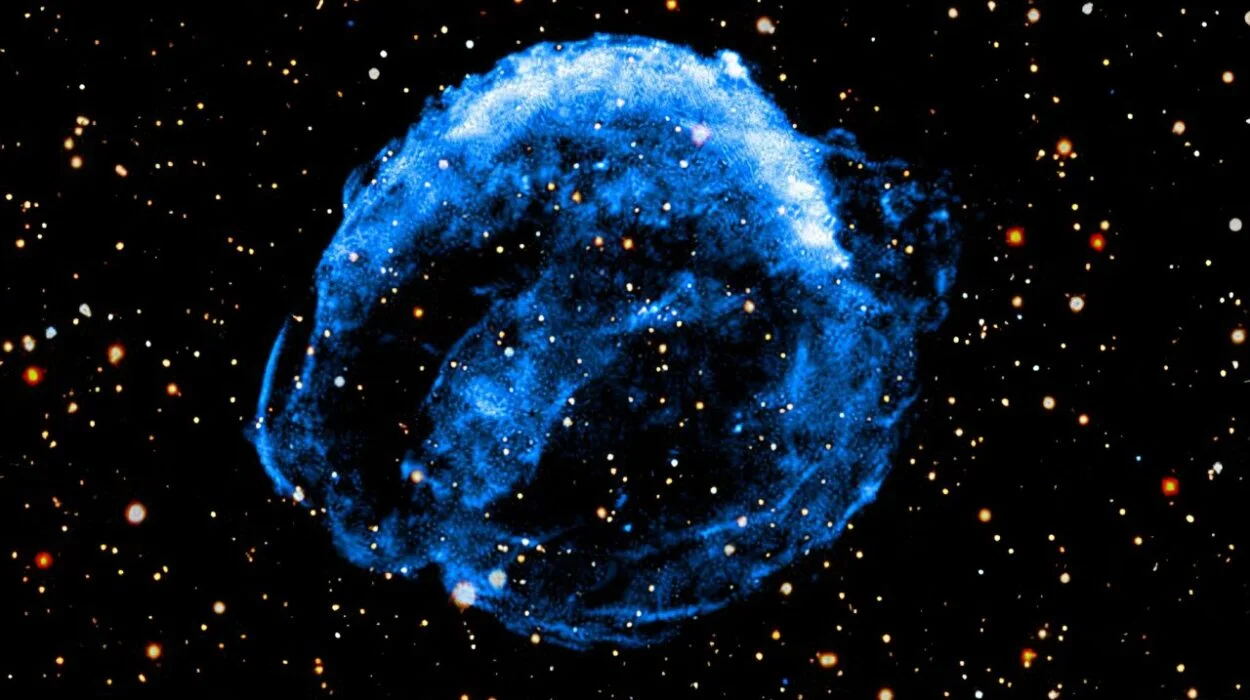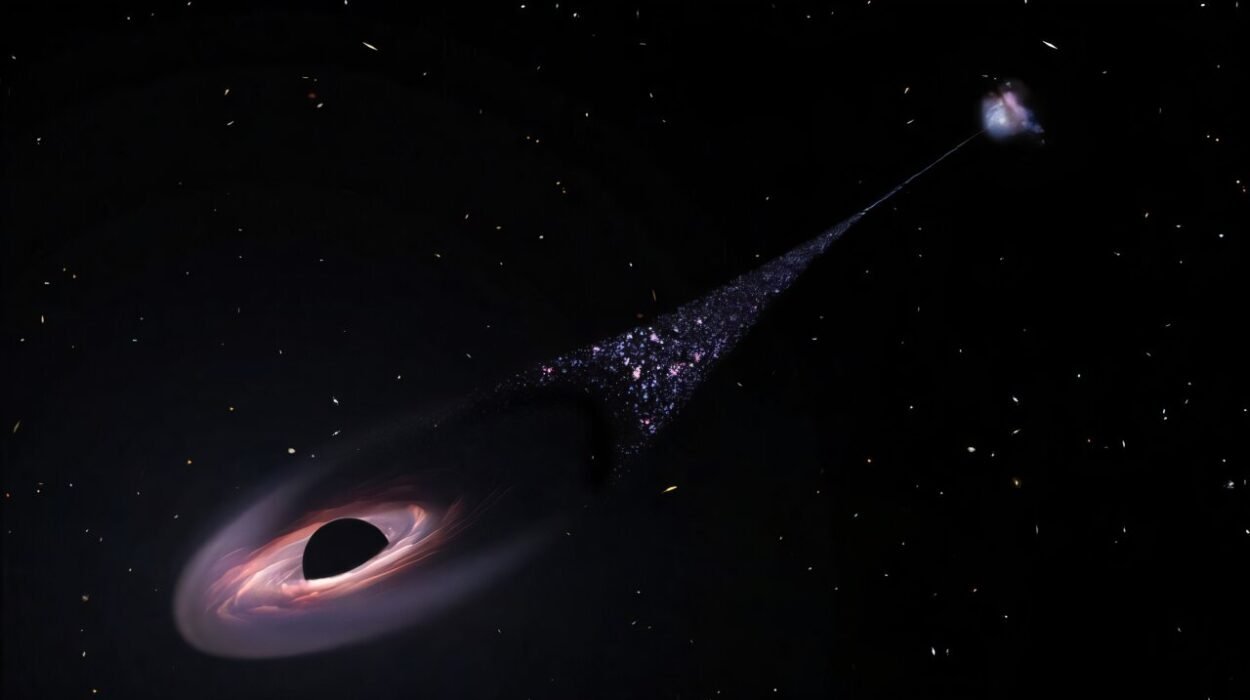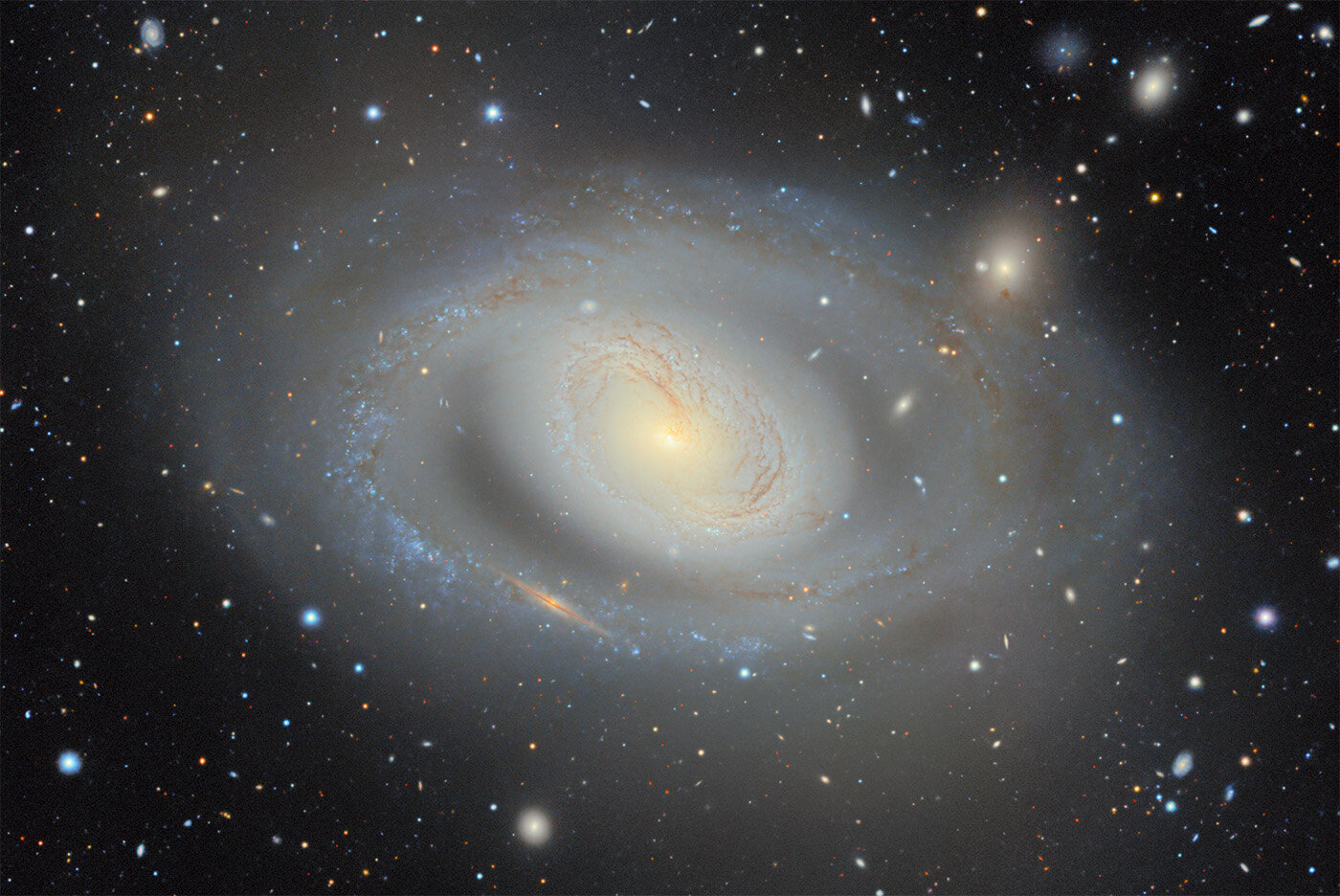
Imagine opening a map of the night sky and finding nearly 4 billion stars and galaxies spread across a single digital image. That is now possible with a new 5.6-trillion-pixel map covering roughly three-quarters of the sky, giving astronomers—and anyone curious enough to explore it—an unusually deep view of the universe beyond the Milky Way.
The new map comes from the DESI Legacy Imaging Surveys team and combines observations from multiple ground- and space-based surveys into one enormous view of the sky. It covers about 75% of the sky in visible and near-infrared light, focusing on the extragalactic universe—the part beyond the regions obscured by the dust and stars of our own galaxy.
The scale is difficult to picture. The map contains nearly 4 billion celestial objects, primarily stars and galaxies, and incorporates 263,407 individual telescope exposures.
Anyone can view the data through the Legacy Survey Sky Viewer. Astronomers can use it to investigate objects they have observed elsewhere, while citizen scientists can explore the same enormous dataset themselves.
For researchers, the map is more than a spectacular digital picture. It can serve as a starting point for finding unusual objects, including gravitational lenses and transient events such as supernovae. It can also support investigations into dark matter and dark energy.
The map is expected to remain the most comprehensive two-dimensional view of the universe for years to come.
“It’s part of the fabric of astronomy research now,” said David Schlegel, a co-lead of the Legacy Surveys and a scientist at the Department of Energy’s Lawrence Berkeley National Laboratory. “When you’re working with astronomical objects today, you often start by pulling up the Legacy Imaging Viewer to see what you’re looking at.”
The photograph behind a three-dimensional universe
The Legacy Surveys were originally designed for a very specific purpose: preparing the way for the Dark Energy Spectroscopic Instrument, or DESI.
At its simplest, the new map is a deep photograph of the sky. It records where stars and galaxies appear and how bright they are. That information allows DESI to select targets for more detailed observations and measure their light at different wavelengths.
Those measurements provide distances to galaxies, allowing scientists to build a three-dimensional map of the universe.
That 3D view is essential to one of DESI’s central scientific goals. By examining how galaxies are distributed and clustered at different periods in cosmic history, scientists can investigate how dark energy has influenced the expansion of the universe over time.
The enormous new 2D map therefore sits at the beginning of a much larger astronomical process: first identifying what is in the sky, then determining where those objects are in the universe and when their light began its journey toward Earth.
DESI needed a bigger sky
The expansion of the map was driven in part by DESI itself.
In April 2026, DESI completed its original five-year survey ahead of schedule and had observed vastly more objects than expected. That efficiency created an unusual problem: the survey needed more potential galaxies to observe.
“it became clear we might run out of galaxies to look at and run out of sky, and we better start doing something about that,” Schlegel said.
The new Legacy Surveys map has already begun serving that purpose. It has been used to select DESI targets since June 2026 and is expected to guide the telescope’s observations in the years ahead.
DESI’s early results have also produced intriguing hints that the influence of dark energy may be weakening over time. Those results could represent a shift in how scientists understand the universe’s future, but improved results based on DESI’s first five years of observations are expected in 2027. DESI is continuing its observations into 2028.
Hundreds of thousands of images became one
Creating the map was itself a formidable computational undertaking.
The dataset combines observations from three major ground-based surveys: the Dark Energy Camera Legacy Survey at NSF Cerro Tololo Inter-American Observatory, the Mayall z-band Legacy Survey at NSF Kitt Peak National Observatory, and the Beijing-Arizona Sky Survey at the University of Arizona’s Steward Observatory.
Years of observations from NASA’s Wide-field Infrared Survey Explorer satellite mission and additional public data were also incorporated.
The ground-based observations were collected across 2,285 nights. Every night brought its own atmospheric conditions and telescope characteristics, meaning the images could not simply be stacked together without extensive computational processing.
A team spent about a year developing the computer code needed to combine the observations. Processing the complete collection then took eight weeks on the Perlmutter supercomputer at Berkeley Lab’s National Energy Research Scientific Computing Center.
More than 160 scientists contributed to collecting the data, while a team of 20 produced the final dataset released to the public.
A reference sky for the next generation
The map’s usefulness is not limited to DESI.
As new observatories such as the NSF-DOE Vera C. Rubin Observatory and NASA’s Nancy Grace Roman Space Telescope begin operating, scientists will be able to compare their observations against this extensive reference view of the sky.
The dataset is also expected to play a role in training artificial intelligence systems designed to analyze petabytes of astronomical data.
More than 1,800 scientific papers have already referenced earlier versions of the Legacy Surveys data, a measure of how deeply the surveys have become embedded in astronomical research.
“For our team, these data are fundamental to our investigation of the expansion history of the universe and the formation of our galaxy,” said Arjun Dey, co-lead of the Legacy Surveys and an astronomer at NSF NOIRLab. “But the skies belong to everyone, and this survey gives everyone the chance to explore the sky and marvel at its wonders.”
And that may be the most striking feature of the new map. A project built partly to feed galaxies into one of the world’s major cosmological surveys has also produced something far more open-ended: an enormous, publicly accessible window onto nearly 4 billion celestial objects, ready for the next question someone thinks to ask.