Evidence from observations with the European Southern Observatory’s Very Large Telescope suggests a giant moon-like object is orbiting a brown dwarf in the CD-35 2722 system. If confirmed, it would represent the first plausible detection of an exomoon beyond our solar system and challenge long-standing definitions of planets and moons.
For decades, astronomers have searched for convincing evidence of moons beyond the solar system. Thousands of planets have been identified around distant stars, yet no exomoon has been confirmed. Now, observations from the European Southern Observatory’s Very Large Telescope (VLT) have uncovered what researchers describe as the strongest evidence yet for such an object—although the discovery comes with an unexpected twist.
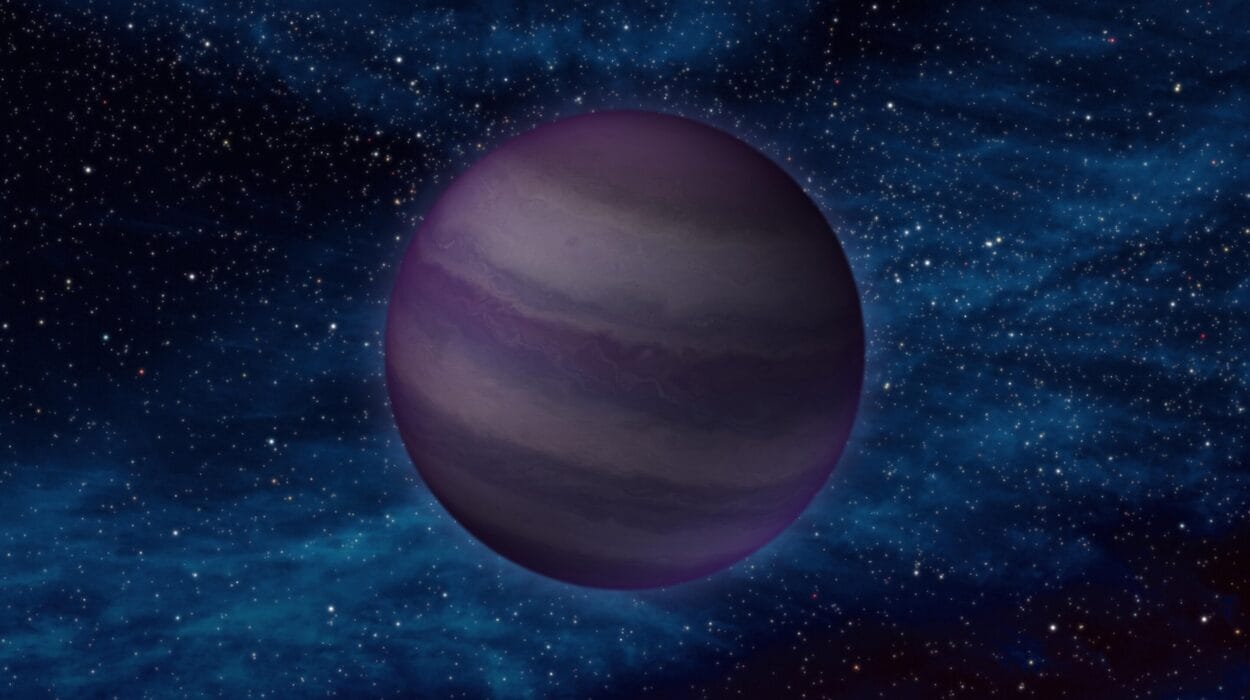
Rather than orbiting a planet, the newly identified body circles a brown dwarf, an object too massive to qualify as a planet but too small to sustain the nuclear fusion that defines a star. That unusual arrangement makes the system difficult to classify using familiar astronomical terms.
The findings are published in Nature.
An unusual three-body system
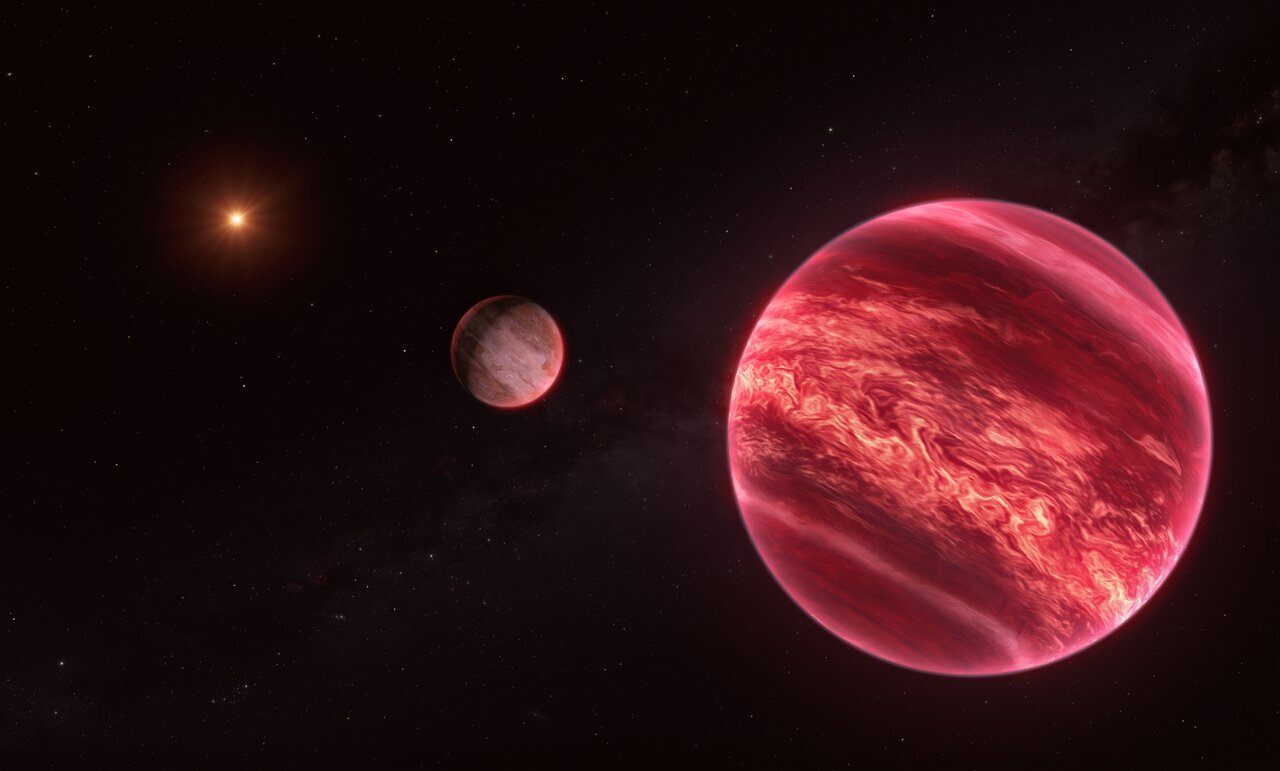
At the center of the system is CD-35 2722, a young star with roughly half the Sun’s mass. Orbiting that star is a brown dwarf more than 30 times the mass of Jupiter. The newly detected object revolves around the brown dwarf instead of the star itself.
Researchers describe the object as an exosatellite, a natural satellite outside the solar system. Yet it is far larger than the moons found in our own planetary neighborhood. According to the study, the object has at least the mass of Jupiter, placing it firmly within the range normally associated with giant planets.
That creates an unusual classification problem.
“This system is somewhat hard to define using Solar-System-based words like ‘planet’ and ‘moon’,” said lead author Kevin Hoy, an ESO student in Chile who is also affiliated with Universidad Diego Portales and the Millennium Nucleus of Young Exoplanets and their Moons (YEMS).
Why astronomers hesitate to call it a planet
The object’s mass alone might suggest it should be considered a planet. Its orbital path, however, tells a different story.
“The exosatellite is clearly massive enough to be a planet, but it does not orbit a star, though it orbits an object that orbits a star,” Hoy explained. “Being the third wheel in this system makes us want to call it a moon, even if it is nothing like the small, rocky moons we have in our system.”
The researchers emphasize that the object differs dramatically from familiar moons such as those orbiting Earth or Jupiter. Instead of being relatively small and rocky, it appears to be a giant gaseous world accompanying an even larger brown dwarf.
Alice Zurlo, director of YEMS and a collaborator on the study, said the discovery highlights how systems beyond our own often blur the categories astronomers rely on.
“The satellite we report is a giant gaseous body orbiting a highly massive companion, itself several times the mass of Jupiter,” she said.
Zurlo added that the solar system provides a straightforward distinction between the Sun, planets, and moons, making terminology relatively simple. In the CD-35 2722 system, however, “we are blurring the lines between stars, planets, and moons,” making the entire system more difficult to describe.
Searching for exomoons has proven remarkably difficult
Despite the discovery of more than 6,000 exoplanets, convincing evidence for moons orbiting those distant worlds has remained elusive.
Only a handful of possible exomoon candidates have been proposed over the years, and none has gained broad confirmation. Even recent observations have stopped short of providing definitive proof.
Just months before the new report, another research team led by Quentin Kral used the Very Large Telescope Interferometer to investigate the HD 206893 system. Those observations revealed hints of a possible satellite but did not provide firm evidence that one exists.
The CD-35 2722 observations therefore stand out because the researchers believe they have identified the strongest case yet for a moon-like companion beyond the solar system.
“As exotic as it is, this system is truly unique and represents a breakthrough: the first plausible detection of an exosatellite,” Zurlo said.
Detecting an unseen companion through its gravitational pull
The research team did not observe the object directly. Instead, they relied on the CRIRES+ instrument mounted on ESO’s Very Large Telescope.
Using the radial velocity technique, astronomers measured tiny motions of the brown dwarf caused by the gravity of the unseen companion. The same approach famously led to the discovery of the first exoplanet orbiting a Sun-like star.
In this case, the method detected subtle “wobbles” in the brown dwarf’s motion. Those movements provide the evidence that a massive object is orbiting it.
According to the researchers, the measurements strongly support the presence of the proposed exosatellite, although additional observations will be needed to confirm the discovery.
Future telescopes could uncover many more unusual systems
Beyond adding a potential first exomoon to astronomy’s growing catalog, the discovery may broaden scientists’ understanding of how planetary systems form and evolve.
Finding satellites around a wider variety of objects could reveal that nature builds systems far more diverse than those found in our own solar system. Such discoveries may also force astronomers to reconsider the language used to classify planets, moons, brown dwarfs, and other celestial bodies.
The researchers expect the European Southern Observatory’s upcoming Extremely Large Telescope (ELT) to play a key role in that effort. Equipped with a 39-meter (128-foot) mirror and advanced instruments, the observatory is expected to detect even smaller exomoons than current facilities can identify.
As astronomers continue exploring planetary systems unlike anything close to home, discoveries such as the one in CD-35 2722 suggest that the universe does not always fit neatly into familiar categories. Sometimes the hardest part is not detecting a new world—it is deciding what to call it.