Have you ever watched ripples spread across a quiet pond after tossing in a small stone? Have you listened to your favorite song through headphones, felt the warmth of sunlight on your face, or noticed your phone instantly connecting to Wi-Fi? At first glance, these experiences seem completely unrelated. Yet they all share one remarkable connection—they involve waves.
Waves are everywhere. They travel through oceans, air, the Earth, and even the empty vacuum of space. They carry music to your ears, light to your eyes, and information across the globe. Without waves, there would be no radio, no television, no mobile phones, no internet, no medical ultrasound, and no sunlight reaching Earth. Even earthquakes reveal their secrets through waves.
Physics uses the concept of waves to explain countless natural phenomena. Although waves can appear in many different forms, they all follow the same fundamental principles. Once you understand what a wave is, you begin to see the world in a completely new way.
What Is a Wave?
A wave is a disturbance or oscillation that transfers energy from one place to another without transporting matter over long distances. In simple terms, a wave carries energy while the material through which it travels usually stays in the same general location.
Imagine holding one end of a rope while a friend holds the other. If you quickly move your hand up and down, a pulse travels along the rope. The wave moves toward your friend, carrying energy. However, each tiny section of the rope only moves up and down around its original position instead of traveling from one end to the other.
This is one of the most important ideas in wave physics: waves transport energy, not the material itself.
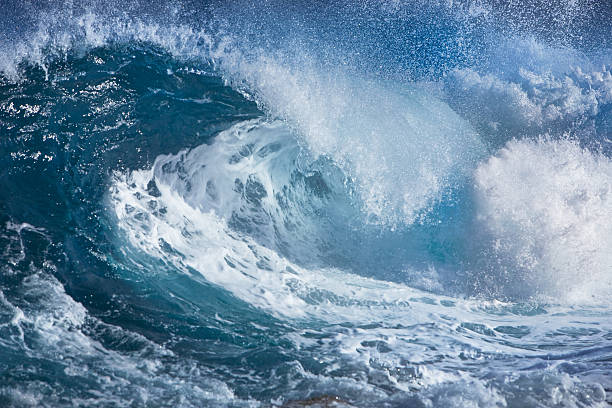
Water waves provide another familiar example. As waves move across the ocean, it may seem as though the water itself is traveling forward. In reality, individual water molecules mostly move in circular or nearly circular paths while the wave carries energy across the surface.
The Scientific Definition of a Wave
In physics, a wave is defined as a propagating disturbance that transfers energy and momentum through a medium or through space while the particles of the medium experience oscillatory motion about their equilibrium positions. Electromagnetic waves are an important exception because they can travel without a material medium.
This definition applies to every kind of wave, from tiny vibrations inside atoms to enormous gravitational waves that stretch across the universe.
Why Waves Matter
Waves are one of nature’s most efficient ways of transferring energy.
When you speak, vibrating vocal cords create sound waves that travel through the air to another person’s ears. Inside the ear, these waves are converted into electrical signals that the brain interprets as sound.
Sunlight reaches Earth as electromagnetic waves after traveling about 150 million kilometers through the vacuum of space. Without these waves, life on Earth would not exist.
Doctors use ultrasound waves to examine unborn babies and internal organs without surgery. Seismologists study earthquake waves to understand Earth’s interior. Astronomers analyze light waves from distant galaxies to learn about the universe’s history.
Waves connect nearly every branch of science.
How Waves Transfer Energy
To understand waves, it helps to separate energy from matter.
Imagine a row of dominoes standing upright. When the first domino falls, it transfers energy to the next one, which falls and transfers energy to the next. Although energy moves through the entire line, each domino only falls in its own place.
A wave behaves in a similar way. Each particle transfers energy to neighboring particles without traveling long distances itself.
This process allows energy to move efficiently across enormous distances.
Waves Need Different Ways to Travel
Not all waves travel in the same way.
Some waves require matter to move through. These are called mechanical waves. They cannot exist in a vacuum because they depend on particles vibrating and passing energy to one another.
Other waves require no material at all. These are electromagnetic waves, which can travel through the empty vacuum of space because they consist of oscillating electric and magnetic fields.
This difference explains why astronauts cannot hear explosions in space. Sound is a mechanical wave that needs air or another material medium, while light is an electromagnetic wave that travels perfectly well through space.
Mechanical Waves
Mechanical waves depend on a medium such as air, water, solids, or gases.
When one particle vibrates, it transfers energy to nearby particles. This chain reaction allows the wave to move through the material.
Mechanical waves appear in many forms throughout nature.
Ocean waves move across water surfaces.
Sound waves travel through air and solids.
Earthquake waves travel through Earth’s crust and mantle.
Vibrations in guitar strings create musical notes.
Even the shaking of a building during an earthquake results from mechanical waves passing through the ground.
Electromagnetic Waves
Electromagnetic waves are completely different.
Instead of requiring vibrating particles, they consist of changing electric and magnetic fields that continually generate one another as they travel.
Because they do not need a medium, electromagnetic waves can cross the vast emptiness between stars and planets.
Visible light is only a tiny part of the electromagnetic spectrum. Other electromagnetic waves include radio waves, microwaves, infrared radiation, ultraviolet radiation, X-rays, and gamma rays.
Despite their differences in energy and wavelength, all electromagnetic waves travel at the speed of light in a vacuum, approximately 299,792,458 meters per second.
Transverse Waves
In a transverse wave, particles move perpendicular to the direction the wave travels.
If you shake one end of a rope up and down, the wave moves horizontally while each part of the rope moves vertically.
The wave’s motion and the particles’ motion occur at right angles.
Light waves are transverse electromagnetic waves. Waves on stretched strings are also good examples of transverse waves.
These waves contain distinctive high points called crests and low points called troughs.
Longitudinal Waves
Longitudinal waves behave differently.
In these waves, particles move back and forth in the same direction the wave travels.
Instead of crests and troughs, longitudinal waves contain compressions, where particles are crowded together, and rarefactions, where particles are farther apart.
Sound waves moving through air are longitudinal waves.
As a speaker vibrates, it pushes nearby air molecules together, creating compressions. These compressions move through the air until they reach your ears.
Surface Waves
Some waves combine features of both transverse and longitudinal motion.
Surface waves occur where two different materials meet, such as the boundary between water and air.
Ocean waves are excellent examples. Water particles move in nearly circular paths while the wave travels across the surface.
These waves create the familiar rolling motion seen at beaches around the world.
The Parts of a Wave
Every wave has measurable characteristics that determine how it behaves.
The highest point of a transverse wave is called the crest.
The lowest point is known as the trough.
The equilibrium position is the wave’s resting level before any disturbance occurs.
The distance between two neighboring crests or two neighboring troughs is called the wavelength.
The height of the wave measured from the equilibrium position to the crest is called the amplitude.
Each of these properties influences how the wave carries energy.
Amplitude
Amplitude measures the maximum displacement of a vibrating particle from its equilibrium position.
Greater amplitude usually means the wave carries more energy.
A loud sound has greater amplitude than a quiet sound.
Large ocean waves contain more energy than small ripples.
Bright light often has greater intensity because its electromagnetic wave has a larger amplitude.
Amplitude affects the strength of a wave but not its speed in most situations.
Wavelength
Wavelength is the distance between identical points on consecutive waves, such as crest to crest.
Long wavelengths correspond to lower frequencies.
Short wavelengths correspond to higher frequencies.
Different wavelengths determine the color of visible light. Red light has a longer wavelength than blue light.
Radio waves may have wavelengths measuring hundreds of meters, while gamma rays have wavelengths smaller than atomic nuclei.
Frequency
Frequency measures how many complete waves pass a given point each second.
Its unit is the hertz, named after physicist Heinrich Hertz.
One hertz means one complete wave passes every second.
A frequency of one thousand hertz means one thousand waves pass each second.
Higher-frequency sound produces higher musical notes.
Higher-frequency visible light appears blue or violet, while lower-frequency light appears red.
Period
The period is the time required for one complete wave cycle.
Frequency and period are closely related.
A wave with a high frequency has a short period because many waves occur every second.
A wave with a low frequency has a longer period.
Wave Speed
Wave speed describes how quickly a wave travels through a medium or through space.
The speed depends on both the properties of the wave and the material through which it moves.
Sound travels much faster through steel than through air because particles in solids are more tightly packed.
Light travels fastest in a vacuum and slows slightly when passing through water, glass, or other transparent materials.
Wave speed is related to wavelength and frequency through one of physics’ most important relationships:
Wave Speed = Frequency × Wavelength
This equation explains why changing one property often changes another.
Reflection
Reflection occurs when a wave bounces off a surface.
You experience reflection every time you look into a mirror.
An echo forms when sound waves reflect from mountains, buildings, or canyon walls.
Radar systems use reflected radio waves to locate aircraft and storms.
Reflection helps scientists study everything from the ocean floor to distant planets.
Refraction
Refraction happens when a wave changes speed as it enters a different material.
Because its speed changes, the wave bends.
A straw placed in a glass of water appears bent because light refracts as it passes from air into water.
Rainbows form because sunlight is refracted and dispersed inside raindrops.
Eyeglasses, cameras, microscopes, and telescopes all rely on refraction.
Diffraction
Diffraction occurs when waves bend around obstacles or spread after passing through narrow openings.
Sound often bends around corners, allowing you to hear someone even when you cannot see them.
Water waves spread after passing through gaps in harbor walls.
Light also diffracts, although its very short wavelength usually makes the effect less noticeable in everyday life.
Interference
When two or more waves meet, they interact through interference.
If their crests align, they combine to produce a larger wave. This is called constructive interference.
If a crest meets a trough, they partially or completely cancel each other. This is destructive interference.
Noise-canceling headphones use destructive interference by producing sound waves that cancel unwanted background noise.
Resonance
Resonance occurs when an object naturally vibrates at the same frequency as an external wave.
Even small repeated forces can produce large vibrations under resonance.
Musical instruments depend on resonance to amplify sound.
Bridges and buildings are carefully designed to avoid dangerous resonance caused by wind or earthquakes.
Resonance also plays an important role in medical imaging and modern electronics.
Real-Life Examples of Waves
The world is filled with examples of waves.
Ocean waves transport enormous amounts of energy across Earth’s seas.
Sound waves allow communication, music, and language.
Light waves make vision possible.
Radio waves transmit television broadcasts, GPS signals, and wireless internet.
Microwaves cook food by causing water molecules to vibrate.
Infrared waves carry heat from the Sun and warm your skin.
Ultraviolet waves help produce vitamin D but can also damage skin cells after excessive exposure.
X-rays allow doctors to examine bones and internal structures.
Gamma rays are produced during radioactive decay and energetic cosmic events.
Earthquake waves reveal the structure of Earth’s interior.
Gravitational waves, predicted by Albert Einstein and first directly detected in 2015, are tiny ripples in space-time produced by massive accelerating objects such as merging black holes and neutron stars.
Waves in Modern Technology
Modern civilization depends on waves in countless ways.
Wireless communication uses radio and microwave signals.
Fiber-optic internet transmits information using pulses of light.
Medical ultrasound creates detailed images using high-frequency sound waves.
MRI scanners rely on radio waves and powerful magnetic fields.
Sonar systems detect underwater objects using reflected sound waves.
Satellite communication depends on electromagnetic waves traveling through space.
Even remote controls use invisible infrared waves.
Without wave physics, many technologies that define modern life would not exist.
Common Misconceptions About Waves
Many people think waves always move matter from one place to another.
In reality, most waves primarily transfer energy while particles oscillate around fixed positions.
Another common misconception is that all waves require air. This is only true for mechanical waves like sound. Electromagnetic waves travel perfectly well through the vacuum of space.
Some people also imagine all waves looking like ocean waves. In fact, many waves, such as sound waves, look entirely different because they consist of compressions and rarefactions rather than visible crests and troughs.
The Importance of Waves in Science
Waves are among the most powerful concepts in all of physics because they appear across an astonishing range of scales.
They describe vibrations inside atoms, the behavior of electrons, the motion of oceans, the shaking of Earth during earthquakes, the radiation from distant galaxies, and even the fabric of space-time itself.
Scientists use waves to investigate places humans cannot directly reach. They study Earth’s deep interior using seismic waves, explore the Sun through light, detect planets orbiting distant stars by analyzing electromagnetic signals, and observe the universe through gravitational waves.
Every major branch of modern science relies on wave behavior in some way.
Understanding the World Through Waves
Waves are far more than patterns on water or lines drawn in a physics textbook. They are one of nature’s most elegant methods of transferring energy across distances, connecting events that occur on scales ranging from the unimaginably small to the unimaginably large.
Every conversation you have, every song you hear, every sunrise you admire, every message sent across the internet, and every image captured by a telescope depends on waves. They allow us to communicate, explore, heal, discover, and understand the universe.
By learning what waves are, how they travel, and why they behave the way they do, we gain insight into one of the most fundamental principles governing nature. Waves reveal that although the universe is incredibly diverse, it is also beautifully connected through simple physical laws that operate everywhere—from the smallest atom to the farthest galaxy.