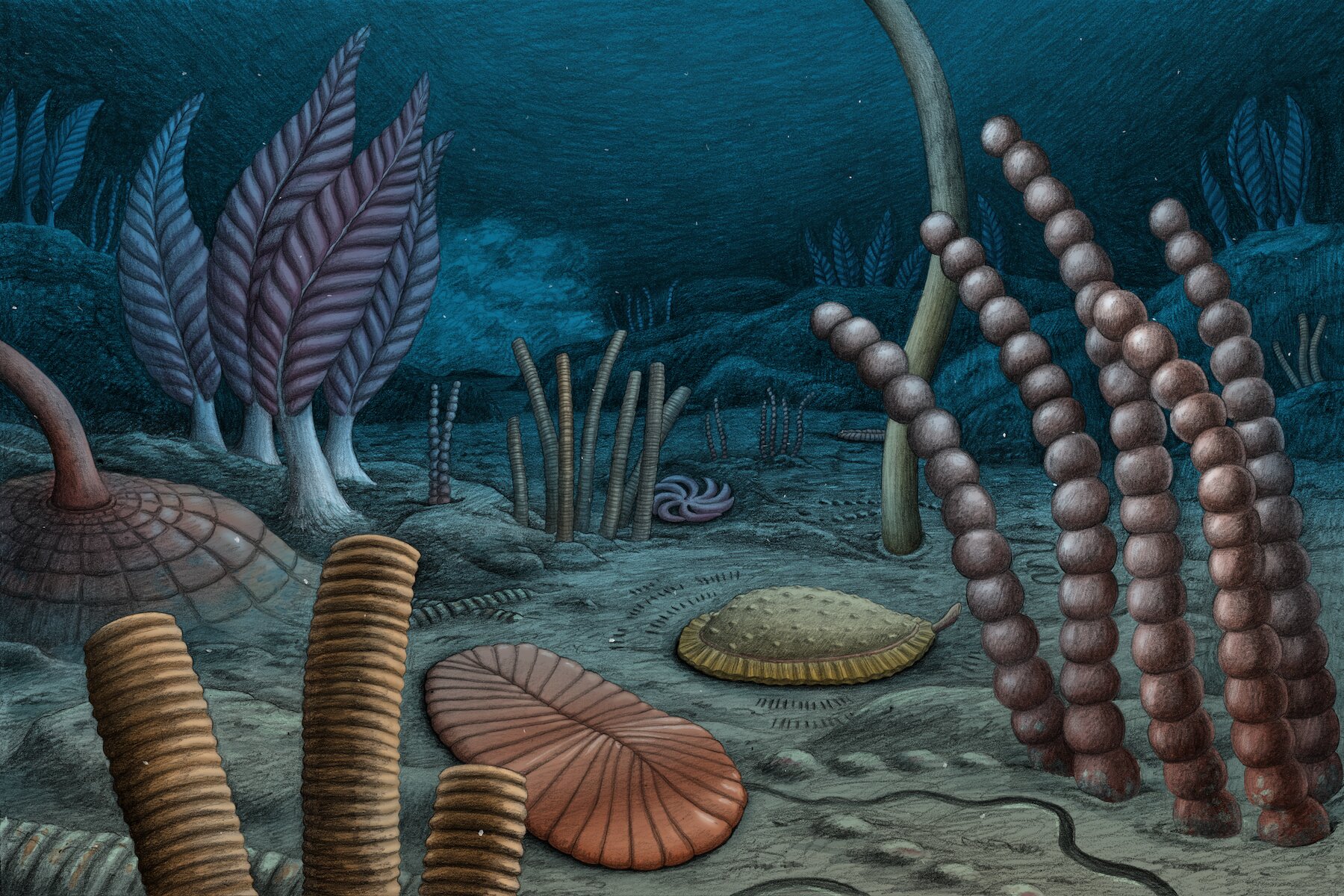
Remote rock layers in Canada’s Northwest Territories have revealed some of the oldest known complex animal fossils ever found, including organisms linked to movement and sexual reproduction. Researchers say the discovery pushes key milestones in animal evolution back by as much as 10 million years and uncovers the first-known North American examples of several iconic Ediacaran species.
More than half a billion years ago, long before dinosaurs or even fish existed, strange soft-bodied creatures spread across the seafloor of Earth’s ancient oceans. Now, scientists working in a remote region of northwestern Canada say they have uncovered one of the most important windows yet into that mysterious world.
The fossil site, located in the Mackenzie Mountains of Canada’s Northwest Territories, contains more than 100 fossils from the Ediacaran biota, an enigmatic collection of early multicellular organisms that lived before animals developed shells or bones. The findings, published in the journal Science Advances, suggest that some behaviors associated with animal life appeared significantly earlier than previously thought.
Researchers from the American Museum of Natural History and Dartmouth led the study.
“For 3 billion years, life on Earth was dominated by microbes,” said lead author Scott Evans. “Then, all the sudden, we get these strange-looking marine animals big enough to see and capable of behaviors we would find familiar today.”
Fossils From a Critical Turning Point
The Ediacaran Period represents one of the most important transitions in Earth’s history. During this interval, life evolved from mostly microscopic organisms into larger and more complex forms that resemble the earliest animals.
These fossils come in unusual shapes, including flat disks, ribbed ovals, and leaf-like fronds. Some are connected to groups still alive today, such as mollusks and jellyfish relatives. Others appear unlike anything currently living on Earth.
Because these organisms lacked hard skeletons, preserving them required exceptionally rare conditions. As a result, fossil-rich Ediacaran sites are scarce worldwide.
Scientists divide Ediacaran fossils into three major assemblages based on age: the Avalon, White Sea, and Nama assemblages. Until now, fossils from the White Sea assemblage had never been identified in North America.
That changed with the Canadian discovery.
North America’s First White Sea Assemblage
The newly uncovered fossils were found on the traditional lands of the Sahtú Dene and Métis communities, who granted researchers permission and guidance to access the area.
The discovery includes six fossil groups never before documented in North America. Among the most notable are Dickinsonia, Funisia, Kimberella, and Eoandromeda.
Researchers describe Dickinsonia as a flattened organism that moved across the seafloor while absorbing nutrients through its underside. Evans compared its appearance to a “bathmat” or pancake-like structure with segmented divisions.
Funisia, meanwhile, may preserve the oldest known evidence of sexual reproduction in the fossil record. The tubular organism lived in clustered groups and likely reproduced by releasing sperm and eggs into the surrounding water, similar to modern corals.
Kimberella could be even more significant. Scientists interpret it as a possible early relative of mollusks with a muscular foot adapted for scraping food from the seafloor. It may also represent one of the earliest known bilaterians — animals with symmetrical left and right sides, along with distinct front and back ends. Today, bilaterians make up more than 99% of known animal species.
The team also identified Eoandromeda, a possible early comb jelly with eight spiral-shaped arms.
Fossils Older Than Expected
The biggest surprise came from the age of the fossils themselves.
Some of the specimens are estimated to be around 567 million years old, making them 5–10 million years older than previously known White Sea fossils. That means the White Sea assemblage may have emerged earlier than scientists once believed, overlapping with the older Avalon assemblage instead of appearing afterward.
Researchers say this could force scientists to rethink how Ediacaran ecosystems evolved through time.
Study co-author Justin Strauss said the region has enormous untapped potential because fossil evidence from this part of the rock record was previously lacking.
The site may become even more important in the future because the fossil-bearing layers are covered by hundreds of feet of additional rock that could contain more undiscovered specimens.
Early Animals May Have Begun in Deep Water
The study also challenges assumptions about where the earliest animals evolved.
Researchers found evidence that these organisms lived in deeper marine environments than previously recognized for White Sea fossils. This supports an emerging idea that early animal evolution may have started offshore in relatively stable deep-water settings before animals gradually expanded into shallower coastal ecosystems.
That pattern differs from much of later animal evolution, which is often associated with shallow seas.
“These results suggest a pattern where evolutionary innovation begins in deeper environments and later spreads toward the coast,” Evans said.
Scientists believe the environmental stability of deeper oceans — including fewer fluctuations in temperature and oxygen levels — may have helped support the development of early complex life.
Why This Matters
The Canadian fossil site offers an unusually detailed glimpse into one of the least understood chapters in Earth’s history: the rise of the first complex animals.
By extending the timeline for movement, sexual reproduction, and bilaterian evolution, the fossils reshape scientists’ understanding of when critical biological innovations first appeared. The discovery also expands the known geographic range of major Ediacaran organisms and suggests that deep oceans may have played a central role in the earliest stages of animal evolution.
As researchers continue exploring the fossil-rich rocks of the Mackenzie Mountains, the site could become one of the world’s most important records of how animal life first gained a foothold on Earth.
Study Details
Scott Evans et al, Discovery of White Sea assemblage fossils from Laurentia, Science Advances (2026). DOI: 10.1126/sciadv.aed9916. www.science.org/doi/10.1126/sciadv.aed9916