Few periods in world history combine technological innovation, cultural sophistication, and imperial scale as profoundly as China’s Han era. Lasting from 206 BCE to 220 CE, this period shaped political institutions, scientific thought, artistic expression, and social organization in ways that continued to influence East Asia for millennia. Yet the Han world is not known only through written records. It survives in physical traces—objects buried in tombs, preserved in deserts, sealed beneath earth, or hidden in ancient manuscripts.
Archaeology has transformed our understanding of this era by revealing not just royal power or military strength, but the intimate realities of daily life, scientific inquiry, medical knowledge, and cosmological belief. Many of the most astonishing discoveries have emerged from tomb complexes, where burial customs aimed to preserve both status and continuity beyond death. Others come from frontier outposts, urban ruins, and technological artifacts that demonstrate remarkable ingenuity.
These discoveries are not merely relics. They are data—material evidence that allows historians, scientists, and archaeologists to reconstruct social systems, technological capabilities, environmental conditions, and intellectual traditions. Each find reshapes what we know about how people lived, thought, healed, governed, and imagined the universe.
The following ten discoveries stand among the most fascinating windows into the Han world. Each reveals a different dimension of a civilization that blended philosophical reflection, scientific experimentation, and administrative complexity into one of history’s most influential empires.
1. The Astonishing Preservation of Xin Zhui from the Mawangdui Tombs
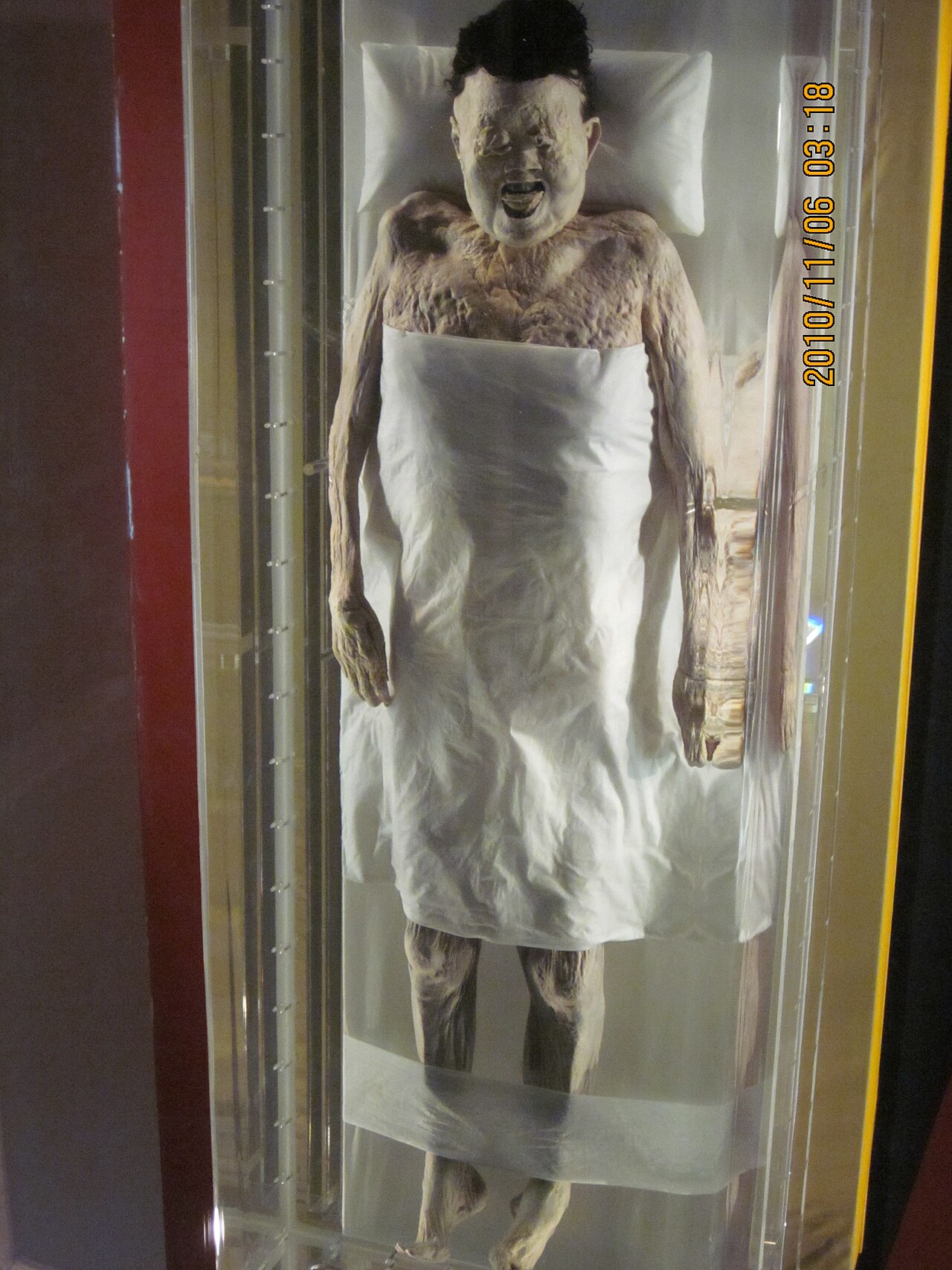
One of the most scientifically extraordinary archaeological discoveries ever made is the remarkably preserved body of Xin Zhui, often called Lady Dai. Buried more than two thousand years ago, her remains were found in a condition so lifelike that medical researchers could examine her organs, blood vessels, and internal tissues.
Unlike natural mummification caused by arid climates, her preservation resulted from deliberate burial engineering. Her tomb consisted of nested coffins sealed within layers of charcoal and clay, creating an airtight environment that prevented decomposition. She was immersed in a mysterious preservation liquid whose chemical composition remains a subject of study.
Modern autopsy revealed detailed medical information. Scientists identified cardiovascular disease, gallstones, and evidence of a rich diet. Her arteries showed signs of blockage, making her one of the earliest documented cases of heart disease.
The discovery transformed understanding of ancient funerary science. It demonstrated that Han burial methods involved sophisticated environmental control and chemical preservation—far beyond what many scholars had previously imagined.
2. The Silk Manuscripts that Rewrote Early Chinese Knowledge
Also discovered at Mawangdui were silk manuscripts containing philosophical, medical, and scientific writings. These texts predate many previously known versions of classical works, providing insight into intellectual traditions before later editorial standardization.
The manuscripts include treatises on breathing exercises, medicinal treatments, cosmology, and physical health practices that resemble early forms of therapeutic movement. Some diagrams depict the human body in ways that suggest observational anatomical knowledge rather than purely symbolic representation.
Material analysis of the silk shows advanced textile production capable of producing durable writing surfaces long before paper became widespread. Ink composition studies reveal complex carbon-based mixtures designed for longevity.
These texts demonstrate that the Han intellectual world was not static. It was experimental, diverse, and deeply concerned with the relationship between body, environment, and cosmic order.
3. The Jade Burial Suits of the Mancheng Tombs and Liu Sheng
Among the most visually striking Han discoveries are burial suits made entirely of jade plaques stitched together with metal wire. These suits encased elite bodies in thousands of carefully shaped pieces of polished stone.
Jade held profound symbolic significance. It was believed to preserve physical integrity and protect the spirit after death. The creation of a burial suit required immense labor, precision cutting, and advanced drilling techniques.
Archaeological analysis reveals regional variations in craftsmanship and metal composition. Some suits used gold wire, others silver or copper, reflecting rank and wealth.
The suits demonstrate not only artistic achievement but also metaphysical belief. They embody the Han conviction that material substances could influence spiritual continuity, blending geology, craftsmanship, and cosmology into a single funerary technology.
4. The Seismoscope of Zhang Heng
In the second century CE, scholar Zhang Heng created one of the earliest known earthquake-detection devices. This bronze instrument could indicate the direction of distant seismic activity even when tremors were not felt locally.
The device featured dragon heads arranged around a cylindrical vessel. When seismic waves disturbed an internal mechanism, a ball dropped from the dragon corresponding to the direction of the earthquake.
Although the internal design is not fully preserved, modern reconstructions suggest a pendulum-based system sensitive to ground motion. The instrument demonstrates that Han scientists were actively studying natural forces and attempting mechanical detection of geophysical events.
This invention reflects empirical observation combined with engineering creativity. It represents one of the earliest known examples of instrumental seismology.
5. The Terracotta Army of the Yangling Mausoleum and Emperor Jing of Han
While earlier imperial tombs featured life-sized figures, the Yangling Mausoleum contains thousands of smaller terracotta figures representing soldiers, servants, and animals. These miniature sculptures formed a symbolic microcosm of imperial authority.
Excavation reveals organized formations reflecting military structure. Scientific pigment analysis shows that many figures were originally painted in vibrant colors that faded over time due to oxidation and environmental exposure.
The tomb complex also includes models of granaries, livestock, and domestic spaces, providing detailed insight into economic and agricultural organization.
These figurines reveal the Han concept of the afterlife as a continuation of earthly governance. They also provide a wealth of information about clothing, military equipment, and social hierarchy.
6. The Bamboo Slips of Dunhuang
In arid frontier regions, wooden and bamboo documents survived in remarkable condition. These slips served as writing materials before widespread paper use and contain administrative records, legal orders, and military communications.
Textual analysis reveals detailed information about taxation, border defense, migration, and supply logistics. They document daily operations of frontier life with precision rarely preserved elsewhere.
Environmental preservation in desert conditions allowed ink strokes and fiber structures to remain intact for centuries. Radiocarbon dating and paleographic analysis help establish timelines of administrative evolution.
These records demonstrate the scale of bureaucratic organization required to manage vast imperial territories and maintain long-distance governance.
7. Early Paper and the Innovation of Cai Lun
Although paper-like materials existed earlier, Cai Lun refined production methods that made paper more practical, durable, and widely usable. His technique involved pulping plant fibers, forming sheets, and pressing them into writing surfaces.
Microscopic fiber analysis of early paper fragments reveals mixtures of bark, hemp, and other plant materials. This innovation dramatically expanded literacy and record-keeping by providing a cheaper alternative to silk or bamboo.
Paper transformed information storage, administrative efficiency, and intellectual exchange. Its adoption represents one of the most consequential technological developments in human communication history.
8. The TLV Bronze Mirrors and Han Cosmology
Han bronze mirrors often feature intricate geometric patterns known as TLV designs. Scholars interpret these patterns as symbolic representations of cosmological models describing the structure of the universe.
Metallurgical analysis reveals sophisticated alloy control and casting techniques. Some mirrors include inscriptions referencing cosmic harmony, celestial movement, and ritual meaning.
The reflective surface combined practical grooming with metaphysical symbolism. These objects served both personal and spiritual functions, illustrating how daily life and cosmological belief were intertwined.
9. The Urban Layout of Chang’an
Excavations of the Han capital reveal one of the most carefully planned cities of the ancient world. Archaeologists have mapped roads, drainage systems, palace foundations, and residential districts arranged according to principles of order and hierarchy.
Soil chemistry and artifact distribution help reconstruct industrial zones, market areas, and administrative sectors. Hydraulic engineering controlled water flow, reducing flooding and supporting dense population centers.
Urban planning reflects political philosophy emphasizing centralized authority and spatial organization aligned with cosmological orientation.
The city functioned not only as an administrative hub but also as a symbolic model of imperial order.
10. The Medical Texts and Anatomical Knowledge of Han Physicians
Medical manuscripts discovered in tombs reveal diagnostic methods, herbal treatments, and physical therapy practices. Some texts describe pulse analysis, disease classification, and surgical procedures.
Illustrations of the human body suggest systematic observation rather than purely symbolic mapping. Comparative analysis with later medical traditions shows continuity and evolution of theoretical frameworks.
These documents demonstrate that Han medicine integrated empirical observation with philosophical interpretation of bodily balance and environmental influence.
The Scientific Value of Han Archaeology
Each discovery provides measurable data—chemical composition, structural design, biological evidence, environmental context. Together they form a multidimensional portrait of an advanced civilization.
The Han world emerges as technologically innovative, scientifically curious, administratively complex, and philosophically sophisticated.
The Living Legacy of Discovery
These finds are not static museum objects. They continue to generate research through advanced imaging, isotopic analysis, material science, and experimental reconstruction.
The past is not silent. It speaks through preserved tissue, carved stone, inked fiber, and engineered metal.
The Han World Revealed
Through archaeology, the Han era becomes more than a historical period. It becomes a living system of knowledge, belief, and technological creativity.
These ten discoveries illuminate a civilization deeply engaged with nature, the body, governance, and the cosmos. They reveal not only what people built, but how they understood existence itself.
And with each excavation, the story grows richer—reminding us that beneath the ground lies not just history, but the accumulated intelligence of humanity waiting to be understood.