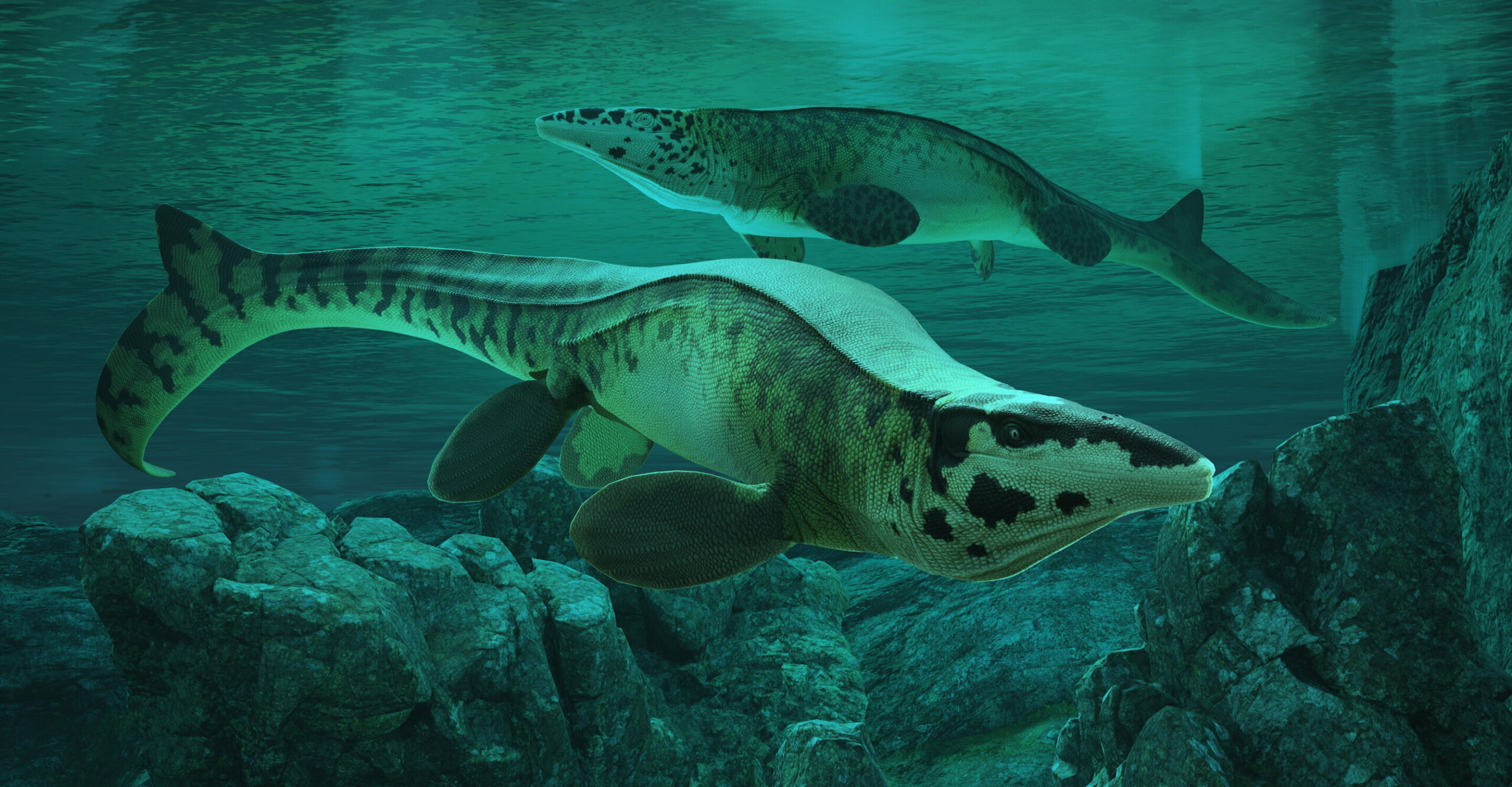
Hidden for decades inside museum collections, a newly identified marine predator has emerged as one of the largest and most aggressive mosasaurs ever found. Named Tylosaurus rex, the giant reptile stretched up to 43 feet long, carried unusually serrated teeth, and may have displayed violent behavior rarely documented in its relatives.
For years, the fossils sat in museum collections under the wrong name. Then one researcher noticed something unusual.
What began as a closer look at a supposedly familiar mosasaur specimen has now revealed an entirely new apex predator from the age of dinosaurs. Scientists from the American Museum of Natural History, the Perot Museum of Nature and Science, and Southern Methodist University have identified a massive marine reptile that prowled ancient seas about 80 million years ago. The newly described species, called Tylosaurus rex, or T. rex, is among the largest mosasaurs ever discovered.
The findings were published in the Bulletin of the American Museum of Natural History.
A Misidentified Fossil Changed the Story
Lead author Amelia Zietlow first encountered the key fossil while working as a comparative biology Ph.D. student at the American Museum of Natural History’s Richard Gilder Graduate School. The specimen had been labeled as Tylosaurus proriger, a known species first described more than 150 years ago.
But the fossil did not fully match the classic description.
After comparing it with the original T. proriger holotype housed at the Harvard Museum of Comparative Zoology, Zietlow and her colleagues began to suspect they were looking at a different animal entirely. More than a dozen similar fossils stored at other institutions appeared to share the same traits.
These specimens were not only larger than T. proriger, but they also possessed finely serrated teeth, a feature considered uncommon among mosasaurs. The fossils also came from a different time and place. While most T. proriger fossils are found in present-day Kansas and date to roughly 84 million years ago, the newly identified species mainly came from Texas and lived about 4 million years later.
That combination of differences convinced the researchers they had uncovered a new species.
Meet Tylosaurus rex
The name Tylosaurus rex translates to “king of the tylosaurs,” a nod to both its size and dominance.
The species name also honors paleontologist John Thurmond, who in the late 1960s recognized that giant tylosaurs from northeast Texas appeared unusually large and potentially distinct from known species. Thurmond informally referred to them as “sea tyrants,” hinting at what scientists would only formally confirm decades later.
The holotype specimen for T. rex is currently displayed at the Perot Museum in Dallas. It was originally discovered in 1979 near an artificial reservoir outside the city.
Researchers estimate the species ranged from roughly 25 feet to 43 feet long, placing the largest individuals at about the length of a school bus.
Built for Power and Violence
Size alone was not what made this mosasaur remarkable.
Scientists say T. rex possessed anatomical adaptations linked to exceptionally strong jaw and neck muscles, suggesting it was an especially powerful predator in ancient marine ecosystems.
Study co-author Ron Tykoski described the animal as potentially far more aggressive than other known mosasaurs.
Evidence for that violence appears directly on the fossils themselves.
One specimen in the Perot Museum collection, nicknamed “The Black Knight,” shows severe injuries including a missing snout tip and a fractured lower jaw. Researchers concluded that the damage was likely inflicted by another member of the same species.
According to the team, this level of apparent intraspecies violence has not been documented to the same extent in other Tylosaurus specimens.
Several famous mosasaur fossils previously identified as T. proriger are now being reassigned to T. rex as part of the new study. They include “Bunker,” a massive specimen displayed at the University of Kansas, and “Sophie,” which is exhibited at the Yale Peabody Museum.
Rethinking Mosasaur Evolution
The discovery did more than add another species to the fossil record. It also exposed deeper problems in how scientists study mosasaur evolution.
Researchers explained that the primary dataset used to analyze mosasaur relationships has remained mostly unchanged for nearly 30 years. For the new study, the team assembled a substantially revised dataset and proposed a new arrangement of evolutionary relationships among tylosaurs.
Their analysis suggests many long-standing assumptions about mosasaur evolution may need to be revisited.
Zietlow said the discovery demonstrates the importance of reexamining old specimens with updated methods rather than relying on decades-old interpretations.
The researchers argue that many earlier studies were built upon the same minimally updated framework, potentially limiting scientists’ understanding of how these marine reptiles evolved and diversified.
Texas Emerges as a Key Fossil Region
The study also highlights northern Texas as an increasingly important region for understanding ancient marine ecosystems.
Most of the fossils tied to T. rex were discovered there, helping researchers piece together a clearer picture of the predator’s anatomy, behavior, and evolutionary history.
Co-author Michael Polcyn said the findings reshape both the physical and evolutionary understanding of mosasaurs and signal what he described as a “new era” of research into these formidable marine predators.
The discovery reinforces the idea that museum collections still contain overlooked scientific treasures. Fossils that have sat on shelves for decades can still transform scientists’ understanding of prehistoric life when examined with fresh eyes and modern analytical tools.
Why This Matters
The identification of Tylosaurus rex shows how scientific breakthroughs do not always come from newly excavated fossils. Sometimes they emerge from reexamining specimens already sitting in museum drawers.
By separating this giant predator from previously known species, researchers have revealed a more complex picture of ancient ocean ecosystems and challenged assumptions that shaped mosasaur research for decades. The study also demonstrates that evolutionary relationships among these marine reptiles may be far less settled than scientists once believed.
Most importantly, the discovery underscores how much remains hidden within existing fossil collections — and how revisiting them can fundamentally change the story of life on Earth millions of years ago.
Study Details
A Gigantic New Species of Tylosaurus (Squamata: Mosasauridae) from Texas, and a Revised Character List for Phylogenetic Analyses of Mosasauridae, Bulletin of the American Museum of Natural History (2026). DOI: 10.1206/0003-0090.482.1.1