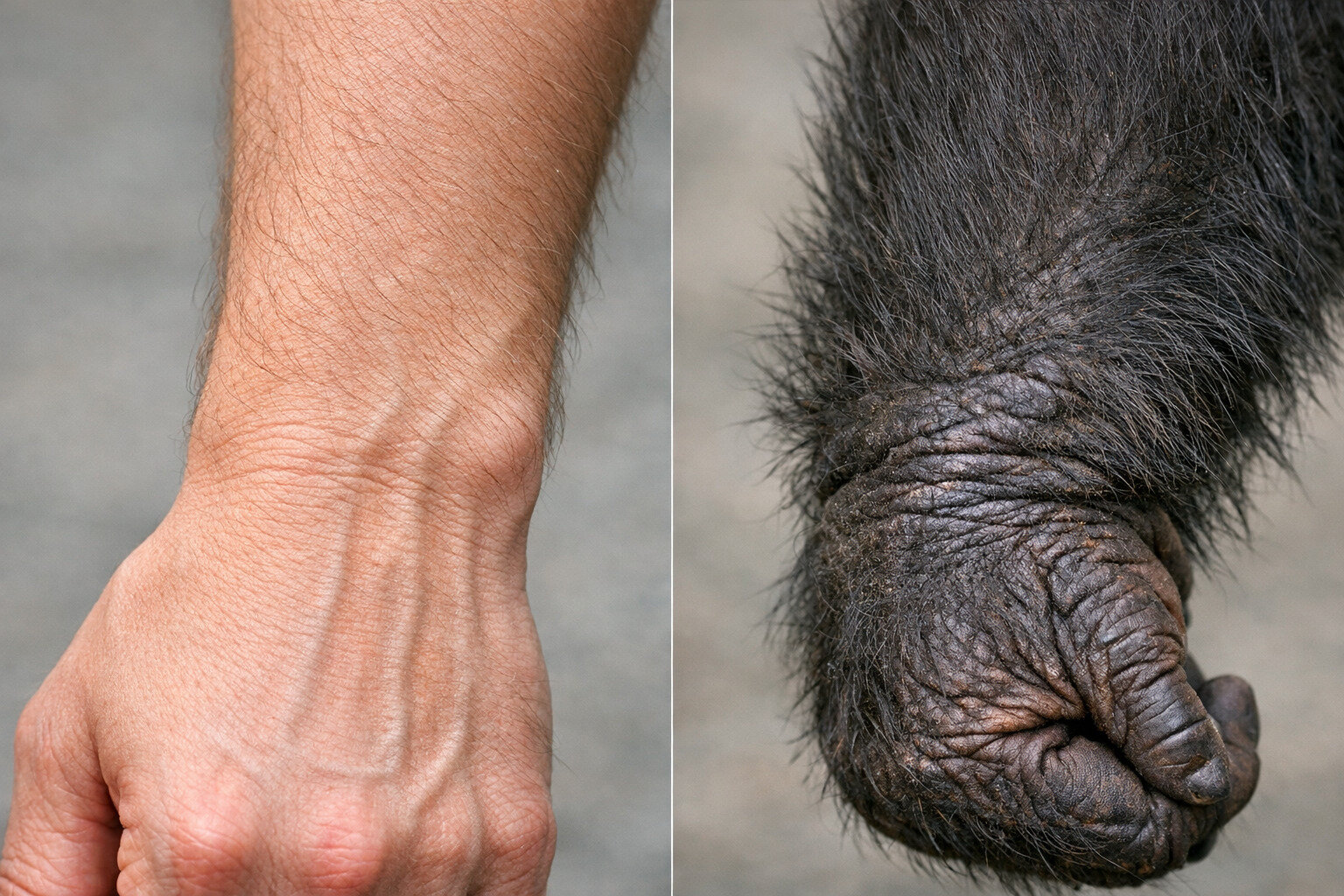
Hidden deep inside the human wrist, two tiny bones may preserve one of the clearest anatomical links to our ancient past. Researchers analyzing modern primates and dozens of fossil hominins found that key wrist structures in humans remain strikingly similar to those of chimpanzees and gorillas, supporting the idea that humans evolved from a knuckle-walking ancestor.
The human hand can thread a needle, shape stone tools, type on keyboards, and perform movements with extraordinary precision. Yet beneath that dexterity lies an unexpected evolutionary story — one that may still reflect a past built for climbing, swinging, and moving on all fours.
In a new study published in the journal Proceedings of the Royal Society B: Biological Sciences, researchers uncovered evidence that some of the most important bones in the modern human wrist closely resemble those found in African apes. The discovery adds new support to the long-debated theory that humans and African apes inherited wrist anatomy from a shared knuckle-walking ancestor.
Tiny Wrist Bones Reveal Deep Evolutionary Connections
The study focused on the carpal bones, a cluster of small bones that form the wrist. These bones have long posed a challenge for scientists because of their irregular shapes and complex geometry, making precise comparisons difficult.
To overcome that problem, researchers used advanced three-dimensional scanning methods combined with a mathematical mapping technique known as spherical harmonics. This allowed the team to capture detailed geometric information from wrist bones across a broad sample of living primates and 55 fossil hominins.
The scientists then applied machine learning algorithms to classify fossil wrist bones according to how closely they matched those of modern primates.
What emerged was a surprisingly consistent pattern.
Two bones in particular — the lunate and the triquetrum — showed especially strong similarities between humans and African apes such as chimpanzees and gorillas. According to the researchers, these inner wrist bones are nearly identical across the groups.
That similarity suggests the shared anatomy is not accidental. Instead, it likely reflects an inherited evolutionary foundation stretching back to a common ancestor.
Human Hands Did Not Evolve All at Once
The findings also help explain a longstanding puzzle in human evolution: if human wrists still resemble those of African apes, how did human hands become capable of such advanced manipulation?
The answer, according to the researchers, appears to involve a slow and uneven transformation.
As early human ancestors gradually relied less on their forelimbs for movement through trees and locomotion, the wrist began to change piece by piece. Individual bones shifted position, widened, and reorganized over long evolutionary timescales.
Rather than evolving in a single leap toward modern human anatomy, the wrist appears to have passed through an extended transitional phase. During this period, hominins possessed a mixture of traits. Some wrist bones began to resemble those of modern humans, while others retained features associated with primates that still used their palms to support body weight during ground movement.
The researchers described this process as a prolonged experimental stage in evolution.
“Our results are most consistent with an evolutionary narrative which begins with an African ape-like ancestral locomotor behavior, is followed by a lengthy experimental period in which hominins committed the forelimb to neither locomotion nor manipulation, and ends with the extremely recent emergence of extensive tool production and use,” the study authors wrote.
Tool-Using Abilities Appeared Much Later
One of the study’s most important conclusions is that the defining traits linked to sophisticated tool use emerged relatively late in human evolution.
The researchers found that modifications associated with advanced manipulation were concentrated on the thumb side of the wrist, also known as the radial side. These specialized features only became consistently established in later members of the genus Homo.
In other words, the modern human wrist was not built entirely from scratch. Instead, it appears to be an ape-like structure that was gradually modified for increasingly refined hand movements.
“The recent human carpus is essentially an African ape-like carpus with derived modifications of the radial side of the wrist that may have evolved in response to recent selection for sophisticated manipulatory behaviors,” the researchers explained.
That evolutionary layering may help explain why the human hand combines both strength and precision so effectively. Ancient structural foundations remained in place while newer adaptations fine-tuned the wrist for delicate control.
Why Wrist Evolution Matters
The study highlights how even small bones can preserve critical clues about the evolutionary journey that shaped modern humans.
Human hands are central to toolmaking, technology, art, and countless everyday actions. Understanding how those abilities evolved helps scientists trace the broader transformation from ape-like ancestors to modern humans.
The findings also reinforce the idea that evolution often works gradually, modifying existing structures rather than replacing them entirely. Features originally associated with locomotion may later be adapted for entirely different functions.
In the case of the human wrist, the anatomy that once supported movement through ancient environments may ultimately have helped create the biological foundation for writing, engineering, and complex tool use.
Why This Matters
The research offers fresh evidence that the modern human hand did not emerge suddenly or independently from ape ancestry. Instead, it evolved through a long sequence of subtle anatomical changes built upon an older framework shared with African apes.
By combining 3D imaging, mathematical modeling, and machine learning, the study also demonstrates how new technologies are reshaping the study of human origins. Tiny wrist bones that were once difficult to analyze are now providing clearer answers about how human anatomy evolved over millions of years.
Most importantly, the findings show that some of the structures enabling human precision today may still carry the imprint of an ancient, knuckle-walking past.
Study Details
Laura E. Hunter et al, Did modern human carpal morphology evolve from knuckle walking traits?, Proceedings of the Royal Society B: Biological Sciences (2026). DOI: 10.1098/rspb.2026.0556