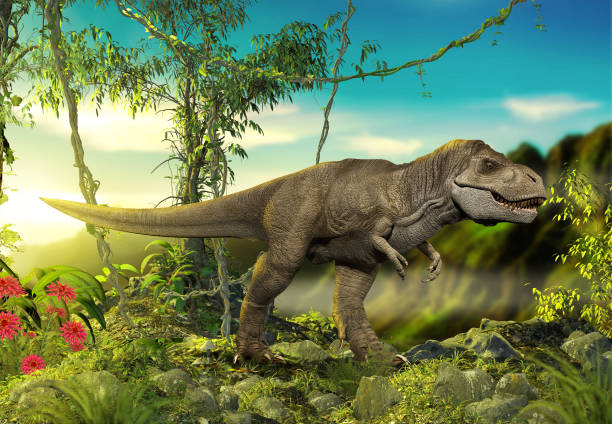
Giant meat-eating dinosaurs may have shrunk their arms because their heads became the primary weapons for killing prey. Researchers analyzing 82 theropod species found that reduced forelimbs were strongly linked to the evolution of massive, powerful skulls rather than simply larger body size. The findings suggest predators like Tyrannosaurus rex increasingly relied on crushing jaws instead of claws as prey animals grew enormous.
Tiny arms have long been one of the biggest mysteries surrounding some of the most fearsome predators in Earth’s history. For decades, scientists debated why dinosaurs such as Tyrannosaurus rex evolved comically small forelimbs despite their enormous bodies and deadly reputations.
Now, researchers from UCL and the University of Cambridge believe they may finally have the clearest explanation yet: the arms became less important because the head had already taken over the job of killing.
The new study, published in Proceedings of the Royal Society B, examined evolutionary patterns across 82 species of theropod dinosaurs. The analysis revealed that shortened forelimbs evolved multiple times independently, always alongside the development of large, heavily built skulls and powerful jaws.
Big Heads Replaced Arms as Weapons
The researchers found that reduced arms appeared in at least five different theropod groups, including tyrannosaurids, abelisaurids, carcharodontosaurids, megalosaurids, and ceratosaurids.
According to lead author Charlie Roger Scherer, a Ph.D. student at UCL Earth Sciences, the pattern strongly points toward a shift in hunting strategy.
As some theropods evolved stronger skulls and more devastating bite forces, their arms gradually became less useful for attacking prey. Over evolutionary time, those unused forelimbs shrank.
The study argues that this transition may have been driven by the rise of gigantic herbivores, especially enormous sauropods with bodies stretching close to 100 feet long. Trying to slash or grab such massive animals with claws may have been ineffective compared to locking on with powerful jaws.
Researchers described this as a likely “use it or lose it” scenario in evolution. Once the head became the dominant attack tool, natural selection no longer favored maintaining large, functional forelimbs.
Measuring the Strength of Dinosaur Skulls
To investigate the connection, the team created a new method for measuring skull robustness.
Instead of focusing only on size, the researchers evaluated how strongly built the skulls actually were. They considered factors such as how tightly the skull bones connected together, the overall shape of the skull, and estimated bite force. Compact skulls were considered stronger than long, narrow ones.
Using this system, T. rex ranked as the dinosaur with the most robust skull of all the species analyzed.
Close behind was Tyrannotitan, a giant theropod that lived in what is now Argentina more than 30 million years before T. rex appeared.
The researchers discovered that dinosaurs with the strongest skulls also tended to have the most reduced forelimbs. Crucially, this relationship was stronger than the connection between arm size and total body size.
That finding challenges the long-standing idea that tiny arms were merely an accidental consequence of becoming enormous animals.
Small Arms Were Not Limited to the Largest Dinosaurs
One of the study’s most important findings came from dinosaurs that were not especially gigantic.
The researchers highlighted Majungasaurus, a predator that lived in Madagascar about 70 million years ago. Although far smaller than T. rex at roughly 1.6 metric tons, it still possessed a heavily built skull and remarkably tiny hands.
That example helped demonstrate that powerful heads — not simply huge bodies — were the strongest predictor of forelimb reduction.
The team also discovered that different dinosaur groups shrank their arms in different ways.
Among abelisaurids, the hands and lower arms became especially reduced, with later species evolving extremely tiny hands. Tyrannosaurids followed a different path, with all sections of the arm shrinking at relatively similar rates.
This suggests that while several dinosaur groups reached the same end result — tiny forelimbs — they may have evolved those traits through different developmental processes.
An Evolutionary Arms Race
The study proposes that prehistoric ecosystems may have triggered an evolutionary competition between predators and prey.
As giant herbivores became larger and harder to kill, theropods may have responded by evolving increasingly strong skulls and more powerful bites. Some predators also grew to enormous body sizes themselves.
Over time, the skull became such an effective weapon that forelimbs no longer played a central role in hunting.
The researchers caution that the study identifies strong correlations rather than direct proof of cause and effect. However, they argue it is far more likely that stronger skulls evolved first, followed by arm reduction.
From an evolutionary perspective, abandoning an effective hunting tool before developing a replacement would make little sense.
Why This Matters
The study offers one of the most comprehensive explanations yet for one of dinosaur evolution’s most iconic features.
Rather than viewing tiny arms as awkward evolutionary leftovers, the research reframes them as part of a broader adaptation strategy tied to hunting behavior, skull mechanics, and prey size.
By examining patterns across dozens of species instead of focusing only on T. rex, the researchers showed that reduced forelimbs evolved repeatedly in separate dinosaur lineages. That repeated pattern strengthens the case that these changes served a real functional purpose.
The findings also reveal how evolution can reshape entire bodies around changing survival strategies. In some of the largest predators ever to walk the planet, the head ultimately became so effective that the arms simply stopped mattering.
Study Details
Drivers and mechanisms of convergent forelimb reduction in non-avian theropod dinosaurs, Proceedings of the Royal Society B: Biological Sciences (2026). DOI: 10.1098/rspb.2026.0528