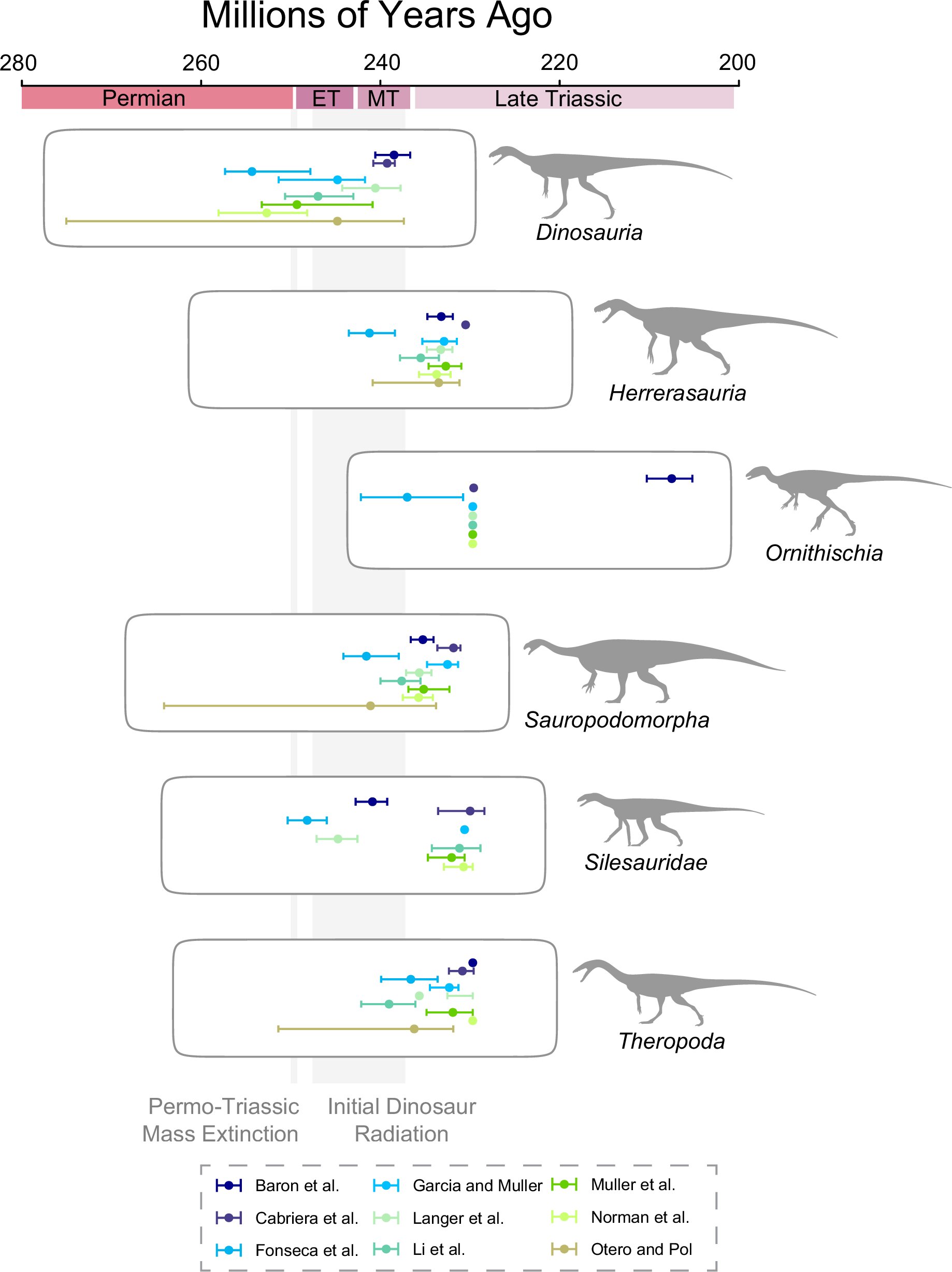
Researchers using advanced Bayesian tip-dating techniques have discovered that dinosaurs likely originated between 250 and 240 million years ago, a full 10 million years earlier than the oldest confirmed fossils suggest. This early emergence was followed by a period of rapid evolutionary radiation, where the three major dinosaur lineages diverged and specialized at an unprecedented pace during the Middle Triassic.
For over a century, the timeline of dinosaur evolution has been anchored by the physical evidence left behind in the earth—petrified bone and mineralized footprints. However, the fossil record is notoriously fragmented, often leaving gaps of millions of years between the appearance of a common ancestor and its specialized descendants. This has long left paleontologists wondering: did dinosaurs truly appear when the rocks say they did, or were they stalking the Triassic landscape long before they left a permanent mark?
New research from Yale University and Princeton University suggests the latter. By applying sophisticated statistical models to existing morphological data, scientists have reconstructed a timeline that suggests these majestic creatures appeared significantly earlier than previously recognized, fundamentally changing our understanding of how quickly life recovered and diversified in the deep past.
Decoding the Morphological Blueprint
To reach these conclusions, researchers Chase Doran Brownstein and Christopher Thomas Griffin turned to a method known as Bayesian tip-dating analysis. Rather than relying solely on the age of a single “first” fossil, this approach allows scientists to analyze the relationships between species by looking at their physical traits—their morphology—and calculating the rate of change over time.
The team examined nine different morphological datasets compiled by the scientific community in recent years. These records act as a biological inventory, detailing the shapes and sizes of dinosaur bones, as well as the presence or absence of specific evolutionary markers, such as the hollow bones of theropods or the distinctive hip structures of ornithischians.
By processing this data through advanced statistical techniques, the researchers could account for the uncertainty surrounding early dinosaur phylogeny. This method allows for a more fluid understanding of evolution, acknowledging that the first physical fossil found by humans is rarely the first individual of a species to have lived.
A Rapid Burst of Evolutionary Innovation
The study, published in the Proceedings of the Royal Society B, indicates that dinosaurs likely emerged between 250 and 240 million years ago (Ma). This puts their origin in the Middle Triassic, roughly 10 million years before the earliest unambiguous dinosaur fossils appear in the geological record.
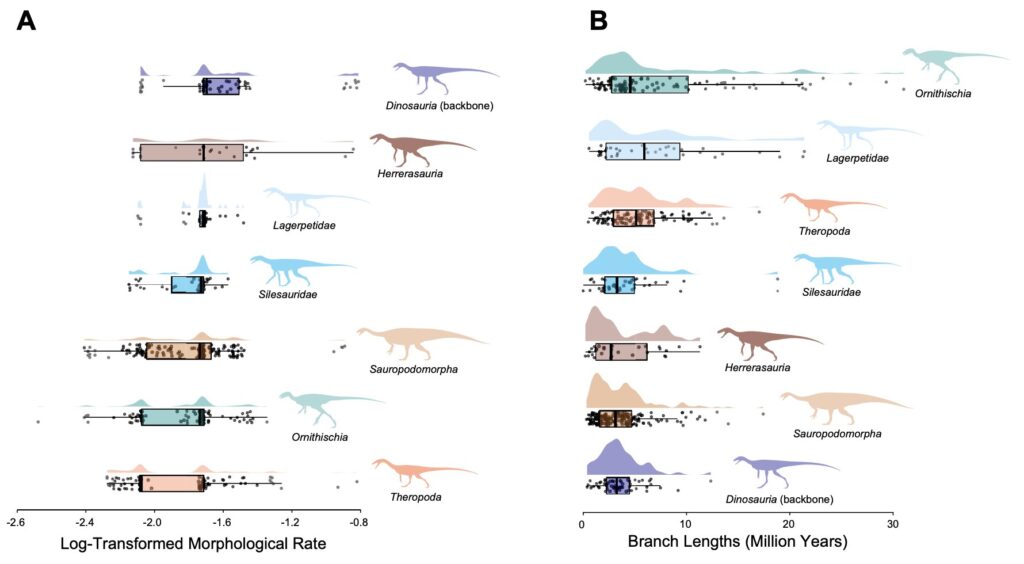
This revised timeline reveals a critical phase of “rapid radiation.” The researchers found that once dinosaurs emerged, they didn’t just slowly expand; they underwent a massive burst of morphological evolution. During this window, the group split into the three major clades that would define the Mesozoic Era.
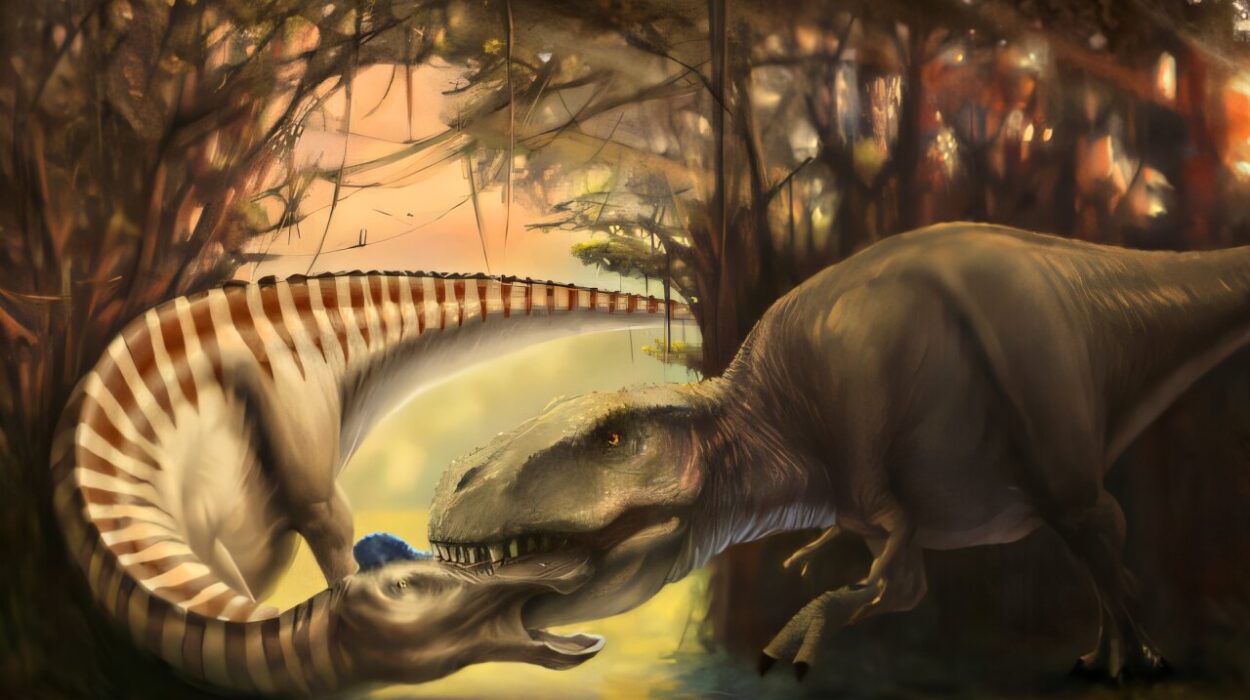
First were the theropods, the bipedal carnivores characterized by their hollow bones and three-toed hind limbs, a lineage that would eventually produce both the Tyrannosaurus rex and modern birds. Simultaneously, the sauropodomorphs began their journey, starting as medium-sized herbivores before eventually evolving into the long-necked titans like Brachiosaurus. Finally, the ornithischians, a diverse group of plant-eaters that includes the likes of Triceratops, developed their own distinct physical characteristics.
According to the study, this peak of morphological evolution occurred in the early Late Triassic, a time when the lineages were diversifying into ecologically disparate groups from a single common ancestor.
Modeling Life, Death, and Preservation
A key component of this research involved the fossil-birth-death (FBD) approach. This model does more than just track the appearance of new traits; it mathematically simulates the origin of species, the rate at which they go extinct, and the likelihood of those animals being preserved as fossils over millions of years.
The instability often found in the dinosaur family tree—where different studies disagree on how early species are related—can be explained by this rapid diversification. When species evolve very quickly in response to new ecological opportunities, their early forms can look very similar, making it difficult for scientists to distinguish the exact “branches” of the tree.
The Yale and Princeton team suggests that the diversity of dinosaurs was sculpted by multiple rapid radiations. These bursts of life often followed successive mass extinctions, where dinosaurs filled the voids left by other disappearing animals. This biological explanation accounts for why the fossil record seems to show a sudden appearance of distinct groups in the Late Triassic (237 to 201.4 Ma); the “pre-work” of evolution had already been happening for millions of years.
Why This Matters
This research shifts the focus of dinosaur origins from a search for a “missing link” fossil to a broader understanding of evolutionary tempo. By identifying that dinosaurs emerged 10 million years earlier than previously confirmed, scientists can better understand how life on Earth responds to major environmental shifts and extinctions.
It demonstrates that the “Age of Dinosaurs” didn’t begin with a slow crawl, but with a sprint of biological innovation. These findings provide a new framework for other researchers to validate, potentially refining our models of how the most species-rich living tetrapod lineage—birds—eventually took flight. Understanding the pace of this early evolution helps clarify the history of our planet and the resilient nature of life as it explores and conquers new ecological frontiers.
Study Details
Chase Doran Brownstein et al, An early burst of skeletal evolution at the origin of dinosaurs, Proceedings of the Royal Society B: Biological Sciences (2026). DOI: 10.1098/rspb.2026.0102.