A new study from Yale University has identified a previously unknown species of proto-crocodile, Eosphorosuchus lacrimosa, preserved alongside its cousin in a single block of rock for 210 million years. The discovery, made through advanced CT scanning of fossils excavated decades ago, provides a rare snapshot of ecological specialization and biodiversity at the dawn of the “Age of Reptiles.” These findings suggest that early crocodile relatives were already diversifying their physical traits to fill distinct environmental roles long before dinosaurs dominated the planet.
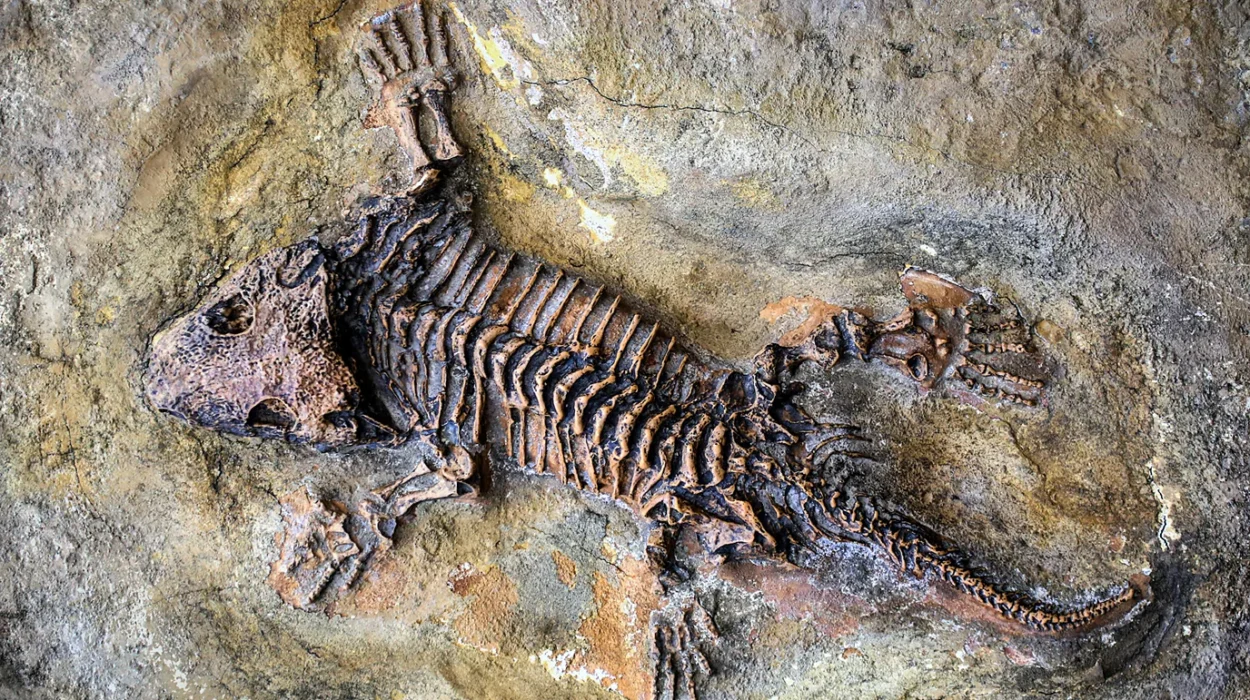
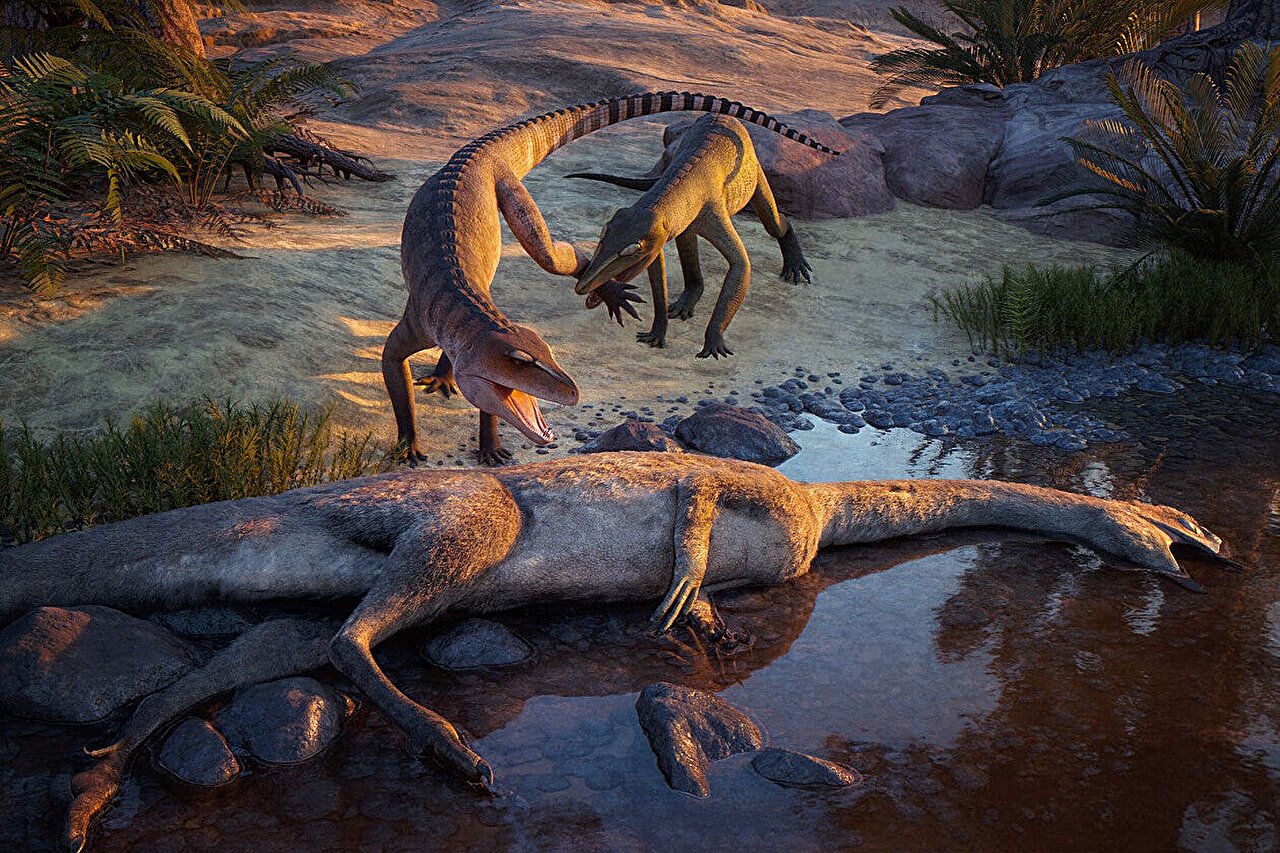
Two hundred and ten million years ago, a catastrophic event—perhaps a sudden mudslide or a rushing flash flood—instantly froze a moment in time on a humid riverbank in what is now northern New Mexico. In that final second, two small, jackal-sized reptiles stood side-by-side among the low ferns. Though they were close cousins in the lineage that would eventually lead to modern alligators and crocodiles, they were not identical. One was a known predator with a long, slender snout, while the other possessed a reinforced skull built for a different style of hunting. They died together, were buried together, and remained entombed in the same stone for millions of years, waiting for modern technology to finally tell their separate stories.
The Mystery Within the Ghost Ranch Bone Bed
The story of this discovery began in 1948 at Ghost Ranch, New Mexico, a site world-renowned for its exceptional preservation of Triassic life. Paleontologists at the time excavated two massive blocks of rock, roughly the size of a car, which eventually made their way into the collections of the Peabody Museum of Natural History at Yale. For three-quarters of a century, these fossils were part of the scientific record but remained largely unexamined in detail.
The scientific community had long assumed that the two crocodile relatives found together in the rock were both specimens of Hesperosuchus agilis. This species was a known land-dweller of the Late Triassic, characterized by large back legs, thin arms, and a speedy build that allowed it to hunt near prehistoric waterways. However, upon closer inspection, the physical evidence suggested that the two animals were not as similar as they first appeared.
Digital Dissection and the Birth of a “Dawn-Bringer”
The breakthrough came when a research team led by Bhart-Anjan Bhullar, an associate professor of Earth and planetary sciences at Yale, decided to take a second look at the long-stored fossils. Despite having stared at the specimen for years, Bhullar noticed that the facial structure of one of the animals did not match the established anatomy of Hesperosuchus. To solve the mystery, the team utilized computed tomography (CT) scans at the Yale Chemical and Biophysical Imaging Center.
This technology allowed researchers to perform a “digital disassembly” of the fossil. By looking through the stone bone by bone, they could see anatomical details that were hidden from the naked eye for millions of years. The scans revealed that the second animal had a shorter snout, a more robust skull, and expanded jaw muscles designed for snapping shut on larger, more struggling prey. These distinct physical traits confirmed that this was not a second Hesperosuchus, but an entirely new species.
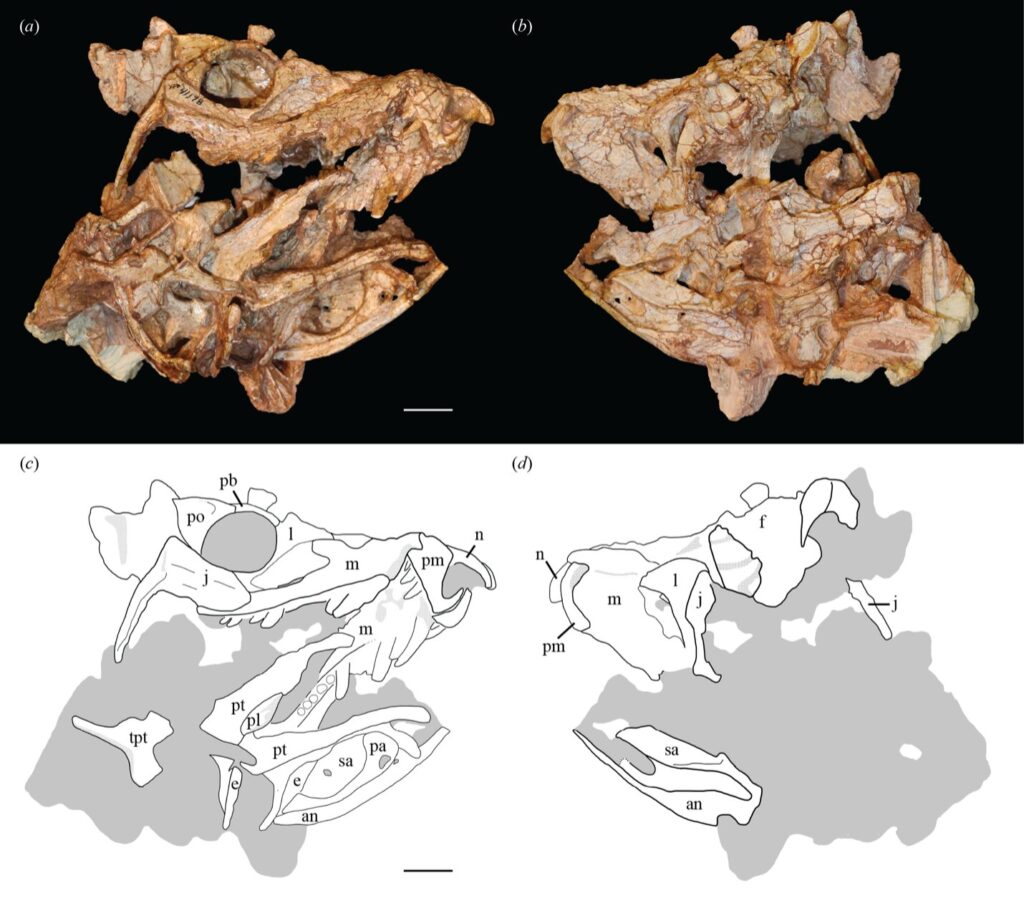
The team named the new creature Eosphorosuchus lacrimosa. The genus name is derived from the Greek god Eosphorus, meaning “dawn-bringer,” combined with “soukhos,” the Greek word for crocodile. This name reflects the species’ position at the beginning of a major evolutionary shift for the crocodile lineage.
A Rivalry of Dynasties
The discovery of Eosphorosuchus provides critical context for the Late Triassic period, a time when two great reptile dynasties were competing for global dominance. On one side was the lineage that would eventually produce modern birds—the dinosaurs. At this specific point in history, however, the dinosaurs were not the giants they would later become. Instead, they were slim, delicate creatures that moved on two legs, resembling modern herons.
On the other side of this evolutionary rivalry were the crocodile ancestors. Unlike the semi-aquatic reptiles we know today, these proto-crocs were fast-running, four-legged predators. They were more heavily built than the early dinosaurs, occupying ecological niches similar to those of modern jackals, foxes, or dogs. The presence of both Hesperosuchus and Eosphorosuchus in the same location proves that these animals were already branching out into different specializations to avoid direct competition with one another.
Ecological Partitioning in the Triassic
What makes this specific fossil so scientifically valuable is its “preservational history.” Because the two animals died and were buried in the exact same instant, they provide an indisputable record of coexistence. In the field of paleontology, it is often difficult to prove that two different species found in the same general area actually lived together at the same time. This “time-slice” eliminates that uncertainty.
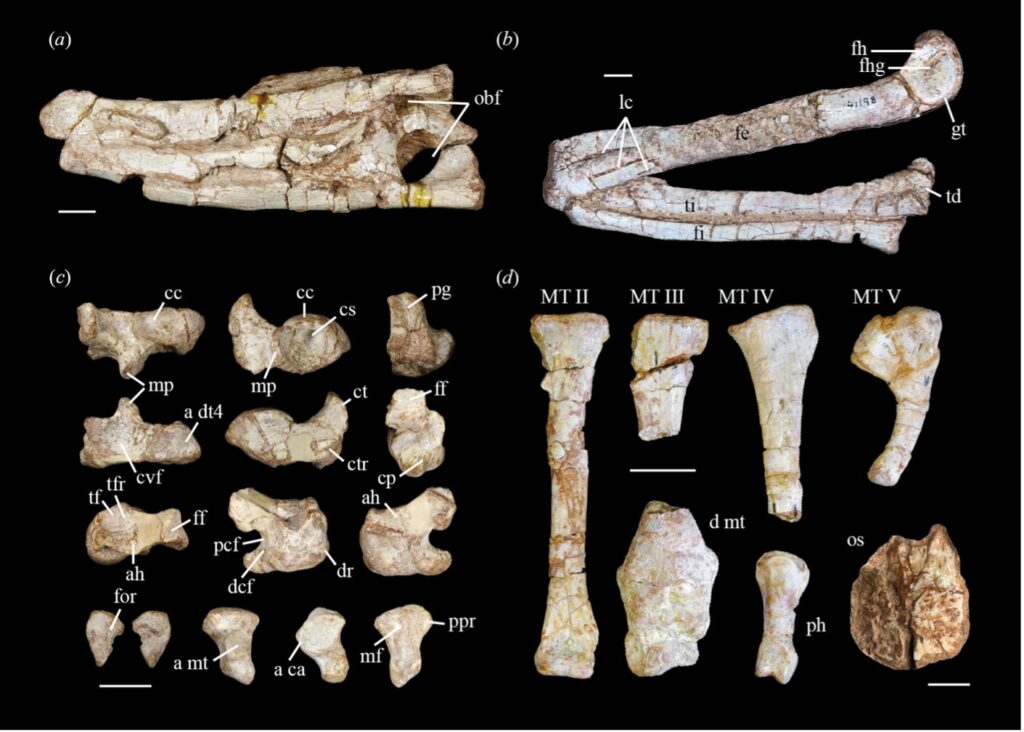
The anatomical differences between the two creatures show that they had partitioned their ecological roles. While the long-snouted Hesperosuchus likely specialized in certain types of prey, the shorter, stronger jaw of Eosphorosuchus allowed it to target different food sources. This functional diversification is a hallmark of a rich and healthy ecosystem, where closely related species evolve unique traits to survive alongside one another.
Why This Matters
The identification of Eosphorosuchus lacrimosa is more than just the naming of a new prehistoric animal; it is a testament to the hidden secrets waiting within existing museum collections. It highlights how modern imaging technology can breathe new life into specimens that have been sitting on shelves for over 75 years, providing insights that the original excavators could never have imagined.
Furthermore, this discovery reshapes our understanding of the early “Age of Reptiles.” It demonstrates that the ancestors of crocodiles were undergoing a period of intense evolutionary experimentation and diversification long before they were relegated to the water. By specializing their feeding anatomy and physical forms, these “dawn” crocodiles successfully dominated their environment, offering a glimpse into a complex world of competition and survival that existed millions of years before the first giant dinosaurs walked the Earth.
Study Details
Miranda Margulis-Ohnuma et al, A short-snouted ‘sphenosuchian’ with unusual feeding anatomy demonstrates that ecological specialization occurred early in crocodylomorph evolution, Proceedings of the Royal Society B: Biological Sciences (2026). DOI: 10.1098/rspb.2026.0130