Physicists have shattered previous records by extending the lifetime of magnons to 18 microseconds, a nearly hundred-fold increase over previous capabilities. By utilizing short-wavelength waves in ultra-pure crystals cooled to near absolute zero, researchers have transformed these magnetic excitations into viable candidates for long-term quantum memory and information transport.
The quest for the perfect quantum messenger has long been hindered by the fragile nature of subatomic signals. In the realm of quantum computing, information is often lost in the blink of an eye, disappearing before it can be processed or stored. For years, scientists have looked toward magnons—tiny, ripple-like waves of magnetization that travel through solid materials—as a potential solution. While these waves possess the unique ability to shrink to the nanometer range and fit onto compact microchips, they have historically vanished within a few hundred nanoseconds. Now, a research team led by Wiener has fundamentally changed that timeline, proving that these magnetic ripples can endure long enough to serve as the backbone of future quantum architectures.
The Nature of the Magnetic Ripple
To understand this breakthrough, one must first visualize the magnon not as a physical particle like an electron, but as a collective disturbance. Much like a stone thrown into a pond creates ripples that spread across the surface, a magnon is a wave of magnetization moving through a solid magnetic material. Unlike photons, which require empty space or specialized optical fibers to travel, magnons exist entirely within the structure of a magnetic solid.
This characteristic gives them a distinct advantage over other information carriers. Because their wavelengths can be reduced to the nanometer scale, magnonic circuits could theoretically be integrated into hardware no larger than the chips found in contemporary smartphones. Additionally, because they are excitations of a solid, magnons naturally interact with other fundamental quasi-particles, including phonons and photons. This inherent connectivity makes them an ideal candidate for building hybrid quantum systems where different types of quantum information need to be exchanged or translated.
Overcoming the Lifespan Barrier
Despite their potential, the practical application of magnons was stalled by their “fleeting” nature. In previous experiments, the period during which a magnon could reliably carry quantum information was far too brief for complex computation. The team’s achievement of an 18-microsecond lifetime represents a paradigm shift. This duration places magnons on a level playing field with superconducting qubits, the current gold standard used in leading quantum processors.
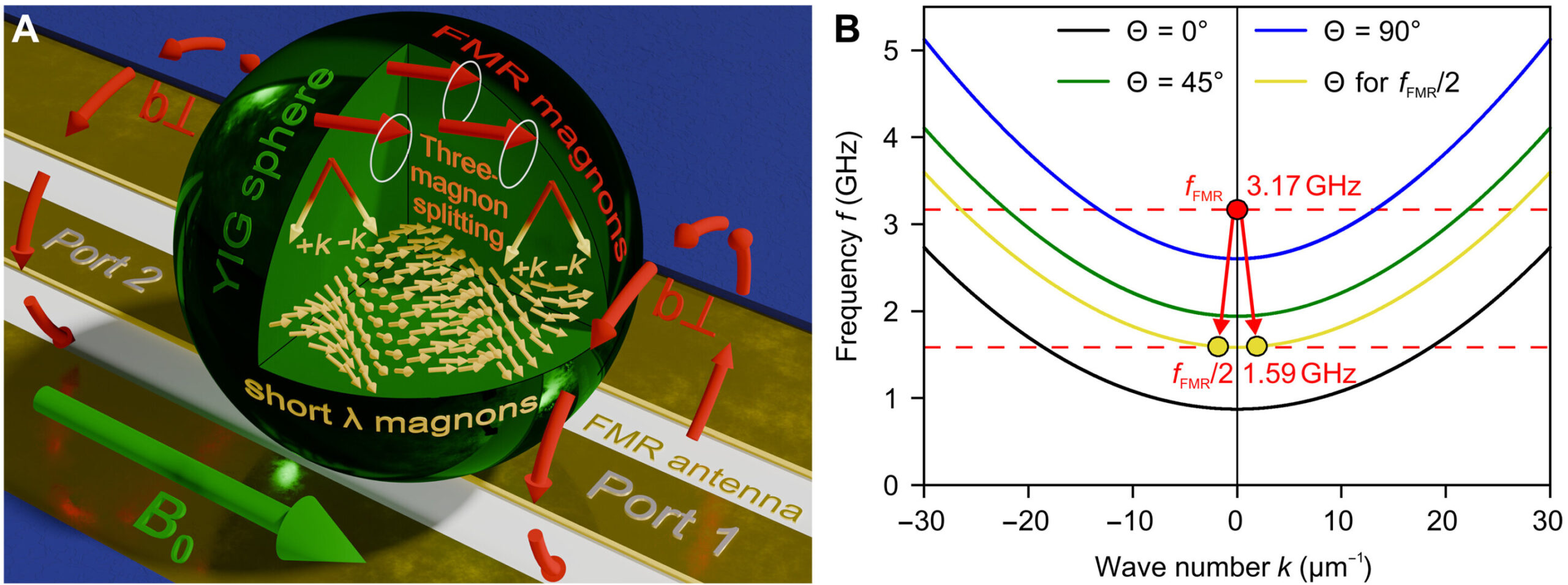
The researchers achieved this leap by addressing the two primary causes of magnon decay: physical defects and thermal interference. Typically, researchers have used uniform magnons, but these are highly sensitive to imperfections on the surface of a crystal. Wiener’s team instead excited short-wavelength magnons. These specific waves are inherently less sensitive to surface defects, allowing them to travel through the material without being scattered by the microscopic flaws that limited all previous experiments.
Achieving the Deep Freeze
The second half of the solution required extreme environmental control. The researchers utilized ultra-pure spheres of yttrium iron garnet (YIG), a synthetic crystalline material known for its magnetic properties. To eliminate the chaotic interference caused by heat, these spheres were placed inside a mixed-phase cryostat and cooled to a staggering 30 millikelvin.
At this temperature—only a fraction of a degree above absolute zero—the thermal processes that usually agitate a crystal and destroy magnons effectively freeze. By combining the resilience of short-wavelength waves with the stillness of an ultra-cold environment, the team allowed the magnons to persist for a duration previously thought unattainable. The findings, recently published in the journal Science Advances, suggest that the previous limits were not a result of the laws of physics, but rather a limitation of the environment and material purity.
Purity and the Path Forward
Perhaps the most encouraging aspect of the study is the discovery that the current 18-microsecond limit is not a fundamental ceiling. By testing three different YIG spheres of varying quality, the team observed a direct correlation: the higher the purity of the crystal, the longer the magnon survived. Even the sphere with the lowest purity managed to outperform all previous historical records.
This realization shifts the challenge from the realm of theoretical physics to the realm of materials science. It implies that as manufacturing techniques for yttrium iron garnet and other magnetic solids improve, the lifetime of magnons will likely continue to climb. There is no known law of nature preventing even longer durations; rather, it is a matter of removing the minute trace impurities that remain trapped within the crystal lattice.
Why This Matters
The ability to maintain a magnon for 18 microseconds changes its role from a temporary signal into a robust tool for technological innovation. In the high-stakes race to build a scalable quantum computer, scientists have long searched for a “quantum bus“—a reliable path that can connect and synchronize hundreds of qubits simultaneously. Long-lived magnons can function as this bus, serving as low-loss communication links that operate directly on a solid-state chip.
Furthermore, the discovery paves the way for universal translation in quantum architectures. Because magnons reside in solids and couple so easily to other systems, they can act as intermediaries between different quantum technologies that are otherwise incompatible. By serving as a long-lived quantum memory and a versatile translator, these magnetic ripples could provide the missing infrastructure needed to transition quantum computing from experimental laboratory setups into practical, everyday technology.
Study Details
Ultralong-living magnons in the quantum limit, Science Advances (2026). DOI: 10.1126/sciadv.aee2344