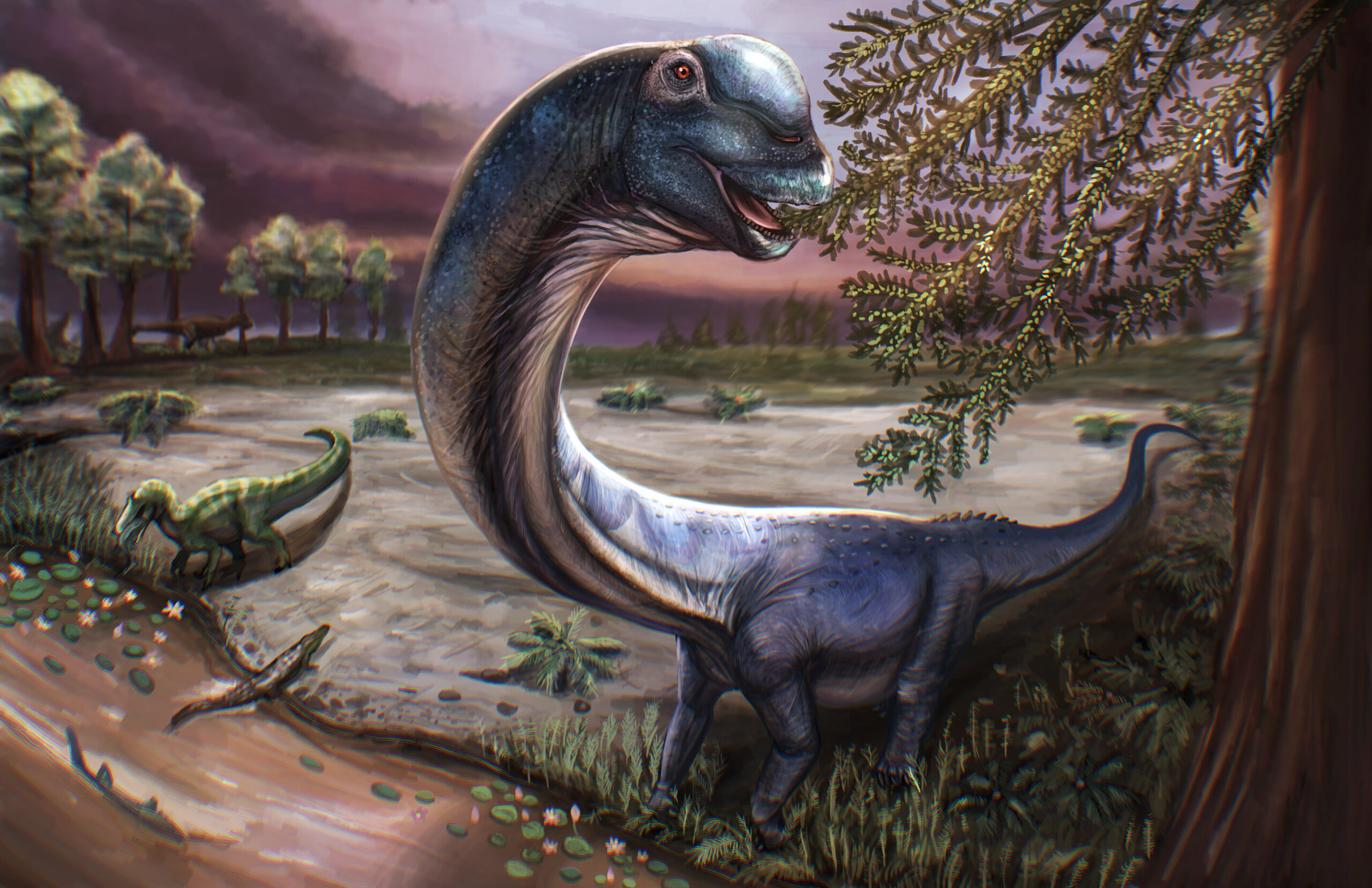
Towering bones pulled from the edge of a pond in northeastern Thailand have revealed the largest dinosaur ever found in Southeast Asia—an enormous long-necked plant-eater estimated at 27 metric tons and 27 meters long. Named Nagatitan chaiyaphumensis, the newly described sauropod may represent one of the region’s last great giants before the landscape shifted into a shallow sea.
The bones didn’t look like much at first—scattered remains resting quietly at the edge of a pond in Thailand. But ten years after their discovery, those fossils have now revealed something far bigger than anyone expected: a previously unknown dinosaur species that may have been one of Southeast Asia’s final giant sauropods.
The dinosaur, described in a new Scientific Reports paper, is not only a new species—it is the largest dinosaur ever identified from the region.
A Giant Hidden in Plain Sight
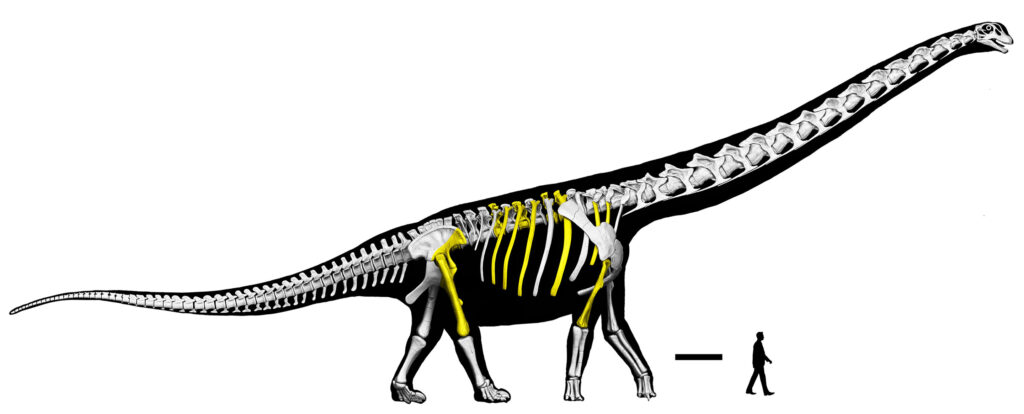
The fossils were found in northeastern Thailand, in the province of Chaiyaphum. Over time, researchers examined the remains in detail, focusing on major skeletal components including spine, rib, pelvis, and leg bones.
One bone in particular stood out: a front leg bone measuring 1.78 meters long. That single piece alone suggested the animal was no ordinary herbivore.
By analyzing the fossil material, the research team estimated that the dinosaur measured around 27 meters in total length and weighed roughly 27 metric tons—about the same as nine adult Asian elephants.
The discovery was led by researchers from University College London (UCL), Mahasarakham University, Suranaree University of Technology, and the Sirindhorn Museum in Thailand.
Introducing Nagatitan chaiyaphumensis
The dinosaur has been officially named Nagatitan chaiyaphumensis.
Its name carries layered meaning. “Naga” refers to a mythological aquatic serpent found in Thai and Southeast Asian folklore. “Titan” references the giants of Greek mythology. The final part, “chaiyaphumensis,” identifies the fossil’s geographic origin in Chaiyaphum province.
The species is now the 14th dinosaur formally named in Thailand, adding another major entry to the country’s growing paleontological record.
Bigger Than “Dippy,” But Not the Biggest on Earth
Lead author Thitiwoot (Perth) Sethapanichsakul, a Thai Ph.D. student at UCL Earth Sciences, emphasized that while this dinosaur was enormous, it still sits below the absolute giants of dinosaur history.
He noted that Nagatitan likely weighed at least 10 metric tons more than the famous museum specimen “Dippy,” the Diplodocus (Diplodocus carnegii). However, it was still much smaller than colossal sauropods such as Patagotitan (60 metric tons) and Ruyangosaurus (50 metric tons).
Even so, for Southeast Asia, this was a record-breaking find.
A “Last Titan” From Thailand’s Youngest Dinosaur Rocks
Researchers described Nagatitan as “the last titan” of Thailand for a key geological reason.
According to Sethapanichsakul, the fossil was discovered in Thailand’s youngest dinosaur-bearing rock formation. That detail matters because rocks laid down later—closer to the end of the dinosaur era—are unlikely to contain dinosaur remains in this region.
The reason is environmental change. By that time, the area appears to have become a shallow sea, making it far less likely for dinosaur fossils to form or survive.
That makes Nagatitan potentially one of the most recent large sauropods that scientists will ever find in Southeast Asia.
Life in the Early Cretaceous: Hot, Dry, and Full of Predators
Nagatitan chaiyaphumensis lived during the Early Cretaceous, between 100 and 120 million years ago.
The environment at the time is described as arid to semi-arid, conditions that sauropods may have preferred. The researchers suggest these massive dinosaurs likely benefited from the large surface area of their long necks and tails, which could have helped them shed heat and regulate body temperature.
The fossil site also appears to have been part of a meandering river system. That river habitat would have supported a diverse ecosystem, including fish, freshwater sharks, and crocodiles.
In other words, this wasn’t a quiet prehistoric landscape. It was active, competitive, and dangerous.
Surrounded by Other Dinosaurs and Flying Reptiles
Nagatitan did not live alone.
The research describes a Cretaceous community that included smaller plant-eaters such as iguanodontians and early branching ceratopsians—relatives of Triceratops. But there were also major predators in the area, including large meat-eaters such as carcharodontosaurians and spinosaurids.
Above them, pterosaurs flew over the river system, feeding on fish.
Together, these details offer a snapshot of a thriving ecosystem where giant herbivores moved through dry landscapes shaped by rivers, while predators and aerial hunters stalked the same terrain.
Where It Fits in the Dinosaur Family Tree
Nagatitan belonged to the sauropods—the long-necked, long-tailed plant-eaters that include well-known dinosaurs such as Diplodocus and Brontosaurus.
More specifically, it was classified as a somphospondylan sauropod, a subgroup that became widespread around 120 million years ago.
The team determined it belonged even deeper in the evolutionary tree, within a narrower Asian-only group called Euhelopodidae, a lineage found exclusively in Asia.
That classification strengthens the idea that Asia hosted its own distinct branch of sauropod evolution, separate from the better-known giant species discovered elsewhere.
What Makes This Dinosaur a New Species
Scientists did not declare this a new dinosaur simply because it was large.
According to the study, Nagatitan chaiyaphumensis is distinct due to a combination of unique features in its spine, pelvis, and leg bones. Those anatomical differences are what separate it from other known sauropod species.
A life-size reconstruction of the dinosaur is now on display at the Thainosaur Museum at Asiatique in Bangkok, offering the public a rare chance to see what Southeast Asia’s largest known dinosaur may have looked like at full scale.
International Collaboration and High-Tech Fossil Research
Co-author Professor Paul Upchurch of UCL Earth Sciences highlighted the importance of collaboration between Thai institutions and UCL.
The fossils were studied both in Thailand and at UCL, with the research supported by 3D scanning and printing. This approach allowed researchers to examine the specimen and collect data without requiring constant travel, which Upchurch noted also helps reduce carbon footprint.
Upchurch said the discovery offers valuable insight into what was happening in Southeast Asia during the Jurassic and Cretaceous periods, and reflects UCL’s broader interest in the evolution of giant plant-eating dinosaurs.
Thailand’s Dinosaur Boom Is Still Just Beginning
Project leader Dr. Sita Manitkoon, a researcher at the Paleontological Research and Education Center at Mahasarakham University and a National Geographic Explorer, emphasized that Thailand may hold far more dinosaur discoveries than the world currently realizes.
She stated that Thailand has extremely high dinosaur fossil diversity—possibly the third most abundant in Asia in terms of dinosaur remains.
Thailand’s dinosaur research history is also relatively young. The first dinosaur in the country was named in 1986, and formal study has only been underway for about 40 years.
Yet, she says, a new generation of Thai paleontologists is rapidly expanding the field and promoting the importance of paleontology nationwide.
For Sethapanichsakul, the discovery is also personal. He described it as fulfilling a childhood dream—not only contributing to science, but officially naming a dinosaur.
Why This Matters
Nagatitan chaiyaphumensis is more than a new species—it’s a major data point in understanding how dinosaurs evolved and spread across Asia. Its classification within the Asian-only Euhelopodidae group strengthens the idea that the continent developed unique sauropod lineages, shaped by regional environments and isolation.
Just as importantly, the fossil’s position in Thailand’s youngest dinosaur-bearing rocks suggests scientists may be approaching the edge of what the region can reveal about giant dinosaurs. That makes each discovery even more valuable, especially as researchers continue working through large collections of fossils that remain undescribed.
The message is clear: Southeast Asia is not a footnote in dinosaur history. With finds like Nagatitan, it is becoming one of the most important regions for uncovering how Earth’s biggest plant-eaters lived, evolved, and disappeared.
Study Details
Thitiwoot Sethapanichsakul et al, The first sauropod dinosaur from the Lower Cretaceous Khok Kruat Formation of Thailand enriches the diversity of somphospondylan titanosauriforms in southeast Asia, Scientific Reports (2026). DOI: 10.1038/s41598-026-47482-x , doi.org/10.1038/s41598-026-47482-x