The human brain is often described as the most complex object in the known universe. Containing roughly eighty-six billion neurons and an even greater number of connections, it is the biological engine of thought, memory, emotion, and identity. For centuries, scientists have tried to understand how this intricate organ works, how its structure gives rise to consciousness, and how its failures lead to disease. Despite extraordinary advances in neuroscience, the brain has remained stubbornly resistant to complete understanding. Its complexity is not merely large; it is overwhelming.
In recent years, however, a quiet transformation has begun. Artificial intelligence, particularly machine learning and deep neural networks, is changing how scientists study the brain. AI systems are now capable of analyzing brain data at a scale and depth that exceeds human cognitive limits. They can identify patterns too subtle for human observers, integrate information across multiple spatial and temporal scales, and generate predictive models of brain structure and function. In doing so, AI is not replacing neuroscientists, but extending their reach, enabling humanity to map the brain more comprehensively than ever before.
This development marks a pivotal moment in the history of neuroscience. To understand why AI has become so powerful in this domain, it is essential to explore both the nature of the brain itself and the limitations of traditional approaches. Only then can we appreciate how artificial intelligence is reshaping one of the most ambitious scientific quests of all time: the effort to understand ourselves.
The Immense Challenge of Mapping the Brain
Mapping the human brain is not a single task, but a constellation of interrelated challenges. At one level, scientists aim to chart the brain’s anatomy: the physical locations of neurons, the shapes of cells, and the pathways of connections known as synapses. At another level, they seek to understand function: how electrical and chemical signals flow through neural circuits to produce perception, thought, and behavior. At yet another level lies development and change, as the brain constantly rewires itself in response to experience, learning, and disease.
The sheer scale of this problem defies intuitive understanding. Each neuron can form thousands of synaptic connections, creating an astronomical number of possible pathways. Even mapping a tiny fragment of brain tissue at synaptic resolution generates terabytes of data. Traditional methods, relying on human experts to analyze images or interpret signals, quickly become impractical. The human brain, ironically, is not well suited to manually deciphering the full complexity of another brain.
Moreover, the brain operates across many levels simultaneously. Molecular processes unfold within milliseconds, neural circuits interact across centimeters, and cognitive functions emerge over seconds or minutes. Capturing these interactions requires integrating diverse data types, from genetic information and protein expression to electrical activity and behavioral output. Human cognition excels at conceptual reasoning and creativity, but it struggles with high-dimensional data spaces containing millions or billions of variables. This mismatch between the problem’s complexity and human analytical capacity has long constrained progress.
Traditional Brain Mapping and Its Limits
Historically, neuroscience advanced through careful observation, ingenious experiments, and incremental theory building. Early anatomists dissected brains to identify regions associated with specific functions. Later, techniques such as electroencephalography and functional magnetic resonance imaging allowed researchers to observe brain activity in living individuals. Microscopy and staining methods revealed the cellular architecture of neural tissue, while electrophysiology uncovered the electrical language of neurons.
These methods remain foundational, but they also have inherent limitations. Imaging techniques often involve trade-offs between spatial resolution, temporal resolution, and invasiveness. Data interpretation frequently depends on averaging signals across many neurons or individuals, potentially obscuring important variations. Most critically, the analysis process itself has been constrained by human attention and intuition. A researcher can examine only a limited number of images, graphs, or recordings in detail, and subtle patterns may go unnoticed.
As neuroscience datasets grew larger and more complex, these limitations became increasingly apparent. The brain was producing more data than the human mind could meaningfully organize. What was needed was not simply faster computers, but systems capable of learning from data, identifying structure within complexity, and adapting their analyses as new information emerged. This is precisely the domain in which artificial intelligence excels.
The Rise of Artificial Intelligence in Neuroscience
Artificial intelligence, particularly in its modern form, is built on algorithms that can learn patterns from data rather than relying on explicitly programmed rules. Machine learning systems improve their performance through exposure to examples, adjusting internal parameters to capture statistical regularities. Deep learning, a subset of machine learning, uses layered artificial neural networks inspired by biological brains, enabling the extraction of increasingly abstract features from raw data.
The convergence of AI and neuroscience was driven by several factors. Advances in computing power made it feasible to train large models on massive datasets. Improvements in data acquisition generated unprecedented volumes of brain-related information. At the same time, conceptual parallels between artificial neural networks and biological neural circuits encouraged cross-fertilization between fields. AI researchers borrowed ideas from neuroscience, while neuroscientists began to adopt AI tools.
What distinguishes AI from earlier computational approaches is its capacity to handle complexity without simplification. Instead of reducing data to a small set of predefined features, AI systems can ingest raw images, signals, or sequences and discover relevant structures on their own. This ability has proven transformative for brain mapping, where the most important features are often unknown in advance.
AI and Brain Imaging: Seeing What Humans Cannot
One of the most visible impacts of AI in neuroscience has been in the analysis of brain imaging data. Techniques such as MRI, fMRI, and diffusion tensor imaging generate detailed representations of brain structure and activity. However, interpreting these images requires detecting subtle variations across millions of voxels, a task that quickly exceeds human perceptual limits.
AI algorithms, particularly convolutional neural networks, excel at image analysis. Trained on large datasets, they can learn to recognize complex spatial patterns associated with specific brain states, developmental stages, or pathological conditions. These systems can identify features that are imperceptible to human observers, such as faint structural changes that precede the onset of neurological disease.
Beyond diagnosis, AI-driven imaging analysis enables more precise brain mapping. By integrating data across individuals, AI can generate probabilistic maps of brain organization, revealing both commonalities and individual differences. This approach acknowledges that no two brains are exactly alike, while still identifying consistent patterns that define human neural architecture. In doing so, AI moves neuroscience beyond static atlases toward dynamic, personalized models of the brain.
Mapping Neural Connections with AI
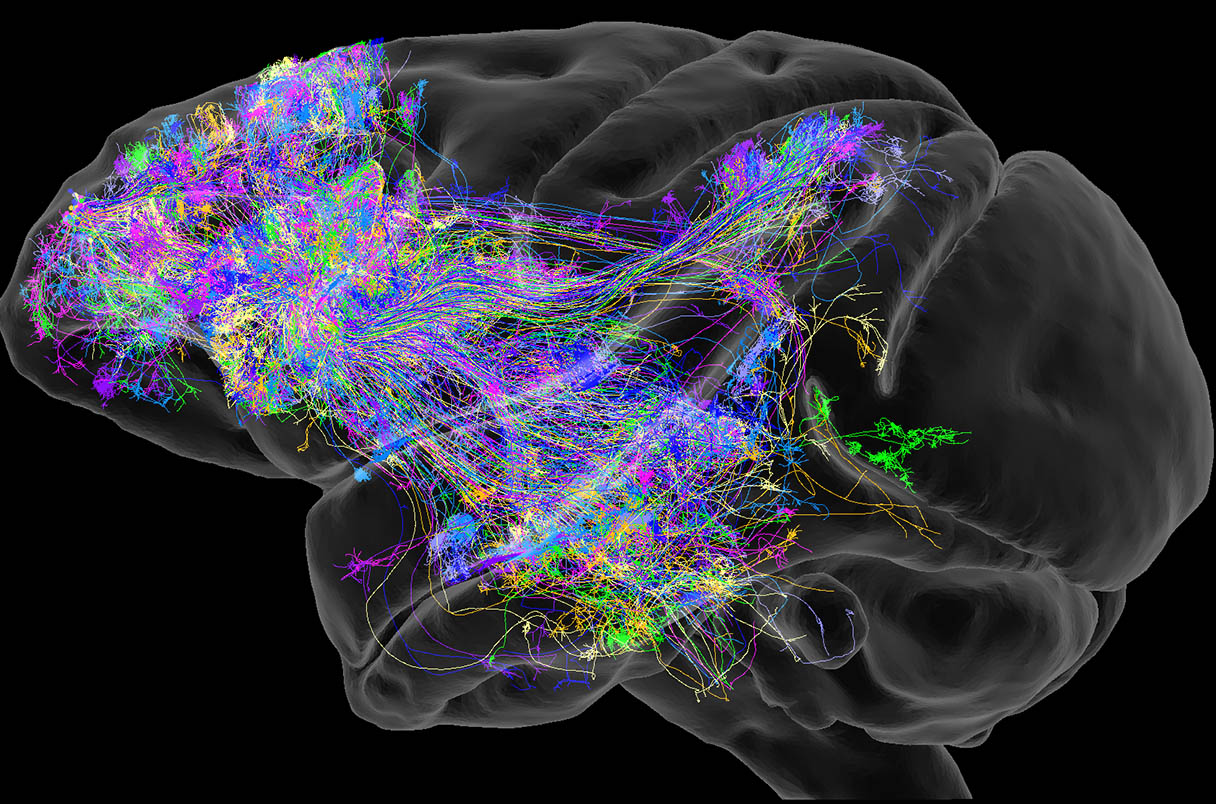
Perhaps the most ambitious goal in brain mapping is the creation of a connectome, a comprehensive map of all neural connections. At the microscale, this involves tracing individual synapses between neurons. At the macroscale, it involves charting pathways between brain regions. Both levels generate immense datasets that are impossible to analyze manually.
AI has become indispensable in this effort. Automated image segmentation algorithms can identify neurons and synapses in electron microscopy images, a task that once required painstaking human annotation. These systems learn to distinguish cell boundaries, classify synaptic types, and reconstruct three-dimensional neural circuits from two-dimensional slices. What would take humans decades can now be accomplished in weeks or months.
At larger scales, AI analyzes diffusion imaging data to infer the organization of white matter tracts connecting brain regions. By modeling how water molecules diffuse along neural fibers, AI systems can reconstruct complex connectivity patterns. These maps reveal how information flows through the brain and how disruptions in connectivity contribute to disorders such as schizophrenia, autism, and neurodegenerative diseases.
Understanding Brain Function Through AI Models
Mapping structure is only part of the story. The brain is a dynamic system, constantly processing information and adapting to its environment. Understanding how neural activity gives rise to cognition has long been one of science’s greatest challenges. Here again, AI offers powerful tools.
Machine learning algorithms can analyze neural recordings, such as those obtained from electrodes or imaging techniques, to identify patterns of activity associated with specific tasks or mental states. These systems can decode sensory information, predict behavior, and even infer intentions from brain signals. Importantly, they can do so in real time, opening new possibilities for brain–computer interfaces.
AI models also serve as theoretical tools. By training artificial neural networks to perform cognitive tasks, researchers can compare their internal representations to those observed in biological brains. Similarities between artificial and biological representations suggest shared computational principles. In this way, AI does not merely analyze brain data; it becomes a testbed for hypotheses about how brains compute.
Learning from Development and Plasticity
The human brain is not a static organ. It develops from a simple neural tube into a highly structured system, shaped by genetic programs and environmental experience. Throughout life, it remains plastic, capable of reorganizing itself in response to learning, injury, and aging. Capturing this dynamism is essential for a complete brain map.
AI excels at modeling change over time. Recurrent neural networks and other temporal models can analyze longitudinal brain data, identifying trajectories of development or degeneration. These models can detect early deviations from typical development, offering insights into neurodevelopmental disorders. They can also track how brain networks reorganize during recovery from injury, informing rehabilitation strategies.
By integrating data across time, AI helps neuroscientists move beyond snapshots of the brain toward narratives of change. This temporal dimension is crucial for understanding not only how the brain is organized, but how it becomes organized and how it adapts.
AI and the Molecular Brain
Brain mapping is not limited to neurons and circuits. At a deeper level, the brain’s function depends on molecular processes involving genes, proteins, and signaling pathways. Advances in molecular neuroscience have generated vast datasets describing gene expression patterns across different brain regions and cell types.
AI has become essential for making sense of this molecular complexity. Machine learning algorithms can identify cell types based on gene expression profiles, revealing previously unknown neuronal subclasses. They can uncover relationships between molecular signatures and functional properties, linking genes to circuits and behavior.
This integration of molecular and systems-level data represents a new frontier in brain mapping. By connecting genes to networks, AI helps bridge the gap between biology and cognition. It also provides new avenues for understanding neurological and psychiatric disorders, many of which involve subtle molecular disruptions rather than gross anatomical changes.
The Role of AI in Brain Disease and Mental Health
One of the most profound implications of AI-driven brain mapping lies in medicine. Neurological and psychiatric disorders often involve complex, distributed changes in brain structure and function. Traditional diagnostic categories, based largely on symptoms, may not reflect underlying biological reality.
AI offers a way to redefine these categories based on brain data. By analyzing patterns across large populations, machine learning systems can identify subtypes of disease with distinct neural signatures. This approach supports the development of personalized medicine, in which treatment is tailored to an individual’s specific brain profile.
Early detection is another critical advantage. AI can identify subtle changes that precede clinical symptoms, enabling intervention before irreversible damage occurs. In conditions such as Alzheimer’s disease, where early treatment is crucial, this capability could have transformative effects.
Why AI Can Map the Brain Better Than Humans Alone
The claim that AI can map the human brain better than we can is not an indictment of human intelligence. Rather, it reflects a fundamental difference between human cognition and machine learning. Humans are exceptional at reasoning, abstraction, and creativity, but they are limited in their ability to process vast amounts of high-dimensional data. AI systems, by contrast, thrive in precisely this domain.
AI does not tire, does not overlook patterns due to cognitive bias, and can operate simultaneously across multiple scales of analysis. It can integrate structural, functional, molecular, and behavioral data into unified models. Importantly, it can continually update these models as new data become available, refining its understanding over time.
However, AI’s strengths complement rather than replace human insight. Human scientists formulate questions, design experiments, and interpret results within broader theoretical and ethical frameworks. AI provides the analytical power to explore these questions at a depth and scale that would otherwise be unattainable.
Ethical and Philosophical Dimensions
The use of AI in brain mapping raises profound ethical and philosophical questions. Brain data are deeply personal, reflecting aspects of identity, cognition, and mental health. Ensuring privacy, consent, and responsible data use is essential. As AI models become more powerful, concerns about misuse, surveillance, or discrimination must be addressed proactively.
There are also deeper questions about understanding itself. If AI systems can identify patterns in the brain that humans cannot intuitively grasp, what does it mean to “understand” the brain? Does explanation require human interpretability, or is predictive accuracy sufficient? These questions challenge traditional notions of scientific knowledge.
At the same time, AI-driven brain mapping invites reflection on the nature of intelligence. As artificial systems learn from biological brains, and neuroscientists learn from artificial ones, the boundary between natural and artificial cognition becomes increasingly blurred. This reciprocal relationship enriches both fields, offering new perspectives on what it means to think.
The Future of Brain Mapping
The integration of AI and neuroscience is still in its early stages. As data grow richer and algorithms more sophisticated, brain maps will become increasingly detailed, dynamic, and personalized. Future models may simulate entire brain networks, capturing not only structure and activity but also learning and adaptation.
These advances will not yield simple answers to age-old questions about consciousness or free will. Instead, they will provide more nuanced frameworks within which such questions can be explored. By revealing how complex mental phenomena emerge from physical processes, AI-assisted brain mapping will deepen our understanding of the human condition.
Crucially, this progress will depend on interdisciplinary collaboration. Neuroscientists, computer scientists, ethicists, clinicians, and philosophers must work together to ensure that AI serves human values. The goal is not merely to map the brain, but to use that knowledge wisely.
A New Way of Seeing Ourselves
In mapping the human brain better than we can alone, AI is offering humanity a new mirror. It reflects back patterns of organization and activity that underlie thought, emotion, and behavior. This reflection is not always intuitive or comfortable, but it is profoundly illuminating.
The brain, once seen as an inscrutable black box, is becoming a landscape that can be explored in unprecedented detail. AI provides the tools to navigate this landscape, revealing connections and dynamics that were previously hidden. In doing so, it does not diminish the mystery of the mind, but reframes it within a richer, more informed context.
Ultimately, the story of AI and brain mapping is a story about human curiosity amplified by technology. It is about extending our cognitive reach to confront complexity without simplifying it away. As artificial intelligence continues to evolve, it will remain an essential partner in the ongoing effort to understand the most intricate structure we know: the human brain itself.