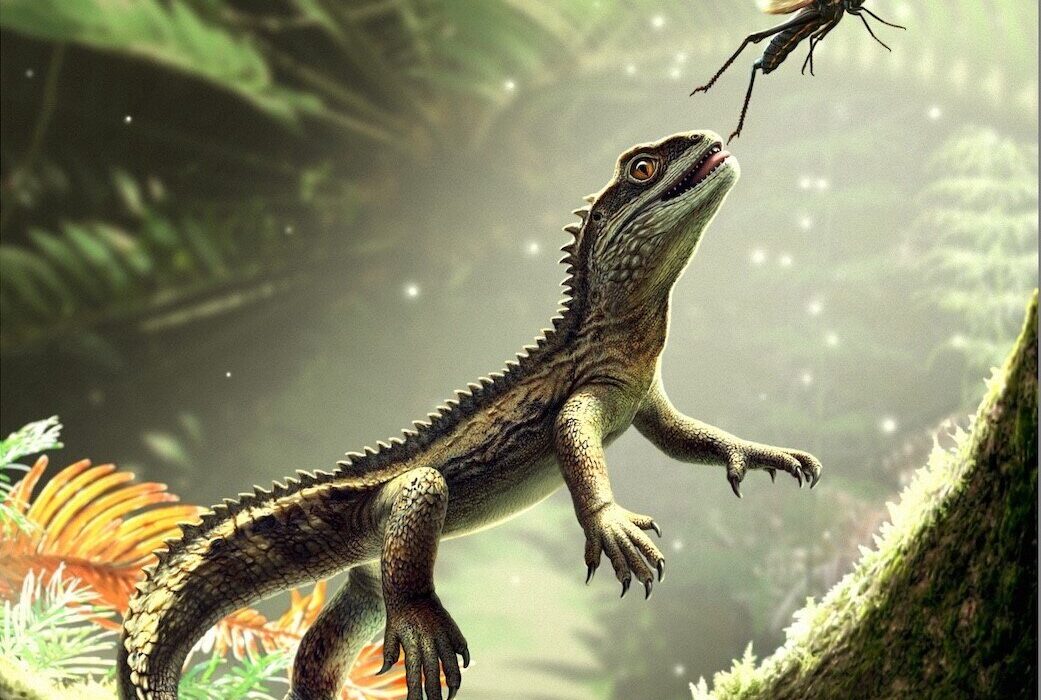
The first stages of the archosauromorph radiation were marked by unusually high rates of new species appearing, followed by a long decline in speciation as extinction gradually became more common. That pattern emerges from a fossil record spanning the late Permian to the Early Jurassic and suggests that the early expansion of dinosaurs and their close relatives was not driven by a single process.
Archosauromorphs include dinosaurs and a broad range of their close relatives, and their diversification during the Triassic produced many of the lineages that would dominate terrestrial ecosystems later in the Mesozoic. The radiation began around the aftermath of the end-Permian extinction and continued into the Early Jurassic.
To reconstruct how that radiation unfolded, the researchers assembled a dataset containing 410 archosauromorph taxa from the late Permian through the Early Jurassic. Maximum femoral length, used as a proxy for body size, was available for 331 taxa, or 81% of the dataset. First and last appearances were based either on multiple fossil occurrences or on stratigraphic uncertainty, with most dates relying on the latter.
The analysis was designed to address a problem that has complicated earlier attempts to reconstruct the radiation. Many approaches to estimating diversification depend on evolutionary family trees, but fossil phylogenies can be uncertain and using them can require excluding taxa for which suitable phylogenetic information is unavailable.
Instead, the researchers used PyRate, a Bayesian method that works directly with fossil occurrences. It estimates speciation, extinction and preservation rates without requiring an explicit phylogenetic tree, while also allowing uncertainty in fossil ages and preservation to be incorporated.
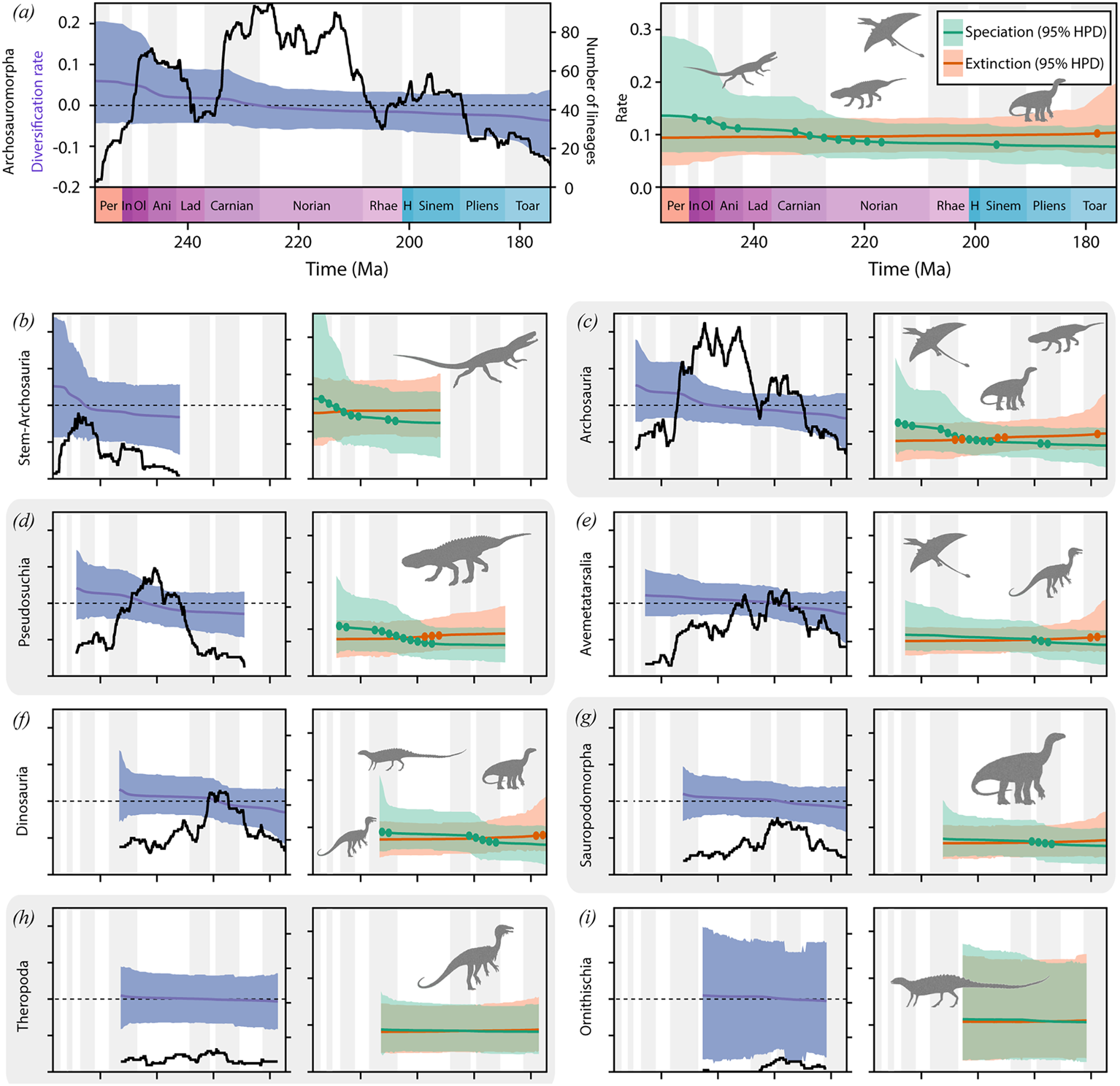
The researchers analyzed Archosauromorpha as a whole and separately examined stem-archosaurs, Archosauria, Pseudosuchia, Avemetatarsalia, Dinosauria, Sauropodomorpha, Theropoda and Ornithischia.
Speciation started high and then fell
The clearest pattern appeared when the entire archosauromorph dataset was analyzed.
Across roughly the first 90 million years represented in the analysis, the overall diversification rate declined. The main reason was a falling speciation rate, while extinction also tended to increase, although its contribution was smaller. The analysis identified strongly supported downward shifts in speciation during the Early, Middle and Late Triassic and the Early Jurassic, together with an increase in extinction near the end of the interval.
The first major decline in speciation extended through the Olenekian and Anisian stages of the Triassic. Four strongly supported downward shifts occurred during this period. Afterward, the mean diversification rate was about half its initial value.
A second decline in speciation extended from the middle Carnian to the middle Norian and contained seven additional strongly supported shifts. By the early Norian, the estimated diversification rate had become negative. Another speciation shift appeared in the Sinemurian, although the overall decline in diversification was less pronounced there.
The extinction trajectory was different. It remained comparatively steady for much of the interval, with a gradual upward tendency rather than the pronounced decline seen in speciation. One strongly supported extinction-rate increase occurred in the Toarcian.
Together, the two patterns produce what the authors describe as an “early burst” of diversification: initially high speciation followed by declining speciation and increasing extinction.
The same broad pattern appears inside major groups
The overall trajectory was not simply an artifact of combining very different lineages. The major subsets generally showed declining diversification and speciation rates alongside relatively stable but increasing extinction rates. Their individual histories also helped explain features of the broader archosauromorph curve.
For example, the dip in overall diversification during the Carnian was associated with a rapid fall in diversification among stem-archosaurs. Pseudosuchians and surviving stem-archosaur lineages contributed to the peak in diversity during the Norian, even though pseudosuchian diversification had become negative by the early Norian as speciation declined and extinction increased.
Avemetatarsalians and dinosaurs followed broadly similar trajectories, although the details differed. Unambiguous avemetatarsalians appear in the Anisian, while dinosaurs appear in the study’s dataset in the Carnian. The estimated diversification rate for Avemetatarsalia was essentially constant across the analyzed time bins, whereas dinosaurs began with downward shifts in speciation.
Within Dinosauria, Sauropodomorpha contributed strongly to the overall pattern. It showed particularly pronounced downward speciation shifts from the Rhaetian into the Sinemurian.
Theropoda and Ornithischia, by contrast, showed little slope in diversification and no distinct, statistically supported shifts in either speciation or extinction. Even so, the net diversification rate of all three major dinosaur groups became negative near the Triassic-Jurassic boundary, although the timing is subject to age uncertainty. The authors associate this broadly with the end-Triassic mass extinction and the later Toarcian faunal turnover.
The lack of obvious shifts in Ornithischia requires particular caution. The authors note that its sample size was small and uneven, so the absence of clear diversification shifts may reflect limited data rather than a definitive feature of the group’s evolutionary history.
An early burst does not by itself prove niche filling
A declining speciation rate after an initial burst is consistent with a familiar explanation for evolutionary radiations. After an extinction removes many organisms, ecological opportunities can become available. As species diversify into those opportunities, the amount of unoccupied ecological space may decline, eventually reducing the rate at which new species arise.
The researchers say their results are consistent with that kind of niche-filling process. But the rate patterns do not establish that niche filling was the sole or even the main cause of the decline.
The authors also consider a different possibility. The early burst could have included a substantial amount of non-adaptive diversification, in which species formation occurs through geographic isolation without immediate large-scale differences in ecological form. They point to the environmental conditions following the end-Permian extinction as potentially compatible with such a process. In this interpretation, extreme thermal gradients and ecological instability could have created barriers to gene flow and promoted geographic isolation.
The fossil record also raises an important qualification about who actually participated in the early burst.
Not every lineage that survived the end-Permian crisis necessarily contributed equally to the subsequent radiation. The authors note that some survivors may have been short-lived “disaster taxa”, sometimes called “dead clades walking,” that persisted briefly after the extinction but did not take advantage of the newly available ecological space.
Their interpretation is therefore that the very high Early Triassic speciation rates were probably concentrated in a restricted subset of archosauromorph lineages that crossed the Permian-Triassic boundary, rather than representing an equally rapid diversification of every surviving lineage.
Extinction rose as diversity accumulated
The second half of the pattern is more unusual.
Speciation declined strongly through much of the radiation, but extinction showed a more gradual increase. The extinction changes were generally much smaller than the changes in speciation, and the strongest shifts tended to occur around recognized extinction events.
The authors consider several possible explanations. One is that lineages may have become increasingly vulnerable as environments changed. But they argue that this alone does not satisfactorily explain why extinction rates increased even in groups that were not already declining.
They instead suggest that the pattern could be compatible with neutral biodiversity dynamics. Under the mechanism they discuss, as the number of species increases while the total number of individuals remains constrained, the average population size of each species can decrease. Smaller populations would then be more vulnerable to stochastic extinction. That process could produce increasing extinction rates as a radiation progresses, even before the overall clade begins to decline.
The authors describe this as a possible explanation rather than a demonstrated mechanism. Their data show the increasing extinction pattern, but the proposed neutral process is an interpretation of that pattern.
The radiation may have started before its morphological expansion became obvious
The timing of the diversification signal also raises the possibility of an early phase that was difficult to recognize from morphology alone.
The authors describe their results as consistent with a “diversity-first” scenario, in which taxonomic diversification of major archosauromorph groups preceded major expansion in morphological diversity. In other words, the number of lineages may have increased rapidly before the full range of distinctive body forms became apparent in the fossil record.
This leads the authors to propose that part of the initial diversification may have been morphologically cryptic or nearly cryptic. Their occurrence-based analysis can estimate diversification directly from the fossil record without requiring the diversification signal to be reconstructed through a phylogenetic tree. The resulting early peak may therefore capture diversification that appears later when inferred from morphological or phylogenetic patterns.
The authors characterize this as possible evidence for cryptic early diversification, rather than a direct observation of evolutionary events that left no morphological signal.
Body size did not show a clear diversification effect
The study also tested whether body size was associated with speciation or extinction.
For the analysis, maximum femoral length was log-transformed and used as the body-size proxy. The model estimated covariance between that trait and both speciation and extinction rates. Missing femoral-length values were estimated during the analysis using a simple linear regression.
The results did not provide strong evidence that body size was associated with either rate in any of the groups examined. Most groups showed weakly positive covariance between body size and speciation and weakly negative covariance between body size and extinction, but the uncertainty around the estimates was large. Overall, the results remained consistent with no real effect of body size on diversification dynamics.
For Archosauromorpha as a whole, the estimated covariance was 0.086 for speciation, with a 95% credibility interval from −0.215 to 0.404, and −0.129 for extinction, with a 95% interval from −0.394 to 0.129.
The direction of the estimates was therefore not consistent with the expectation that larger animals necessarily have higher extinction rates. The authors suggest that the generally passive nature of body-size increase during this radiation could contribute to the weak relationship.
But this part of the result has an important limitation. Femoral length may not represent body mass or body volume equally well across archosauromorphs with very different body shapes, locomotion and posture. Some of the body-size values were also imputed, and the covariance estimates were highly uncertain. The authors therefore regard the negative result as somewhat ambiguous and note that alternative or multiple measures of body size could produce a different signal.
Tests of the fossil record support the broad rate pattern
Because fossil occurrence data are incomplete, the researchers also tested how much their conclusions depended on having internal fossil occurrences rather than only the first and last appearances of species.
They reanalyzed two sets of 100 simulated datasets, generated under time-variable birth-death models with a homogeneous preservation process. They then removed all occurrences except the first and last appearances and compared the resulting estimates with analyses using the complete occurrence data.
The simulations generally recovered similar rate patterns. In the first set, the mean absolute percentage error was 0.63 for speciation and 1.18 for extinction, while the R² values were 0.90 and 0.21, respectively. Net diversification had an R² of 0.80. In the second set, the mean absolute percentage errors were 0.59 for speciation and 0.66 for extinction, with R² values of 0.75 and 0.36. Net diversification had an R² of 0.67.
The timing of individual rate shifts was less accurately recovered without the internal fossil occurrences, but the researchers found that the general trends in rate variation could still be reasonably inferred.
A separate sensitivity analysis produced a different warning. When speciation and extinction times were fixed across 20 replicates, the estimated rate magnitudes became about 10 times larger than those in the main analysis. The general speciation trajectory before the Norian remained similar, but its downward shifts were much steeper, and the diversification trajectory developed irregular oscillations rather than the smoother, stepwise decline of the principal analysis. The sensitivity analysis also recovered a rapid extinction event followed by speciation between the Rhaetian and Sinemurian that was not detected in the main Archosauromorpha analysis.
The researchers therefore used the sensitivity analyses to examine how methodological choices affect the precise shape and magnitude of the inferred rates rather than treating every feature of those alternative curves as an equally secure evolutionary signal.
Preservation assumptions did not change the main result
The principal analysis assumed a homogeneous Poisson preservation process, meaning the preservation rate was treated as constant. The researchers also tested a model in which preservation could vary through time.
For Archosauromorpha as a whole, the time-variable preservation model estimated the lowest preservation rate, below 0.1, in the late Permian and the highest, around 0.23, in the Middle Triassic. It remained around 0.175 during the remaining time bins. Despite those changes in the preservation model, the resulting diversification patterns were otherwise very similar to those from the main analysis.
One modest difference appeared in the Anisian, where the fall in diversification was delayed and less pronounced under the time-variable preservation model. That resulted from a slower decline in speciation combined with an extinction-rate increase during that interval. The extinction increase in the Toarcian was not supported by the alternative model’s Bayes factors, although the shift was small enough that the overall diversification trajectories remained almost identical.
The authors interpret the close agreement between the preservation models as evidence that the principal diversification pattern is reasonably robust to how fossil preservation is modeled.
Across the full analysis, then, the strongest signal is not a single abrupt event but a prolonged change in the balance between speciation and extinction. Archosauromorphs began their radiation with high rates of new species appearing. Speciation then declined repeatedly through the Triassic and into the Early Jurassic, while extinction gradually increased and became particularly elevated around some major turnover events. The authors interpret that combination as evidence for an early burst of diversification and suggest that neutral biodiversity dynamics may have contributed to the increasing extinction rate, while acknowledging that the mechanisms behind the pattern cannot be established from the rate estimates alone.
The study was published in Proceedings of the Royal Society B.