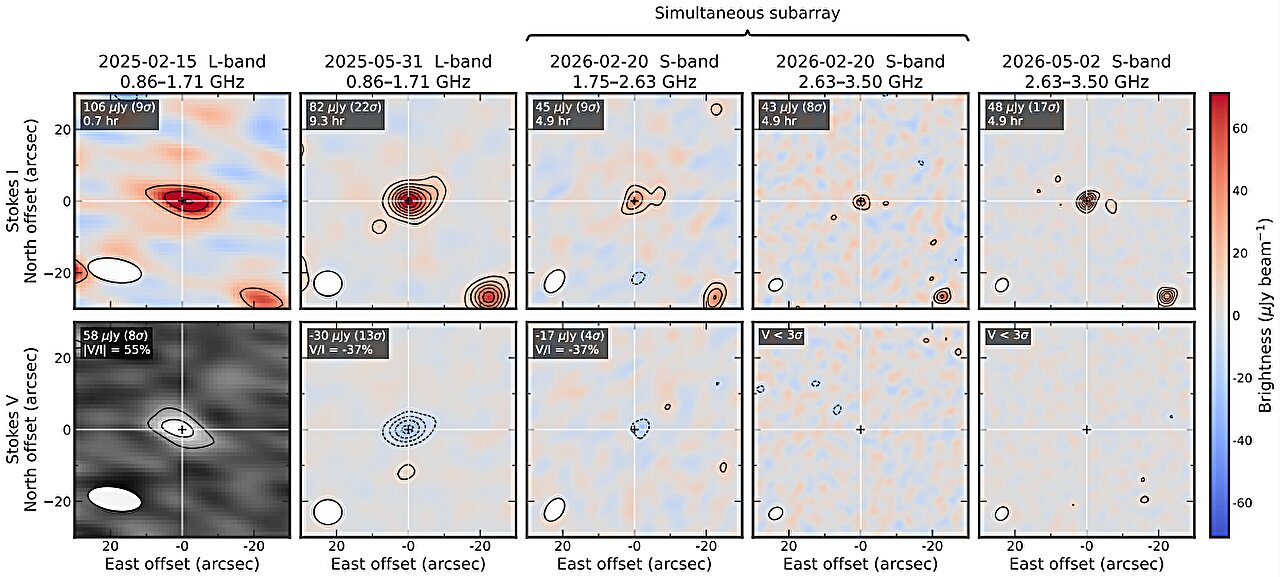
Rapid, highly polarized radio bursts are coming from the giant exoplanet β Pictoris b, not from the young star it orbits, according to observations with the MeerKAT radio telescope. The emission reaches frequencies as high as 3.5 gigahertz, pointing to a magnetic field of at least 1.25 kilogauss at the site where the radio waves are produced. The observations provide the first direct measurement of a magnetic field strength for an exoplanet.
Radio emission from a planetary system does not automatically mean the planet itself is producing it. A magnetically active host star can generate radio waves too, and previous detections of coherent radio emission from systems containing exoplanets could not unambiguously separate the planet from the star.
β Pictoris offered an unusual opportunity to make that distinction. The system lies 19.63 ± 0.06 parsecs away and is about 23 million years old. Its A6V host star has a debris disk and at least three known giant planets. The most massive, β Pictoris b, has a mass of about 12 Jupiter masses and orbits at roughly 10 astronomical units. Across its 24-year orbit, the planet can reach an angular separation of about 0.55 arcseconds from the star.
The star is also magnetically quiet, making it possible to test whether a radio signal detected from the system actually belongs to the planet. β Pic b itself is a young, planetary-mass object with an L2 ± 1 spectral type and an effective temperature of about 1,700 kelvin.
The researchers observed the system with MeerKAT on four occasions during 2025 and 2026, using the L band from 0.856 to 1.712 gigahertz and the S band from 1.75 to 3.5 gigahertz. A radio source appeared at the position of the β Pictoris system in every observing epoch. The critical task was to determine which object produced it.
To locate the source precisely, the researchers tied the radio image to the Gaia celestial reference frame. They used nine compact radio sources associated with Gaia-identified quasars across the field, together with a VLBI calibrator, and fitted an affine correction that accounted for translation, rotation, scale and shear.
After the correction, the radio source was consistent with the known position of β Pic b. Its positional offset from the planet corresponded to a Mahalanobis radius of 1.1, with a probability of about 0.53 for the measured offset to arise from the combined uncertainties. By contrast, the source was inconsistent with the host star at 4.4-sigma significance and with planet c at 4.8 sigma after the researchers incorporated measured systematic uncertainties.
The localization remained stable when the researchers repeatedly removed individual reference sources from the analysis. Across all 55 leave-one-out and leave-two-out fits, the radio position remained consistent with β Pic b. The median offset was about 100 milliarcseconds from the planet compared with about 434 milliarcseconds from the star, while the frame correction itself shifted by a median of only about 4 milliarcseconds.
The positional uncertainties were also tested directly. The researchers injected 160 artificial point sources with the same brightness and beam shape as the β Pic source into regions of the radio image and recovered them using the same fitting procedure. The scatter of the recovered positions was 1.1 times the reported fitting uncertainty, and that factor was included in the final systematic error budget.
A separate test examined whether ionospheric refraction could shift radio positions in a frequency-dependent way. The researchers measured the positions of 40 bright compact sources across eight S-band sub-bands. The field showed a common chromatic shift of 9.8 ± 2.6 milliarcseconds, which was absorbed by the frame-tie correction. The median residual difference between individual sightlines was 32 milliarcseconds, and the researchers conservatively included that differential effect in the positional uncertainty.
Together, these tests supported the assignment of the radio source to β Pic b rather than the host star or planet c.
The radio signal comes in bursts
The emission itself has distinctive properties. During the observations, β Pic b produced rapidly varying bursts with circular polarization of roughly 40% to 70%, along with fainter emission between the bursts.
The bursts were broadband and relatively flat in spectrum, extending across the observing bands. Their circular polarization also changed handedness. The May 31, 2025 L-band observation contained left-handed bursts, while the May 2, 2026 S-band observation included a right-handed burst. The researchers note that such changes are consistent with auroral radio emission, in which the observed polarization depends on magnetic-field orientation and planetary rotation.
The observations also revealed emission outside the strongest bursts. The researchers describe this as a persistent or quiescent component, although its physical origin is less certain. It could be incoherent gyrosynchrotron radiation, or it could consist of overlapping bursts that are individually weaker than the prominent events.
The brightest burst in the L-band data reached 307 microjanskys. Assuming an emitting region roughly the size of the planet, about 1.5 Jupiter radii, the researchers calculate a brightness-temperature lower limit of about 6 × 10¹⁰ kelvin at 1.28 gigahertz. That temperature requires a nonthermal source. Combined with the strong circular polarization, rapid variability and broadband spectrum, the properties point to coherent rather than ordinary thermal radio emission.
The signal points to electron cyclotron maser emission
The researchers identify the bursts as electron cyclotron maser instability, or ECMI, radiation. This mechanism produces coherent radio waves from electrons moving in a magnetic field.
One alternative, plasma emission, would require electron densities of roughly 9 × 10⁹ to 1.5 × 10¹¹ particles per cubic centimeter at the observed frequencies for fundamental emission. Even assuming second-harmonic emission reduces the requirement, the necessary densities would still be about 2 × 10⁹ to 4 × 10¹⁰ particles per cubic centimeter. The authors argue that these densities are far above plausible planetary or brown-dwarf magnetospheric plasma densities and therefore disfavor plasma emission.
ECMI links the frequency of the emitted radio waves directly to the magnetic field at the emission site. The electron cyclotron frequency is approximately 2.8 gigahertz for every kilogauss of magnetic field.
That relationship turns the highest detected radio frequency into a measurement of the planet’s local magnetic field. The S-band burst that was most strongly circularly polarized, at about 70%, remained detectable up to the top of the observing band at 3.5 gigahertz. Under the fundamental-ECMI interpretation, that requires a field of at least about 1.25 kilogauss where the emission originates.
The lower-frequency L-band observations likewise require fields of at least about 600 gauss at their emission sites. The 1.25-kilogauss lower limit from the S-band observations is the strongest direct magnetic-field constraint obtained for β Pic b.
The measurement refers to the field at the radio-emitting region, rather than necessarily to a simple global surface dipole field. The researchers note that ECMI samples the local field where the emission is generated. For comparison within their analysis, they use dynamo scaling to estimate a mean surface field of about 1.2 kilogauss and a polar dipole field of about 0.8 kilogauss. The local field required by the radio emission is higher, which the authors note is consistent with the fact that localized fields in an auroral emission region can exceed the global dipole strength.
Why the star is unlikely to be the source
The radio source’s position already separates it from β Pictoris itself, but the magnetic-field requirement provides another independent constraint.
Spectropolarimetric observations of the A6V star found no large-scale surface magnetic field, with a measured longitudinal field of −14 ± 20 gauss. Modeling of an oblique dipole excludes a large-scale dipole with a polar strength above about 300 gauss at 90% detection probability, and down to about 120 gauss at 50% detection probability. Those limits are substantially below the at least 1.25-kilogauss field required to produce the observed S-band ECMI at its fundamental frequency.
Other possible stellar mechanisms also do not readily account for the observed properties. Thermal chromospheric emission would require a brightness temperature of at least about 10⁷ kelvin even for a source as large as the stellar disk, far above the chromospheric temperature of comparable A-type stars. Incoherent gyrosynchrotron emission would not produce the measured 40% to 70% circular polarization. And a stellar ECMI source would require magnetic fields stronger than the measured stellar dipole limit, even if the radiation were produced at the second harmonic.
The debris disk is also not a plausible source. Its thermal radio emission is expected to be negligible at centimeter wavelengths, with an extrapolation from its shorter-wavelength spectrum predicting fluxes at the nanojansky level.
A rapidly rotating planet with a strong field
The radio bursts have characteristics associated with auroral emission from rapidly rotating magnetic objects. β Pic b has a measured projected rotation speed of about 20 kilometers per second. Spectroscopic measurements indicate a rotation period of roughly eight to nine hours, while JWST photometry gives a period of 9.00 ± 0.13 hours. Its spin axis is nearly equator-on.
The researchers interpret the emission as arising from magnetosphere-ionosphere coupling. In this picture, plasma within a rapidly rotating magnetosphere cannot maintain corotation with the planet at sufficiently large distances. The resulting shear can drive electric currents along magnetic field lines, accelerating electrons toward the atmosphere and producing auroral ECMI emission.
The amount of radio power in this process depends on several properties, including the planet’s rotation rate, magnetic-field strength, plasma mass-loading rate and ionospheric conductance. β Pic b has direct measurements of two of those ingredients: rapid rotation and a kilogauss-scale magnetic field.
The source of the magnetospheric plasma itself is less certain. The authors suggest that it could come from material sputtered from the planetary atmosphere by auroral currents or from gas captured from the surrounding debris disk. These are proposed possibilities rather than demonstrated sources of the plasma.
The timing of the bursts offers another possible clue. The first and third L-band bursts were separated by about eight hours, close to the planet’s measured rotation period. The researchers say this may be a signature of rotational modulation expected from magnetosphere-ionosphere coupling, but the limited observations do not establish that interpretation as a definitive measurement of the planet’s magnetic geometry.
Other possible drivers do not supply enough radio power
The researchers also considered whether an external interaction could produce the observed radio emission.
One possibility is the stellar wind striking the planet’s magnetosphere, similar to some radio processes in the Solar System. But when the expected radio power is scaled from Jupiter using β Pictoris’s measured mass-loss rate of 1.1 × 10⁻¹⁴ solar masses per year, along with β Pic b’s orbital distance and magnetic-field strength, the predicted power falls about three orders of magnitude below the observed emission.
Another possibility is an interaction between β Pic b and a moon, analogous to the interaction between Io and Jupiter. The authors calculate that even after maximizing the hypothetical moon’s orbital radius and choosing parameters favorable to detection, the predicted flux remains more than an order of magnitude below the planet’s quiescent radio emission.
Existing mass limits also exclude moons more massive than roughly Saturn over most of the dynamically stable region around β Pic b.
The authors therefore attribute the observed emission to a rotationally driven process within β Pic b’s own magnetosphere. They note that the bursts resemble auroral radio emission from ultracool dwarfs, where rotationally driven magnetosphere-ionosphere coupling is also used to explain the observed radio behavior.
The planet’s magnetic field fits the dynamo estimate
The magnetic-field measurement can also be compared with a dynamo scaling relation based on the energy available from convection inside planets and stars.
Using β Pic b’s measured luminosity, mass and radius, the researchers place the planet on the magnetic-convective dynamo scaling relation used in their analysis. The relation predicts a mean dynamo surface field of about 1.2 kilogauss, while the radio observations require at least 1.25 kilogauss at the ECMI emission site.
The comparison does not mean that the radio observations measure the planet’s entire magnetic field directly. The radio constraint applies to the local field in the region producing the ECMI. The authors specifically distinguish this local field from the planet’s dipole field and convert both measurements into the convention used for the dynamo relation.
What makes β Pic b particularly useful for this comparison is that its mass has been dynamically measured. The radio detection therefore combines an independently established planetary mass with a directly inferred magnetic-field strength, allowing the object to be placed on the dynamo relation rather than being treated simply as a planetary-mass radio source.
The X-rays may have a different origin
The radio observations also lead the authors to revisit weak X-ray emission previously detected from the β Pictoris system.
The existing X-ray observations cannot spatially separate the host star from its planets. The system has a soft X-ray luminosity of log L_X = 26.5 in the 0.2–2.0 keV band. If that X-ray emission and the radio emission are assumed to come from the same object, β Pic b lies far into the radio-overluminous regime occupied by ultracool dwarfs on the empirical radio/X-ray relation used by the researchers.
The authors emphasize that the placement on this relation assumes a shared origin for the radio and X-ray emission. Because the radio source is now localized to β Pic b while the available X-ray data cannot distinguish the planet from the star, they speculate that the X-rays could also originate from β Pic b. That remains a possibility rather than a localization demonstrated by the present observations.
What the radio bursts leave to future observations
The observations establish a radio source at the position of β Pic b, characterize its rapidly variable and strongly circularly polarized emission, and use the highest observed ECMI frequency to place a lower limit of about 1.25 kilogauss on the magnetic field at the emitting region. The timing and polarization properties are consistent with auroral emission associated with the planet’s rapid rotation, while the exact source of magnetospheric plasma remains unresolved.
The authors note that continued radio monitoring could reveal rotational modulation in greater detail and potentially provide information about the planet’s magnetic obliquity and geometry. They also identify seven other directly imaged giant exoplanets in five systems within 45 parsecs whose separations would allow the same type of astrometric localization. They estimate that an improvement in radio sensitivity by roughly a factor of five to seven with next-generation observatories would bring those systems within detection range.
For β Pic b itself, the radio observations were obtained across four observing sessions, but rapid variability was measurable only in the May 31, 2025 L-band observation and the May 2, 2026 S-band observation. The other epochs did not have enough signal-to-noise per time bin to reveal variability, although they constrained any rapid bursts in those observations to within roughly a factor of two to five of the measured continuum flux.
The study was posted on arXiv.