Deep in the Milky Way, IRAS 18293−0941 is launching a persistent, one-sided radio jet that appears to be aimed relatively close to our line of sight, while its opposite jet runs into a dense molecular cloud tens of parsecs away. The combination of observations points to the system as a strong candidate for a rare Galactic “microblazar” and suggests that its jet may contribute to the ultra-high-energy gamma rays detected nearby.
IRAS 18293−0941 was first proposed as a possible high-mass X-ray binary, but the system remained poorly understood because heavy extinction obscures much of its optical light. Its radio emission, however, presented a striking feature: surveys taken years apart consistently showed a compact central source accompanied by an elongated structure extending to one side.
That persistence became an important clue.
The researchers combined archival observations with new and previously unpublished measurements across radio, optical, infrared and X-ray wavelengths. Radio observations from the Very Large Array show a compact, flat-spectrum core with a one-sided structure extending about 10 arcseconds. The European Very Long Baseline Interferometry observations provide a closer view, resolving the compact core into another elongated, one-sided structure aligned with the larger radio emission.
The radio spectrum also fits the expected behavior of a jet. The compact core has a nearly flat spectral index, while the extended component has a steeper spectrum, consistent with synchrotron radiation from relativistic electrons in different parts of the outflow.
The radio source is not simply an unrelated background object. The milliarcsecond-scale radio position measured with the European VLBI Network agrees, within the stated uncertainties, with the optical position measured by Gaia after accounting for proper motion and astrometric errors. The optical spectrum also lacks a measurable cosmological redshift, supporting a Galactic origin.
The strong imbalance between the approaching and receding sides provides another clue. Relativistic material moving toward an observer can appear brighter because of Doppler boosting. If the jet is moving rapidly and is directed relatively close to our line of sight, the approaching jet can greatly outshine the counterjet.
For the VLA observations, the jet-to-counterjet brightness ratio is greater than 26. Under a continuous-jet model, that requires β cos θ > 0.672, where β is the jet speed as a fraction of the speed of light and θ is its angle to our line of sight. The resulting limits are β > 0.672 and θ ≤ 47.8 degrees. As an illustrative example, adopting a jet speed of 0.75 times the speed of light gives an inclination of about 26 degrees.
The VLBI data independently point in the same general direction, although with weaker constraints. The absence of a detectable counterjet gives a brightness ratio greater than 3.6, corresponding to β > 0.310 and an inclination of no more than 71.9 degrees under the same type of model.
Together, the radio observations indicate a relativistic jet whose axis is relatively close to our line of sight.
The binary also appears nearly face-on
Optical observations provide an independent way to test that geometry.
Long-term I-band monitoring from the University of Jaén Telescope and the Zwicky Transient Facility reveals a periodic modulation. The strongest period in the combined analysis is 5.688 ± 0.005 days. Because ellipsoidal variations in binary stars normally produce two similar brightness changes during one orbital cycle, the researchers interpret this as half the orbital period, giving an orbital period of 11.38 ± 0.01 days.
The resulting light curve has an amplitude of only about 0.02 magnitude and shows two nearly symmetric maxima. The small amplitude and lack of eclipses are consistent with a low orbital inclination.
A simple Wilson–Devinney-type model, using representative parameters for an early-type star and a compact companion of a few solar masses, gives an inclination around 20 degrees. The researchers stress that the precise stellar masses and effective temperatures are not known well enough for a more accurate model.
If the jet emerges perpendicular to the binary’s orbital plane, as expected in the scenario considered, this independently inferred low inclination is consistent with the orientation suggested by the radio jet.
That combination is central to the proposed microblazar interpretation: the binary appears to be viewed relatively close to face-on, while its relativistic jet is directed along nearly the same line of sight.
Heavy dust may hide the expected rapid flickering
One feature might initially seem less consistent with a microblazar: the source does not show strong rapid optical variability.
The observations do not detect significant intra-hour optical flickering above roughly 0.01 magnitude. The X-ray data also show no obvious short-term variability over hours, and searches for pulsations find no significant signal above Poisson noise between 0.0005 and 0.05 Hz.
The researchers propose that the lack of rapid optical variability does not necessarily conflict with their interpretation because the system is surrounded by dense gas and dust.
Optical spectroscopy shows a prominent Hα emission line with an equivalent width of −120 ± 10 angstroms and P-Cygni profiles in several helium lines. Those profiles indicate an outflow from the star with a velocity of roughly 300–400 kilometers per second. The extreme reddening, with E(B−V) around 6–7 magnitudes, makes the underlying stellar spectrum difficult to classify precisely.
The emission-line spectrum favors an early-type O/B giant or supergiant companion in a high-mass X-ray binary configuration, although the authors note that a luminous blue variable interpretation cannot be completely excluded.
Infrared observations reveal substantial warm and cool dust emission. The proposed picture is that radiation from the central system is absorbed and reprocessed by an extended circumstellar environment. Such an extended emitting region could smooth out rapid variations originating much closer to the compact object or in the inner jet.
The X-ray observations provide another piece of the picture. Two 18-kilosecond XMM-Newton observations, taken in 2011 and 2012, show spectra consistent with heavily absorbed shocked plasma with a temperature close to 4 keV and subsolar abundances of about 0.3 times solar. The absorption-corrected 0.5–10 keV flux is about 9 × 10⁻¹² erg per second per square centimeter in both observations.
Using the paper’s adopted distance of 3.6 kiloparsecs, that corresponds to an intrinsic X-ray luminosity of about 1.4 × 10³⁴ erg per second.
The researchers interpret the X-rays as thermal emission from shocks produced where winds from the accretion disk and companion star collide. The relatively steady X-ray emission and moderate luminosity fit that interpretation.
The jet does not stop at the binary
The evidence for an energetic outflow becomes more striking on larger scales.
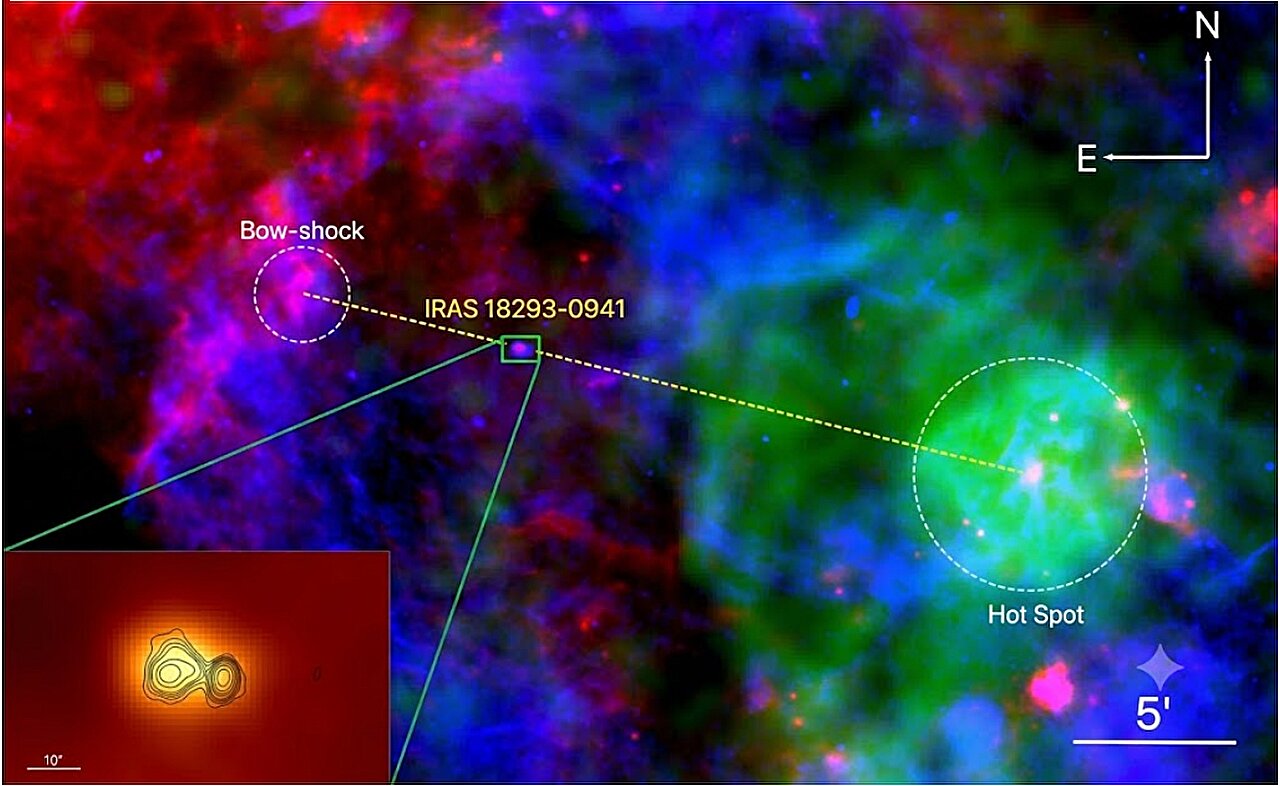
MeerKAT radio observations reveal an extended, edge-brightened structure aligned with the compact VLA and VLBI jet. Rather than filling the structure uniformly, the radio emission mainly traces its outer boundaries, consistent with a jet-inflated cocoon.
The two sides of the system look markedly different.
On the western, receding side, the radio emission contains a localized brightness enhancement interpreted as a possible terminal hotspot. Its radio spectrum is clearly non-thermal, with a spectral index of −0.7 ± 0.1, consistent with synchrotron emission from particles accelerated in a shock.
The same region is associated with Hα emission and far-infrared emission at 70 micrometers. The combination is consistent with ionized gas and warm dust around a shock where the jet encounters its surroundings.
The researchers also find faint Hα filaments along portions of the larger radio structure. These features are spatially associated with the boundaries of the radio cocoon and are interpreted as evidence for shock fronts produced by the expanding jet-driven structure.
The eastern, approaching side is different. It lacks a comparably compact terminal hotspot and instead forms a broader, more diffuse radio structure. The authors interpret that difference as evidence that the two jets are encountering environments with different densities.
On the western side, the jet appears to encounter a denser region that confines the flow and produces a compact interaction zone. On the eastern side, the lower external pressure allows the jet material to expand more laterally, producing a wider and less confined structure.
A weaker non-thermal radio feature along the extrapolated eastern jet direction may indicate another bow shock, although the evidence is less developed than for the western hotspot.
The observations therefore point to a strong density gradient around the system rather than identical conditions on both sides of the binary.
One jet appears to hit a molecular cloud
The researchers connect the western interaction region with a molecular cloud identified through CO observations.
A cloud at Galactic coordinates (21.97, −0.29) has a kinematic distance of about 3.6 kiloparsecs. Its densest emission is spatially close to the proposed terminal interaction region of the receding jet.
Because the observed radio, infrared and Hα structures indicate an interaction between the jet and dense material, the researchers adopt the cloud’s kinematic distance as the fiducial distance to IRAS 18293−0941.
That distance is not directly established by Gaia. The Gaia parallax is formally negative, and earlier estimates had placed the system at roughly 8–9 kiloparsecs based largely on its extreme extinction. The researchers argue that much of the extinction is intrinsic to the system, making the earlier distance estimate less compelling. They also note that moderate changes in the adopted 3.6-kiloparsec distance would not qualitatively alter their conclusions about the jet orientation, environmental interaction or particle acceleration.
The cloud is important for another reason.
A dense target can provide material for relativistic protons escaping from the jet to collide with. Such proton-proton interactions can produce charged pions, whose subsequent decay generates high-energy gamma rays.
That provides a possible physical link between the jet and the nearby ultra-high-energy gamma-ray source LHAASO J1831−1007u*.
The proposed connection to LHAASO
The spatial relationship between the jet termination region, the molecular cloud and LHAASO J1831−1007u* motivates the researchers’ proposed association.
The LHAASO source lies in a crowded region that also contains other high-energy sources, including HESS J1831−098 and 3HWC J1831−095. The LHAASO designation itself carries an asterisk because of potential source confusion.
The Fermi-LAT data add an important qualification. After the researchers removed the contributions of two nearby pulsars using pulsar gating, the GeV source 4FGL J1830.8−0947 remained significant. But its revised position excludes IRAS 18293−0941 and is offset from the molecular cloud. The authors therefore state that this Fermi source could be unrelated to the system.
The proposed connection is instead focused on the higher-energy emission and the physical geometry of the jet-cloud interaction.
The receding jet appears to terminate in or near dense molecular material. In the proposed scenario, relativistic protons accelerated at that termination region escape into the cloud, where collisions with the dense gas produce gamma rays.
The researchers describe the cloud as an efficient target for this process and suggest that IRAS 18293−0941 could be a contributor to the ultra-high-energy emission observed in the region. They do not present the association as an independently established identification of the LHAASO source.
A model links the radio through PeV emission
To test whether the proposed picture can account for the observations as a whole, the researchers construct a broadband spectral-energy-distribution model.
The model assumes a 10-solar-mass black hole accreting from a massive companion at a rate of 2.2 × 10⁻⁶ solar masses per year. The companion is assigned an effective temperature of 4.5 × 10⁴ kelvin and a radius of 2 × 10¹² centimeters, or about 27 solar radii.
The binary is embedded in a dusty shell with an inner temperature of 2,400 K and an outer temperature of 45 K. The model treats the shell as two layers that absorb and reprocess radiation from the central system.
The assumed jet has a kinetic power of about 2 × 10³⁹ erg per second, a velocity of 0.75 times the speed of light, a Lorentz factor of 1.51 and a semi-opening angle of about 6 degrees. Its characteristic modeled length is 10²⁰ centimeters.
Near the binary, the jet is assumed to encounter the dusty shell and form a recollimation shock at about 3 × 10¹⁴ centimeters from the black hole. The model uses a magnetic field of 0.1 gauss at this acceleration region.
Farther out, the jet terminates in a reverse shock. There the model adopts a magnetic field of 100 microgauss and an ambient density of 0.1 particles per cubic centimeter.
The modeled system is assigned an age of 5 × 10⁴ years. The authors emphasize that the adopted jet and shock parameters are plausible time-averaged values and do not necessarily represent the present-day dimensions of the radio lobes. They allow for recent episodic activity or an extended jet that is not currently visible.
The molecular cloud in the model has a characteristic density of about 50 particles per cubic centimeter and a radius of about 40 parsecs. The microquasar is placed about 60 parsecs from the cloud’s center.
Cosmic rays escaping from the terminal shock are allowed to propagate into the cloud. Their diffusion is described using a diffusion coefficient proportional to the square root of particle energy, with a value of 10²⁶ square centimeters per second at 10 GeV.
Within this framework, different parts of the observed spectrum arise from different regions.
Synchrotron emission from the recollimation and reverse shocks accounts for the radio emission. The dusty shell produces the infrared emission. Thermal radiation from the colliding-wind region accounts for the X-rays. In the model, very-high-energy emission comes primarily from inverse-Compton scattering at the recollimation shock, while the ultra-high-energy component comes from proton-proton collisions in the molecular cloud followed by pion decay.
The resulting model reproduces the broadband spectral-energy distribution assembled from radio, optical, infrared, X-ray and gamma-ray observations.
The researchers therefore use the combined observational and modeling evidence to identify IRAS 18293−0941 as a compelling Galactic microblazar candidate. The proposed interpretation depends on several components of the scenario, including the low viewing angle, relativistic jet, dense environment, jet-cloud interaction and the association with the nearby high-energy emission.
The observed evidence also leaves specific parts of the picture open. The source’s exact distance is not directly measured by Gaia, the stellar parameters remain uncertain because of the heavy extinction, the proposed terminal hotspot requires further study, and the nearby gamma-ray region contains multiple potential sources and source-confusion concerns.
The study was published in Astronomy & Astrophysics.