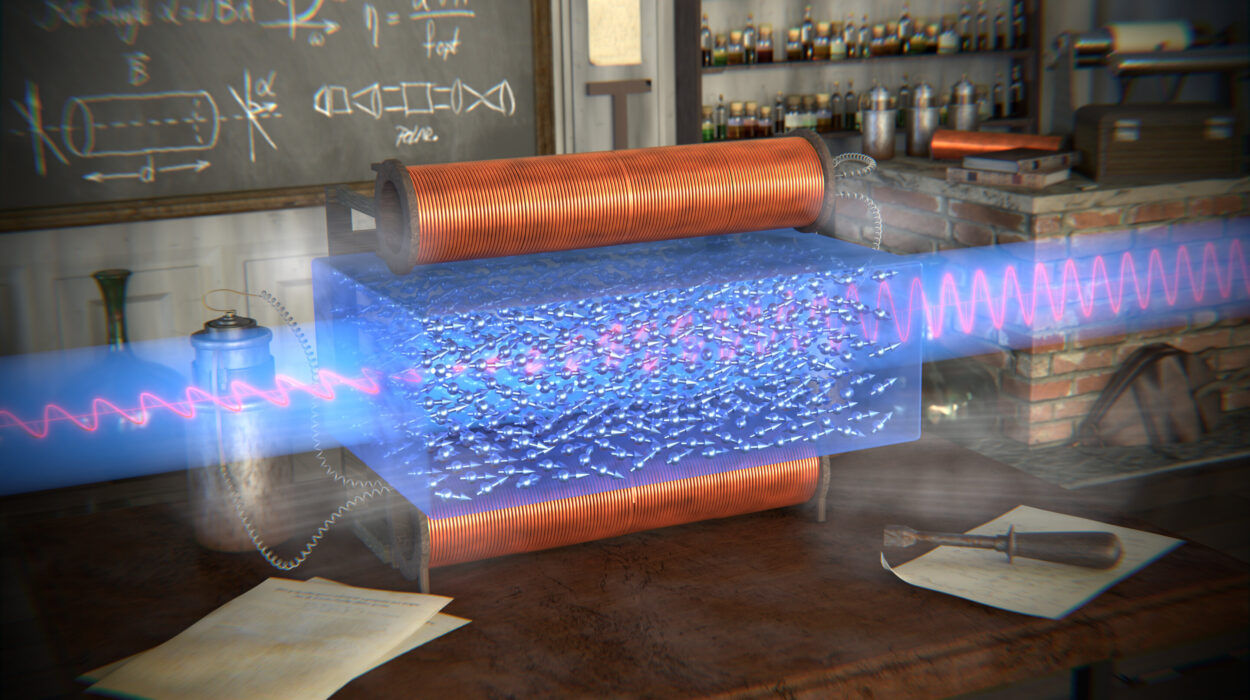
For the first time, researchers have directly recorded individual quantum jumps in sound, watching a tiny mechanical resonator switch between two discrete energy states as its vibration faded.
In everyday life, a vibrating object appears to slow down continuously. A struck bell, for example, gradually becomes quieter until it stops. At the quantum level, however, vibrational energy can change in distinct steps.
A team led by Stanford physicist Amir Safavi-Naeini has now recorded one of those steps in real time. The experiment tracked a mechanical resonator as its vibrational energy changed from an energy state of 1 to 0.
The quantum unit of sound is called a phonon. Unlike a photon, which is a quantum unit of light, a phonon represents the coordinated motion of a large group of atoms.
Quantum jumps have been theorized since the early 1900s. Scientists demonstrated them in trapped ions in 1986 and later in photons in 2007. Evidence for quantum jumps in sound had appeared in earlier experiments, but individual phonons had not previously been observed making these jumps in real time.
The resonator had to keep ringing
The mechanical resonator is small enough to be fabricated using chipmaking techniques but large enough to be seen with a microscope. Its size also makes it possible to place many resonators on a single chip.
The key to the experiment was how long the resonator could continue vibrating. It behaves like a microscopic tuning fork and can ring for about two milliseconds. If an ordinary tuning fork had the same ability to sustain its vibration, it would ring for several hours.
That extended ring time gave the researchers an opportunity to take hundreds of readings during a single vibration. Those measurements allowed them to determine when the vibration disappeared and the resonator made its transition from the energy state of 1 to 0.
A qubit acted as the detector
Watching a quantum system without disturbing it is a persistent challenge in quantum engineering. The Stanford researchers paired the mechanical resonator with a superconducting qubit, an electrical circuit that can store quantum information and act as a detector.
Takuma Makihara and Erik Szakiel, the study’s co-first authors, developed methods for connecting the two systems without damaging either one.
During the resonator’s roughly two milliseconds of vibration, the qubit repeatedly checked whether the phonon was in the energy state of 1 or 0. Those repeated measurements made it possible to identify the moment of the quantum jump.
Safavi-Naeini said the observation provides a basis for developing quantum technologies that use sound. He also said that seeing quantum behavior in vibrating objects is a prerequisite for operations used in quantum computing and sensing.
Possible uses remain under development
The researchers describe the work as a foundational first step. Detecting quantum jumps in sound could potentially help with error correction in quantum computing, where fragile quantum states can produce errors before a calculation is complete. In many quantum computing architectures, a quantum jump represents an error, while detecting when one occurs has been difficult.
The resonator and qubit combination could also be used for highly precise sensing because of its small size and sensitivity. Safavi-Naeini’s team is working with physicist Michael Roukes’ team at Caltech on using the platform to detect and identify proteins within cells.
The researchers also said the work could eventually contribute to devices that use sound, including smartphones and other technologies. Szakiel said the experiment demonstrates fine control over sound and could lead to improvements in devices that rely on sound as a fundamental technology.
The study was published in Science.