High-energy proton collisions at CERN are being used to look for some of the most unusual objects allowed by theories beyond the Standard Model: microscopic black holes and electroweak sphalerons. Using 138 inverse femtobarns of proton-proton collision data recorded by the CMS detector from 2016 through 2018, the analysis found no significant excess of events attributable to either phenomenon. Instead, it used a new way of measuring how different collision events are from one another, combined with machine learning, to place stronger limits on several models of microscopic black holes and sphaleron transitions.
Black holes are normally associated with enormous astronomical objects, but the possibility of making extremely small black holes in particle collisions has been considered in theories with additional spatial dimensions.
Under ordinary four-dimensional physics, the energy available in a 13-TeV collision at the Large Hadron Collider would have to be confined within an extraordinarily tiny region to form a black hole. The paper estimates the corresponding Schwarzschild radius for 13 TeV to be about 10⁻⁵⁰ meters, far smaller than the Planck length of about 10⁻³⁵ meters. On that basis, the LHC could not produce black holes if no physics beyond the Standard Model were involved.
The situation changes in models containing more than three spatial dimensions. In these models, the relationship between mass and Schwarzschild radius is modified by the number of extra dimensions and by a higher-dimensional Planck scale. For representative choices of those parameters, the paper gives a Schwarzschild radius of roughly 10⁻²⁰ meters for a 13-TeV object, comparable to the distance scale associated with the uncertainty principle at that energy. Under those assumptions, microscopic black holes could therefore fall within the LHC’s reach.
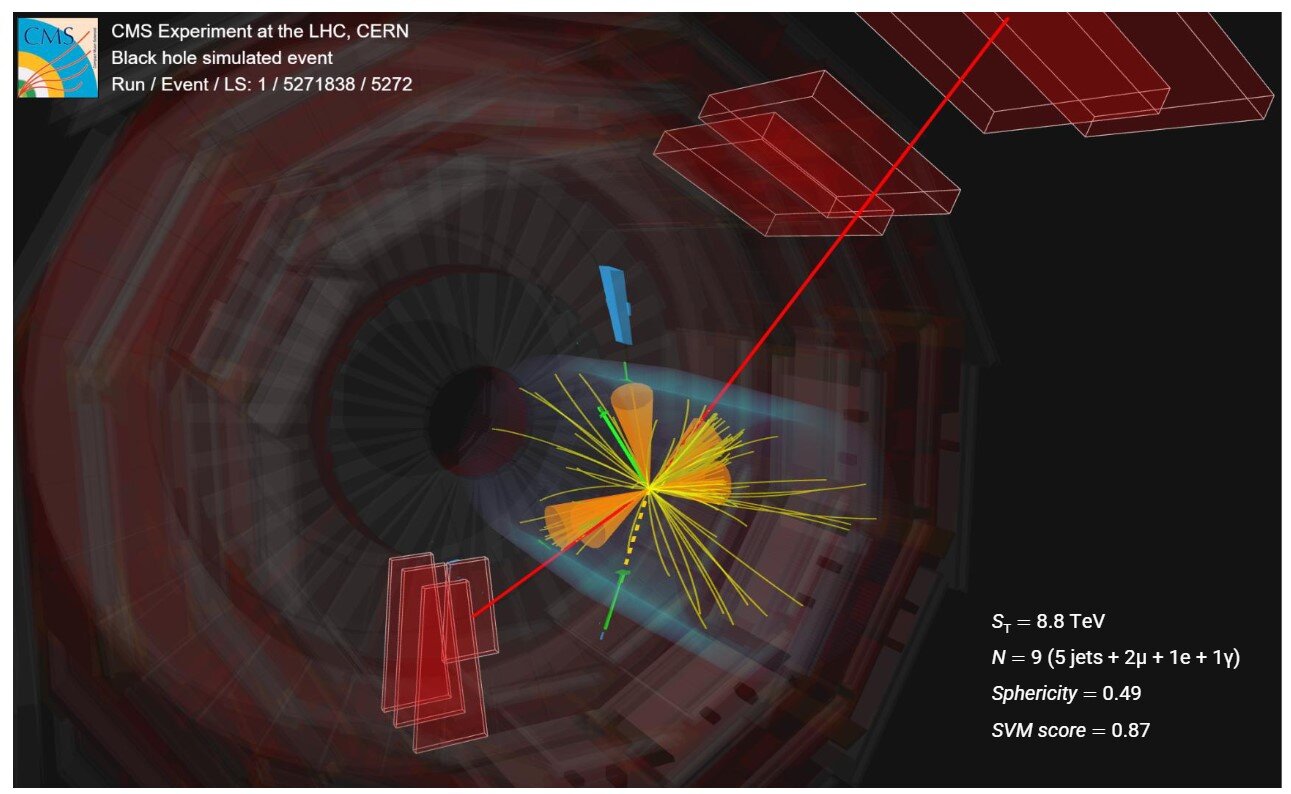
Such an object would not remain intact for long. The analysis assumes that a microscopic black hole would undergo Hawking radiation and rapidly decay into many energetic particles. In the CMS detector, those products could appear as jets, leptons and missing momentum. The resulting events would tend to be relatively isotropic and contain many objects, but those characteristics can also occur in ordinary high-multiplicity Standard Model collisions. Distinguishing the two requires a way to separate rare signal-like events from a much larger background.
A second exotic process
The analysis also searches for electroweak sphaleron transitions.
Sphalerons are unstable, finite-energy configurations in electroweak theory that connect different topological vacuum states. A transition changes the Chern-Simons number of the electroweak field configuration. In the processes considered here, such transitions violate baryon and lepton number while conserving their difference, B − L. The paper notes that this mechanism can explain the matter-antimatter asymmetry problem.
The final states expected from sphaleron transitions can resemble those from microscopic black-hole evaporation, with many energetic particles emerging from the collision. That makes it possible to use similar analysis techniques for both searches.
For the sphaleron search, the analysis considers different probabilities for a change in Chern-Simons number. The parameter p(N₍CS₎) represents the probability of a transition with ΔN₍CS₎ = 1, with samples considered at 0%, 50% and 100%. At the 50% setting, half the simulated events have ΔN₍CS₎ = −1 and half have ΔN₍CS₎ = 1.
Turning collision events into distances
The distinctive feature of the analysis is how it represents a collision event.
Rather than relying only on individual variables, the researchers used a mathematical representation of the phase space of scattering events. An event containing N objects such as jets, photons and leptons can be represented on a phase-space manifold that is described as the product of an (N − 1)-simplex and a (2N − 3)-dimensional hypersphere. For this analysis, N was set to 30. Events containing fewer objects were completed with zero-valued entries, a procedure called zero-padding.
This representation allows a distance to be assigned between two collision events. The distance combines a contribution from the simplex and another from the hypersphere, with a reweighting factor that defines the relative contribution of the two components. The paper describes this as a physically meaningful phase-space distance between events.
To see how the method behaved, the researchers calculated pairwise distances among 10,000 simulated events in each category. The signal sample consisted of a mixture of black-hole mass points using the B1 model with two extra dimensions, while the background consisted of QCD multijet events. Events from the background generally had smaller distances from one another than comparisons involving signal events, although the resulting matrix was difficult for a person to interpret directly.
That is where machine learning entered the analysis.
A support vector machine separates the event populations
The researchers used a support vector machine, or SVM, to classify events according to their phase-space distances. An SVM searches for a boundary that separates signal from background in the relevant representation. Here, the method was particularly suited to the analysis because the input was already defined by a geometric distance between physical collision events.
The SVM output was calibrated using Platt scaling so that the result could be expressed as a signal-like score. The analysis then optimized the selection using the Punzi figure of merit and found that a single threshold of 0.63 could be used across the black-hole mass points.
Changing that threshold between 0.5 and 0.7 altered the signal yield by 4% to 25%, depending on the assumed black-hole mass. The authors emphasize that the underlying distance measure is physically meaningful, which makes the resulting classification more interpretable than approaches based on some other machine-learning representations.
The SVM was trained and studied using simulated samples. The black-hole samples covered different assumptions about rotation, energy and momentum loss, and the way the black hole evaporates.
Two event generators were used for these simulations. BLACKMAX supplied three model variants: nonrotating black holes, rotating black holes without graviton emission, and rotating black holes that include energy and momentum loss. CHARYBDIS2 supplied six additional variants, including rotating and nonrotating black holes, different evaporation models, a conservative model incorporating impact-parameter effects, and models involving stable or evaporating remnants.
Sphaleron events were simulated with the BARYOGEN generator. The generator neglects gauge bosons, which the paper describes as the conservative choice. QCD multijet events were simulated with MADGRAPH at leading order using MLM matching and CP5 tunes to help develop the event-selection strategy and train the machine-learning models.
The search also required spherical, energetic events
The machine-learning score was not the only selection variable.
All reconstructed objects had to satisfy standard quality requirements and have transverse momentum of at least 70 GeV. Events were then required to contain more than three reconstructed objects. Because the expected signal events were highly spherical, the analysis also imposed a sphericity requirement of greater than 0.1.
Sphericity is calculated from the transverse momenta of the objects in an event. It provides a measure of how broadly those momenta are distributed rather than being concentrated along a particular direction. In this analysis, it helped select events with the spherical characteristics expected for the targeted signals.
Another central quantity was Sₜ, the scalar sum of the transverse momenta of the reconstructed objects together with the missing transverse momentum. The analysis examined the relationship between Sₜ and the SVM score after the sphericity requirement. Simulated black-hole events and QCD multijet background showed strong separation in this two-variable space across the models considered.
The background was estimated from collision data
A major challenge was predicting the number of ordinary QCD events in the high-Sₜ region where a signal might appear.
Rather than relying on the precise modeling of the high-Sₜ tail in the QCD simulations, the analysis used the collision data themselves to construct a background prediction. Events were divided into a FAIL region and a PASS region according to whether their SVM score was below or above the 0.63 selection threshold.
The researchers binned the Sₜ distribution and performed a simultaneous fit in the two regions. The expected number of background events in each PASS bin was obtained from the corresponding FAIL yield multiplied by a PASS-to-FAIL ratio modeled as an exponential function of the bin index.
The method was tested in a validation region created by reversing the sphericity requirement, using S < 0.1 while keeping the other selections unchanged. In that region, the predicted background agreed with the data with pulls centered around zero and with symmetric deviations. The paper describes the search as statistically limited, with systematic uncertainties contributing at the few-percent level.
When the final PASS and FAIL distributions were examined, the analysis found no significant excess or deficit relative to the predicted background.
Black-hole masses below 9.0 to 11.4 TeV are excluded in the tested models
Because the data did not contain a significant excess, the analysis set model-dependent 95% confidence-level upper limits on the cross sections of the black-hole models considered.
For one example, the B1 model with a higher-dimensional Planck scale Mᴅ of 2 TeV produced an observed excluded black-hole mass of 11.4 TeV. The theoretical cross section used for comparison included the NNPDF3.1 parton distribution functions.
The full set of black-hole models produced excluded masses ranging from 9.0 to 11.4 TeV, depending on the assumed higher-dimensional Planck scale and other model parameters. The paper reports that these limits extend previous exclusions by 1 to 1.6 TeV.
The limits were not identical across the theoretical scenarios. The analysis considered different numbers of extra dimensions, with n = 2, 4 and 6 represented in the summary plots, as well as different assumptions about black-hole rotation, energy and momentum loss, evaporation and possible remnants. The resulting excluded black-hole mass therefore depends on which model is being tested.
The same results can also be interpreted in terms of the number of extra dimensions excluded within these models. For most of the parameter combinations examined, the paper reports that only one extra dimension remains allowed. Values above six in the corresponding plot are treated as overflow because the simulations did not extend beyond six extra dimensions.
Sphaleron transitions also face tighter limits
The analysis separately interpreted the data in terms of electroweak sphaleron models.
Instead of directly reporting a sphaleron discovery, the search placed upper limits on the pre-exponential factor that enters the predicted sphaleron cross section. The limits were evaluated for the three assumed values of p(N₍CS₎): 0, 0.5 and 1, and as a function of the sphaleron transition energy.
Across the sphaleron models considered, the summary gives limits on the pre-exponential factor from 5 × 10⁻⁴ to 2 × 10⁻³. The paper describes these as a roughly tenfold increase in sensitivity relative to the previous results.
The sphaleron result, like the black-hole result, is therefore a constraint rather than an observation of the proposed process. The absence of a significant excess in the selected collision sample is what allows the analysis to set those upper limits.
The study combines 138 inverse femtobarns of 13-TeV CMS collision data with a new event representation based on distances in phase space and a support vector machine classifier. Within the black-hole models examined, it excludes microscopic black holes below 9.0 to 11.4 TeV, depending on the assumed parameters, while the sphaleron interpretation constrains the pre-exponential factor to between 5 × 10⁻⁴ and 2 × 10⁻³.
The study was published in Progress in High Energy Physics.