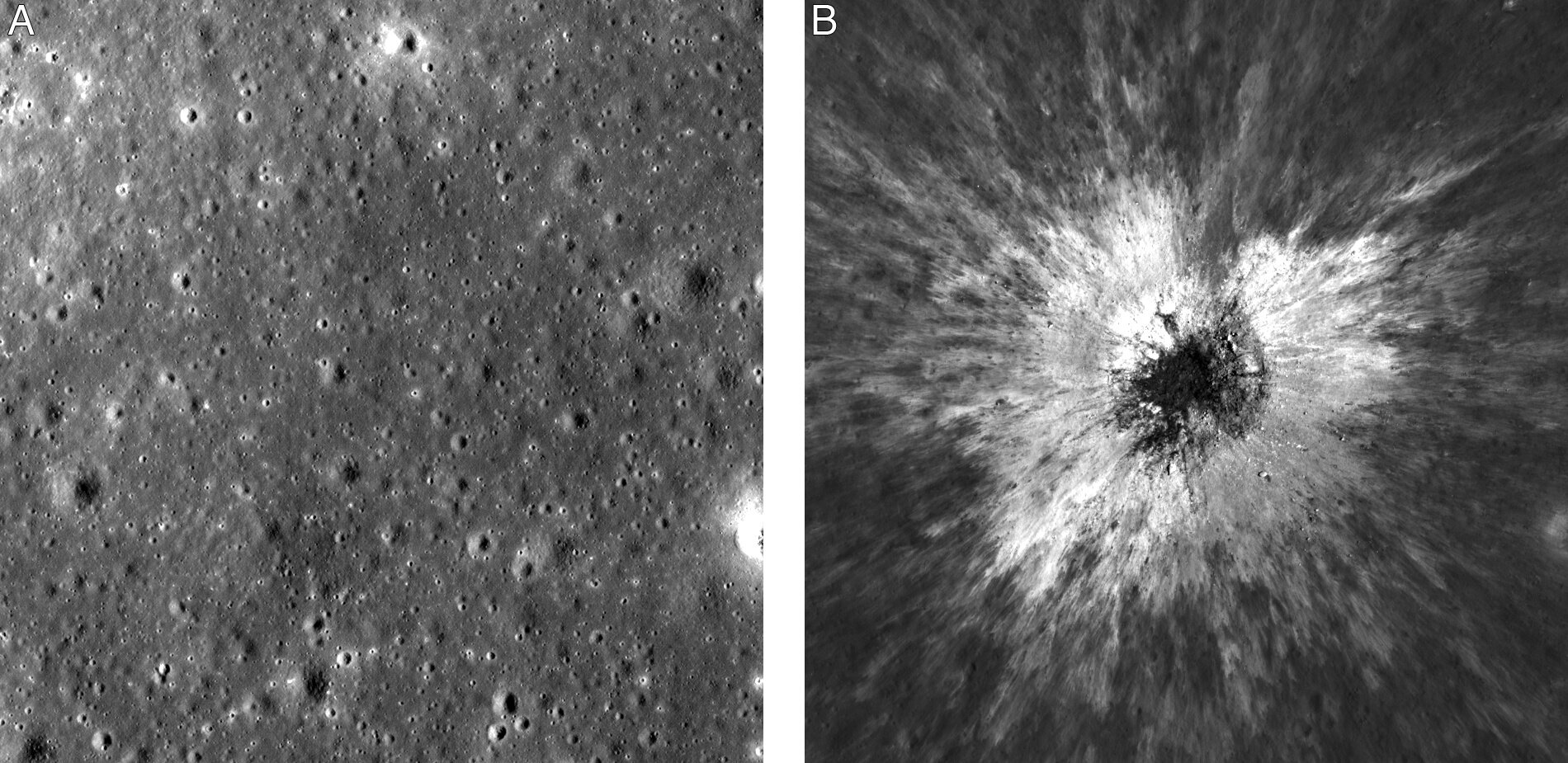
In the spring of 2024, a small cometary or asteroidal fragment struck the Moon and carved a 222-meter-wide crater into the surface near the edge of Mare Crisium. The crater itself is remarkable for its size, but the impact left a much larger footprint: subtle changes in the lunar surface can be detected more than 120 kilometers away, or more than 1,000 crater radii from the new scar.
The crater, named McGetchin crater, was identified not from a single image but by comparing repeated observations of the Moon. The Lunar Reconnaissance Orbiter Camera’s Wide Angle Camera images the entire lunar surface about once a month, allowing researchers to compare images acquired before and after an impact under similar lighting conditions. A routine temporal comparison in fall 2025 revealed that a previously absent crater had appeared at 1.3536°N, 67.1765°E.
The event is the largest contemporary impact crater discovered anywhere in the Solar System, according to the researchers. Before McGetchin crater, the largest contemporary lunar impact crater identified in this way was about 70 meters across. The new crater therefore provides an unusually large and fresh example of an impact that can be examined with both before-and-after imagery and high-resolution measurements of its shape and surroundings.
The crater formed at a complicated boundary
McGetchin crater sits just inside the outer rim of the ancient Crisium basin, near a geological boundary between lunar highland material and mare material. The site is about 330 kilometers from the edge of Mare Crisium, where relatively thin basaltic lava flows had flooded irregular highland terrain around the southeastern flank of the 7.2-kilometer-wide Dubyago N crater.
The terrain was already complicated before the impact. Mare Spumans lies about 20 kilometers west of the new crater and roughly 1,000 meters lower. Nearby mare deposits also preserve evidence of ancient basalt flows that were diverted by changes in topography. A local high point interpreted as an ancient eruptive center lies about 23 kilometers east-southeast of McGetchin crater.
That setting matters because the impact did not strike a simple, uniform layer of rock. The researchers interpret the target as a mixture of thin mare deposits and underlying highland regolith, with the composition changing with depth. The crater therefore provides an opportunity to examine how differences in the material beneath the surface affect the shape of a newly formed crater and the way its ejecta is distributed.
A fresh crater 222 meters across
The researchers measured the new crater using high-resolution images and a three-dimensional terrain model made from stereo observations by the Lunar Reconnaissance Orbiter Camera’s Narrow Angle Camera. The new data have a horizontal sampling of about 3 meters for the terrain model, with better than 1.5-meter vertical precision, while accompanying orthomosaics were sampled at 1 meter per pixel. They compared those measurements with a pre-impact terrain model from Japan’s Kaguya spacecraft, which had 22-meter horizontal sampling and about 3-meter vertical precision.
McGetchin crater is not perfectly circular. Its diameter ranges from 213 meters along one direction to 231 meters along another, giving an average diameter of 222 meters. The western half is wider than the eastern half, with fitted diameters of about 230 and 214 meters, respectively. The researchers found that the centers of those two fitted arcs were within only a few meters of one another, indicating that the asymmetry is not simply the result of the two halves being displaced from each other.
The crater is about 43 meters deep, giving it a depth-to-diameter ratio of 0.19. Its interior is funnel-shaped, with a small hummocky floor measuring roughly 15 by 30 meters. A 16-by-32-meter slump boulder lies about 10 meters below the eastern rim. The crater walls have a median slope of 24 degrees, with a maximum measured slope of 41 degrees over a 12-meter baseline.
The raised rim is about 7.7 meters high on average, with a standard deviation of 2.0 meters across 709 measurement points. That closely matches the 7.8-meter rim height predicted by an existing relation. The maximum relief reaches 13 meters because of a large boulder perched on the southern rim. Removing the boulder reduces the maximum rim height to 10 meters.
The researchers estimated that about 4.6 meters of ejecta should have accumulated at the rim. Subtracting that estimated ejecta thickness from the measured rim height gives an estimated structural uplift of about 3.1 meters, or roughly 40% of the measured rim height.
The energy involved was estimated at 6.5 × 10¹⁰ kilojoules, assuming an impactor density of 3 grams per cubic centimeter and an impact velocity of 15 kilometers per second. That is more than an order of magnitude greater than the estimated energy of the earlier 70-meter crater event. Existing crater-production models indicate that an impact of this magnitude should occur on the Moon only about once every 132 years.
The impact exposed different materials
The fresh crater also provides a look at material that had been buried beneath the older lunar surface.
Images taken under favorable illumination revealed a more than sevenfold range in reflectance inside the crater, from an I/F value of 0.045 to 0.34. The rough, hummocky deepest parts are especially dark, with reflectance below 0.090. Similar dark material appears as patches on the southern crater wall.
The darkest material has a reflectance even lower than distant mature mare material. The researchers interpret it as material enriched in glass produced when impact-generated material was rapidly quenched. They suggest it may have a mare origin. This remains an interpretation of the observed reflectance rather than a direct compositional measurement.
There is no visible pool of impact melt inside the crater. The researchers say this is consistent with an “impact veneer” type of melt emplacement.
Outside the crater, the ejecta blanket has a different reflectance pattern. Material with reflectance above 0.16 is concentrated mainly within about two crater radii of the rim. Its outer edge ranges from 126 to 360 meters from the crater center, with a median extent of 258 meters. The researchers interpret this boundary as the approximate edge of the continuous ejecta deposit.
A narrow tongue of intermediate-reflectance material extends from the northern rim. It lies between patches of much brighter ejecta and aligns with the direction of the crater’s largest diameter. The researchers suggest that this pattern could contain information about the impact direction or about a discontinuity in the properties of the target material. They did not, however, establish its origin. They also found no definitive evidence of a grazing impact, such as the elliptical crater shape or ejecta pattern expected from a strongly oblique impact.
Ejecta traveled far beyond the crater
The most extensive changes appeared only after the researchers combined hundreds of observations from the Wide Angle Camera.
Before the impact, the camera had accumulated an average of 540 observations for every pixel in the target region. Another 60 observations were available after the impact. The researchers photometrically normalized and co-registered the images and combined them into mosaics, increasing the signal-to-noise ratio compared with individual observations.
Dividing the post-impact mosaic by the pre-impact mosaic exposed reflectance changes of about 1% that would otherwise be difficult to see. The analysis revealed two broad disturbance patterns. A distal high-reflectance zone extends roughly 15 kilometers from the impact site. Beyond it is a broader, discontinuous low-reflectance zone that extends more than 120 kilometers, with localized disturbances reaching about 140 kilometers.
The patterns occur at distances exceeding 1,000 crater radii. Some of the most distant disturbances have a delicate, lace-like appearance. The researchers propose that clumps of ejecta separated during the longer flight times required to reach these distant locations. When the sparse particles landed, they churned the uppermost surface, leaving a detectable optical signature. Closer to the crater, where ejecta was more concentrated, those effects would overlap rather than producing the same separated pattern.
Similar distal disturbance zones have been observed around other young lunar craters. The researchers point to an approximately 70-meter crater formed around October 2012, where a low-reflectance disturbance extended roughly 100 kilometers. The new crater therefore provides another example of a surface effect extending far beyond the continuous ejecta blanket.
The distant patterns may come from the earliest stage of impact
The researchers interpret the two broad disturbance zones as possible products of the vapor-rich phase of the impact. In this interpretation, material produced early in the collision formed a rapidly expanding plume that traveled at a low angle across the lunar surface. The plume could have mobilized fine particles and modified the texture of the uppermost regolith, changing how the surface reflected light.
The authors distinguish this process from the more familiar ballistic ejecta that forms rays and the continuous ejecta blanket. They suggest that the distal patterns were produced during the contact-and-compression stage of the impact, when material is initially accelerated from the impact site, rather than during the later excavation stage.
One feature makes that interpretation more difficult.
About 8 kilometers west of the crater is a ridge that rises roughly 700 meters above the crater and then falls steeply toward Mare Spumans. At a location about 14 kilometers from McGetchin crater, the mare surface is up to 2.5% less reflective than it was before the impact. The change is similar to other parts of the distant low-reflectance zone, despite the ridge potentially shielding the surface from low-angle ejecta.
If ballistic particles had produced the disturbance at the base of the ridge, they would have needed to travel at an ejection angle greater than 13 degrees to clear the ridge and reach its base. Material reaching the more distant discontinuous zone would have needed an angle greater than 7 degrees. Those angles are higher than the very low ejection angles conventionally associated with jetting.
The researchers discuss several possible explanations. An elongated impactor could have produced a wider range of ejection angles and velocities. Collisions between escaping gas and particles might also have dispersed trajectories. Another possibility is that two different ejection regimes produced the closer continuous disturbance and the more distant discontinuous zone. The paper does not establish which explanation is correct. Instead, the authors argue that detailed modeling of the 10-kilometer-to-more-than-100-kilometer ejecta patterns could help constrain the poorly understood details of this early stage of impact formation.
The crater’s shape records the buried terrain
The impact also produced an uneven distribution of boulders and ejecta that the researchers connect to the geological boundary beneath the crater.
Boulder concentrations occur on opposite sides of the northern ejecta tongue and in several arcs south of the crater. The two largest boulders are on the southern rim and southeastern flank. They measure 13 by 9 by 3 meters and 8 by 7 by 2 meters, respectively. Shadow measurements gave heights of about 3.2 ± 0.4 meters and 1.5 ± 0.4 meters.
An existing power-law relation for maximum boulder size around lunar and terrestrial craters predicts a maximum boulder diameter of about 8 meters for a crater of this size, with a range of 4 to 12 meters. The average diameter of the largest McGetchin boulder is about 11 meters, which the researchers describe as consistent with that prediction. Most of the boulders larger than 4 meters, 86% of the 25 measured in that category, occur inside the boundary defined by the 0.16 reflectance unit.
Small patches of unusually low reflectance also appear downhill from several large boulders. Their origin is uncertain. The researchers propose three possible explanations: a boulder may have blocked trailing granular ejecta during emplacement, an ejected boulder may have excavated darker material when it landed, or a late-stage, low-angle stream of brighter material may have been blocked by the boulder. Each possibility would imply a different sequence or mechanism for ejecta emplacement, but the observations do not distinguish among them.
The crater’s western side is wider than its eastern side. The researchers interpret this difference as evidence that the impact encountered looser granular regolith on the western side and a more coherent subsurface lava flow on the eastern side. They further interpret the intermediate-reflectance material southeast of the crater as a mixture of highland and mare material excavated from depth.
That interpretation fits the reconstructed subsurface structure. The authors propose that thin mare flows had accumulated against the highland flank of Dubyago N crater and that an approximately 10-meter-thick regolith layer developed over the ancient mare surface. Vertical and horizontal mixing would have produced a mixed highland-mare layer above and around the basalt. The crater’s estimated excavation depth of about 20 meters could therefore have reached both materials.
The highest boulder density occurs within the same southeast ejecta unit that has intermediate reflectance. The researchers interpret that as consistent with bouldery mare material having been excavated from below the surface.
The impact erased much of an older crater record
Before McGetchin formed, the site was covered by heavily cratered Imbrian-aged mare material. The new impact provides a direct before-and-after test of how effectively a crater of this size can erase older surface features.
The largest preexisting crater inside the new crater’s eventual boundary was 40 meters across, yet no trace of it remains. Another large preexisting crater lay along the south-southwestern rim, where the new rim reaches its greatest height, and it too has disappeared from the post-impact surface.
Within the area extending from the new rim to the 0.16-reflectance boundary, only five of 103 preexisting craters measuring 6 to 12 meters across survived in identifiable form. Among larger craters measuring 12 to 48 meters, 12 of 35 survived. Every surviving crater is heavily degraded, and the largest surviving examples occur along an arc from roughly 170 to 280 degrees around the new crater.
The researchers use the same reflectance boundary and the survival of older craters to identify the approximate edge of the continuous ejecta. The median distance from the new rim to that boundary is 146 meters. An existing scaling equation predicts about 157 meters for a 222-meter crater, with an uncertainty range of −52 to +64 meters. The observed extent is therefore consistent with the expected continuous ejecta deposit.
Overall, the basic geometry of McGetchin crater also follows established scaling relationships for fresh lunar craters. Its depth-to-diameter ratio, rim height, largest ejected boulder and continuous-ejecta extent all fall within expected patterns. But its irregular rim and aligned ejecta and boulder features indicate that the target’s internal structure influenced the final shape and distribution of material.
The researchers ultimately interpret the 12-degree alignment of several features, including the southern boulder cluster, northern reflectance tongue, eastern slump boulder and southeastern low-reflectance ejecta zone, as a consequence of the impact straddling the mare-highland boundary. They note that traditional indicators of an oblique impact are absent, so the alignment is not attributed to a grazing impact.
The most distant disturbance remains the least settled part of the story. Reflectance changes more than 120 kilometers from the crater are consistent with high-speed jetting during the contact-and-compression stage, according to the authors, but the trajectories required to cross the nearby ridge do not fit neatly with the simplest picture of very-low-angle jetting. The researchers therefore leave the detailed mechanism open and identify the new observations as a way to improve models of that stage of lunar impacts.
The authors also point to the value of the site for future direct exploration. They state that a mobile surface asset could provide in-situ measurements of the crater and disturbed terrain, including surface properties relevant to the thermal anomalies known around some young lunar craters. Such measurements, they say, would provide additional information about the physical and thermal evolution of the upper regolith.
The study was published in Science Advances.