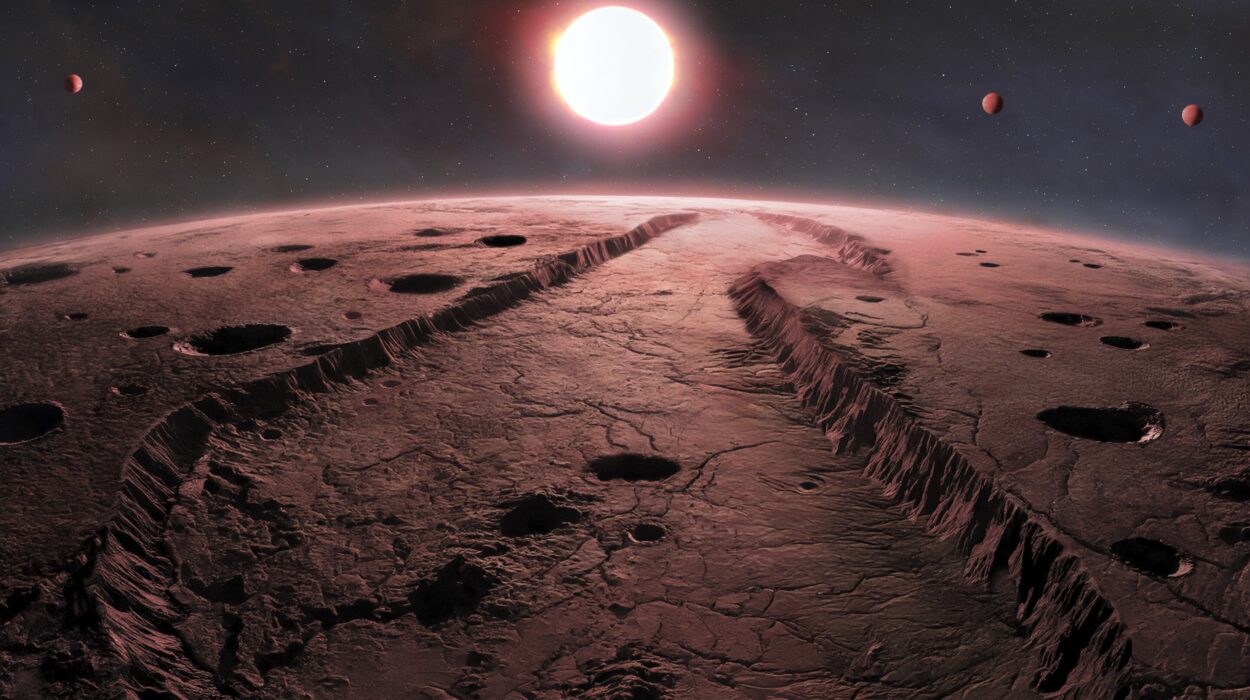
A giant planet orbiting a rapidly rotating A-type star is already crossing the edge of the star’s visible disk, and its path is changing measurably from year to year. Observations of the system show that the planet’s impact parameter, a measure of how far its transit path lies from the center of the stellar disk, increased from about 0.85 in 2019 to 0.93 in 2024. If that rate continues, the planet’s transits will disappear completely around the middle of 2033.
The planet, TOI-1355 b, was identified in observations from NASA’s Transiting Exoplanet Survey Satellite, or TESS, and followed up with ground-based telescopes and spectroscopy. It circles the star TOI-1355, an early A-type star with an effective temperature of about 8,660 kelvins, roughly 2.0 times the Sun’s mass and an estimated age of 0.37 billion years.
The planet completes an orbit in just 2.1702642 days. It is also unusually massive and large, with an estimated mass of 5.84 times Jupiter’s mass and a radius of 1.424 times Jupiter’s radius.
But the feature that sets TOI-1355 b apart is its orbit. Its measured eccentricity is 0.2203, meaning its orbit is noticeably elongated rather than nearly circular. The planet comes closer to its star at some points in its orbit and farther away at others.
The authors describe TOI-1355 b as one of the few known eccentric hot Jupiters orbiting hot stars. Before this work, the paper notes, only one other hot Jupiter around a hot star had been reported with an eccentricity above 0.1. Other known systems of this type had eccentricities consistent with nearly circular orbits.
That combination of a hot star, a close-in giant planet and a significantly eccentric orbit is important to the study because one proposed way of producing hot Jupiters involves first driving a giant planet onto a highly eccentric orbit and then shrinking and circularizing that orbit through tidal interactions.
The observations of TOI-1355 b do not directly establish that history. But the authors interpret the planet’s high eccentricity as evidence that it could be undergoing such high-eccentricity migration.
Four years of changing transit geometry
The changing transit path emerged from observations collected over several years.
TESS observed TOI-1355 in 2019, 2020, 2022 and 2024. The researchers also obtained transit observations with MuSCAT3, the RCO 40 cm telescope, the OACT 91 cm telescope and a 28-cm-class SCT telescope in Herges-Hallenberg.
The TESS measurements required additional processing because light from a nearby variable star contaminated the photometric aperture. The researchers identified and removed high-amplitude variability associated with that nearby source as well as longer-term components unrelated to the planet’s orbital signal.
They then modeled the complete light curve, including the planet’s transits, secondary eclipses and changes in brightness over the orbit. The model accounted for several sources of variation, including the planet’s thermal emission, reflected light, Doppler boosting and changes in the shape of the host star caused by the planet’s gravitational pull.
The transit geometry changed steadily in the fits. In the preferred cloud-free model, the impact parameter was 0.8531 in 2019, 0.8623 in 2020, 0.9040 in 2022 and 0.9275 in 2024.
An impact parameter near zero corresponds to a transit passing close to the center of the stellar disk. A value near one means the planet crosses close to the edge. TOI-1355 b was therefore already making a near-grazing crossing by the time of the 2024 observations.
The fitted rate of change was 0.01633 impact-parameter units per year, with an uncertainty of about 0.0008. The researchers interpret this systematic change as evidence of nodal precession, in which the orientation of the planet’s orbital plane changes over time.
The changing geometry is also consistent with the rapid rotation of the A-type host star. A rapidly rotating star is not perfectly spherical, and its resulting gravitational field can alter the orientation of a nearby planet’s orbit.
The authors calculated that, if the measured rate of change remains constant, the system entered the grazing-transit phase around the beginning of 2024 and the planet will no longer cross the stellar disk around the middle of 2033.
That projection depends on the assumption that the measured rate continues. The study does not establish that the rate must remain constant for the entire interval.
The orbit is eccentric, not simply tilted
The researchers also used the changing impact parameter to investigate the planet’s spin-orbit geometry.
Their calculations constrain the projected spin-orbit obliquity, λ, to either −76° to −5° or 104° to 175°. The corresponding true obliquity, ψ, is constrained to either 7° to 76° or 104° to 173°. The authors emphasize that ψ remains only loosely constrained.
The change in impact parameter alone does not provide a unique measurement of the three-dimensional orientation of the orbit. The researchers therefore point to Doppler tomography as a way to obtain a direct measurement of the projected obliquity and determine whether the planet’s orbit is close to polar, as has been found for several other hot Jupiters around rapidly rotating hot stars.
The study also found no evidence for transit-timing variations. A refined orbital period of 2.17026355 days was obtained from the measured transit times, and the individual transit times showed no detectable departure from the resulting linear ephemeris.
A planet that may still be losing its orbital eccentricity
The planet’s eccentric orbit provides another clue to its possible history.
TOI-1355 b orbits at a semimajor axis of about 0.0400 astronomical units. Because the planet’s orbit is elongated, its closest approach to the star is substantially different from its average orbital distance.
The authors argue that tidal deformation of the planet during these close approaches could be driving the orbit toward circularization. Under the assumption that the orbital angular momentum remains nearly conserved, they calculate that the eventual circularized semimajor axis would be about 0.0381 astronomical units.
The estimated circularization timescale depends strongly on the planet’s poorly understood tidal dissipation parameter, Qp. Using a value of 5 × 10^5, the researchers calculate a timescale of about 33 million years, somewhat shorter than the estimated stellar age of about 370 million years.
They therefore suggest two possibilities: the planet may have acquired its high eccentricity relatively recently, or its actual tidal dissipation parameter may be substantially higher than the value used in the calculation.
That leaves the evolutionary history unresolved. The measured eccentricity establishes the current orbital state, while the proposed high-eccentricity migration scenario remains an interpretation of how the planet reached that state.
The planet’s atmosphere changes across the observations
The same TESS phase curves also provided information about the planet’s atmosphere.
The researchers modeled the brightness of TOI-1355 b as it moved around its star, using separate day-side and night-side brightness temperatures and allowing the location of the hottest region to shift relative to the point directly facing the star.
In the preferred cloud-free model, the day-side brightness temperature at the planet’s semimajor-axis distance was estimated at 3,730 kelvins in 2019, 3,500 K in 2020, 3,700 K in 2022 and 3,440 K in 2024.
Those values are higher than the planet’s calculated equilibrium temperature of 2,740 ± 120 K. The authors say the difference could be associated with a thermal inversion caused by molecules such as titanium oxide or vanadium oxide, or with inefficient redistribution of heat from the day side to the night side. These are proposed explanations, not detections of those molecules.
The night-side estimates were more variable. The brightness temperature was 2,890 kelvins in 2019, 1,170 kelvins in 2020, 2,770 K in 2022 and about 2,710 K in 2024. The 2020 uncertainty was large, extending from roughly 370 to 2,010 K.
The researchers also found changes in the phase offset of the planet’s thermal emission. In the cloud-free model, the offset was −54.5° in 2019, −36.3° in 2020, −56.0° in 2022 and −34.4° in 2024. In particular, the 2020 and 2022 values differed by more than 3 standard deviations.
The authors identify a variable atmosphere as one possible explanation for those changing phase shifts. They do not establish that atmospheric variability is responsible.
The alternative model allowed the planet to reflect starlight from clouds. That model produced different day-side temperatures and albedos, but its Bayesian information criterion was 43 higher than that of the cloud-free model, so the researchers used the cloud-free model for their principal results. They also note that the high day-side temperatures would be expected to vaporize reflective clouds, which argues against the cloudy interpretation within their modeling assumptions.
The small residual fluctuations in the TESS phase curves, at roughly 100 parts per million, may also indicate unmodeled components of the planet’s brightness variation or limitations in the assumed temperature model.
Multiple observations support the planet itself
The planetary interpretation was tested against several possible sources of false transit signals.
The measured planet-to-star radius ratios in seven different photometric bands were consistent within 2 standard deviations. The researchers also used TESS photometry together with the contrast curve from speckle imaging with NESSI on the 3.5-meter WIYN telescope.
No companion star was detected in the NESSI images. Using those observations and the TESS light curve, the researchers calculated a false-positive probability of 1 × 10^−16 for an astrophysical scenario other than a planet orbiting the target star.
The high-resolution GAOES-RV observations from the 3.8-meter Seimei telescope provided 27 usable spectra across two observing epochs. The spectra were used to characterize the host star. The researchers attempted Doppler tomography, which could potentially reveal the planet’s path across the rotating stellar surface, but the signal-to-noise ratio was not sufficient to detect a planetary signature.
The stellar characterization instead produced a projected rotational velocity of 80.8 ± 2.7 kilometers per second, consistent with the star being a rapid rotator.
The researchers also searched for intrinsic pulsations from the A-type star because such variability could interfere with the transit measurements. After removing the planetary transit and phase-curve signals, they found no pulsations down to a 3σ amplitude limit of about 30 parts per million.
That non-detection meant that stellar pulsations were unlikely to have a substantial effect on the transit analysis.
The transit window is becoming narrower
Taken together, the observations trace a planet with a 2.17-day orbit, a mass of about 5.8 Jupiters, a radius of about 1.4 Jupiters and an eccentricity of about 0.22 around a rapidly rotating A-type star.
Its transit geometry is changing measurably. The planet moved from a relatively high-impact-parameter transit in 2019 to a nearly grazing transit in 2024, producing the measured nodal-precession signal.
The atmospheric measurements add another time-dependent feature. The fitted thermal phase offset changed between observing epochs, with the 2020 and 2022 values inconsistent at more than 3σ. The authors say continued observations could determine how those atmospheric parameters evolve.
For now, however, the most immediate geometric prediction comes from the transit itself. If the measured precession rate persists, the planet’s path will move completely off the stellar disk around the middle of 2033. The authors therefore identify continued photometric and atmospheric observations before that point as necessary for following the changing system.
The study was published in Publications of the Astronomical Society. of Japan.