A new study in Science Advances has narrowed down how the Moon’s enormous South Pole–Aitken (SPA) basin likely formed, pointing to a north-to-south impact by a 260-kilometer-wide differentiated object at around 13 km/s. The findings also suggest NASA’s planned Artemis III landing region near the Moon’s south pole could contain valuable lunar mantle material, offering a rare chance to sample deep interior Moon rock.
The Moon’s far side holds one of the solar system’s most extreme scars—and scientists are now closer to understanding exactly how it happened. By using high-resolution 3D simulations, researchers have reconstructed the violent event that carved out the South Pole–Aitken (SPA) basin, refining not just the impact direction, but also the likely size, structure, and speed of the object that created it.
That new clarity may directly influence where NASA looks for the most scientifically valuable samples during upcoming Artemis missions.
The Moon’s Biggest and Oldest Confirmed Impact Basin
Stretching more than 1,200 miles (2,000 km) across the lunar far side, the South Pole–Aitken basin is the Moon’s largest and oldest confirmed impact crater. Its enormous size makes it a key feature for understanding the Moon’s early history.
But for decades, the basin has raised a major question: why does it have such an unusual shape?
SPA is not just elliptical—it is distinctly tapered, with one end narrowing more than expected. That geometry has fueled debate about what direction the impactor traveled when it struck the Moon. Some evidence in the lunar crust has pointed toward a northward-moving impact, while other features—especially the basin’s shape—have suggested the opposite.
The new study argues the basin’s structure fits best with a southward trajectory.
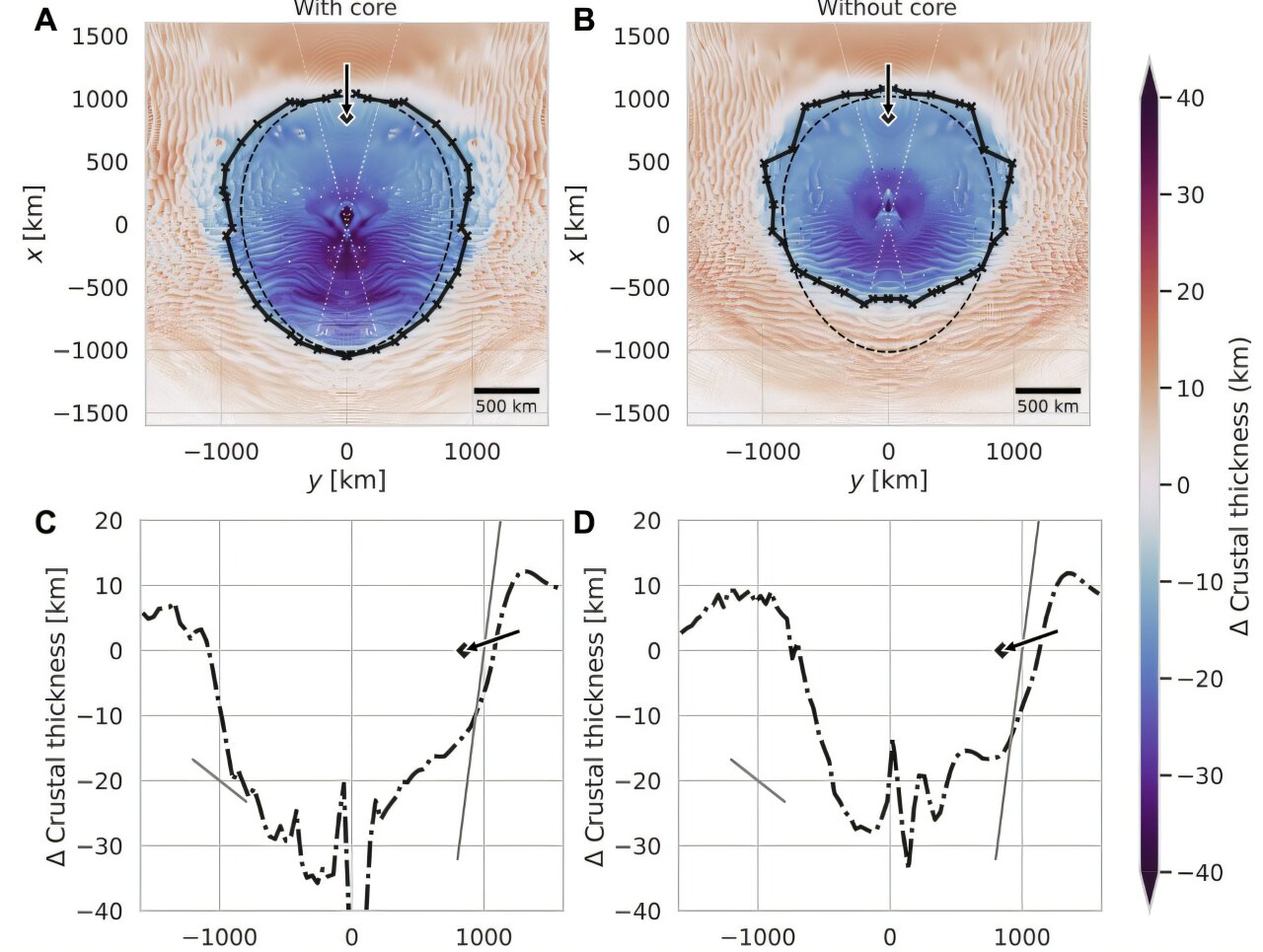
The authors note that large basins on solid bodies such as the Moon, Mars, and Pluto tend to form ellipses that taper in the downrange direction. For SPA, tapering toward the south, a steep crustal thickness gradient toward the north, and a thorium- and iron-rich deposit southwest of the basin all align with a southward impact trajectory.
Why Impact Direction Changes Everything
Knowing which direction the impactor came from is not just a technical detail. It determines where debris from the collision—called ejecta—was thrown across the Moon’s surface.
That matters because some of that ejecta may have come from deep inside the Moon, including material from the lunar mantle. If mantle material was excavated and deposited in reachable locations, future missions could potentially collect samples that reveal the Moon’s interior composition.
Earlier models suggested the SPA impactor was likely 200 to 400 km wide and struck at an angle of 30° to 45°. But those models did not fully connect impact direction to the basin’s crustal thickness distribution, its tapering shape, or ejecta patterns.
This study aimed to close that gap, producing a more complete explanation that matches multiple observed features at once.
High-Resolution Simulations Reveal a Best-Fit Impact Scenario
To test different possibilities, the research team ran high-resolution 3D simulations of impacts on a Moon-like target. They varied key factors such as the impactor’s size, speed, and angle.
They also tested both differentiated and undifferentiated impactors. Differentiated bodies are those whose materials separated into layers early in their history, forming a dense core and outer layers due to heating during formation.
After comparing many outcomes to real observed features of the SPA basin, the researchers found their best match.
Their model suggests SPA was formed by a 260-kilometer-wide differentiated impactor striking from north to south at a shallow angle. Importantly, the impactor did not fully penetrate deep into the lunar surface.
The team argues that the impactor’s dense core played a key role in shaping SPA’s distinctive tapering form.
Their simulations show that debris was launched outward during the impact, followed by gravitational collapse of the transient crater. That collapse produced a large asymmetric central uplift. Most of the Moon’s mantle material excavated during the event ultimately fell back into the basin.
Velocity Tests Point to an Impact Speed Around 13 km/s
The simulations also explored how the impactor’s velocity would affect the crater shape.
At 10 km/s, the basin shape resembled the best-fit case, but the tapering became too extreme. At 16 km/s, the crater became too circular and no longer resembled the real SPA basin.
Based on this, the researchers concluded the most likely speed was between those values, settling on a best-fit estimate of 13 km/s.
That speed carries implications beyond crater geometry—it may hint at where the impactor came from before it struck the Moon.
The researchers write that an impact velocity of 13 km/s implies the object was likely traveling on a low-inclination, Earth-like orbit before impact. They also suggest that, based on early solar system dynamics and collisions among leftover planetesimals, the most likely origin was within the Mars zone, rather than the Venus–Earth zone.
A “Butterfly-Like” Pattern of Mantle Ejecta
One of the most mission-relevant results of the study involves where the impact ejecta landed.
The team’s simulations show the debris formed a “butterfly-like” distribution. Mantle material was predicted to spread roughly 550 km beyond the basin rim in the downrange direction and 650 km in the cross-range direction.
However, the simulations also indicated a major absence: there was no mantle ejecta deposited in the uprange direction.
That finding becomes crucial when considering where Artemis astronauts may land.
Artemis III May Land Where the Moon’s Mantle Was Thrown
NASA’s upcoming Artemis mission is expected to land near the Moon’s south polar region, close to the south rim of SPA. The researchers say that if their north-to-south impact scenario is correct, Artemis astronauts could potentially land in a region containing ejecta deposits that include mantle material.
They highlight a major contrast between the two competing impact-direction theories.
If SPA had formed from a south-to-north impact, the Artemis landing region just beyond the post-collapse rim would likely contain no mantle ejecta. But under the north-to-south scenario supported by their simulations, Artemis III would land downrange of the impact point—exactly where mantle-rich ejecta is expected.
In that case, collecting mantle-derived samples becomes not just possible, but likely.
Testing the Model With Real Lunar Samples
The team acknowledges limitations in their modeling. Even though the simulations were high-resolution for 3D impact studies, they may still miss finer details in crust deformation and ejecta distribution.
But they emphasize that upcoming Artemis samples could directly test their predictions. If astronauts retrieve material from the predicted ejecta deposits, scientists could confirm whether mantle material is present and whether the model’s trajectory assumptions were correct.
They also note that such samples could help determine the age of SPA and reveal more about the composition of the lunar mantle.
Why This Matters
The South Pole–Aitken basin is more than a giant crater—it is a record of one of the most significant events in the Moon’s early history. Pinning down the impactor’s direction, speed, and structure strengthens scientific understanding of how the Moon evolved and what kinds of objects shaped the early solar system.
Just as importantly, the study offers a practical scientific roadmap for Artemis. If astronauts land where mantle ejecta is predicted, they may be able to collect rare material from deep inside the Moon—something that could dramatically improve what scientists know about lunar formation, interior composition, and the timing of major impacts.
In short, this research doesn’t just explain an ancient collision. It may help guide where humanity takes its next most important steps on the Moon.
Study Details
Shigeru Wakita et al, A southward differentiated impactor forms the tapered shape of the South Pole–Aitken impact basin on the Moon, Science Advances (2026). DOI: 10.1126/sciadv.aea1984