Neanderthals may have done more than hunt and eat rhinoceroses—they may have repurposed the animals’ exceptionally durable teeth as tools. New experiments show that modern rhino teeth develop distinctive grooves and fractures when used in stoneworking, closely matching marks found on fossil teeth from multiple Neanderthal sites. The findings suggest Neanderthals deliberately collected and reused rhino teeth as part of their technical toolkit.
At some Neanderthal sites, archaeologists have uncovered a strange pattern that doesn’t fit the usual story of prehistoric hunting and butchery. Instead of piles of broken bones, one layer contains something far more specific: rhinoceros teeth—lots of them, and mostly on their own.
That unusual detail raised a simple but powerful question. What if Neanderthals weren’t just leaving teeth behind accidentally? What if they were keeping them on purpose?
A Mystery Hidden in the Fossil Layer
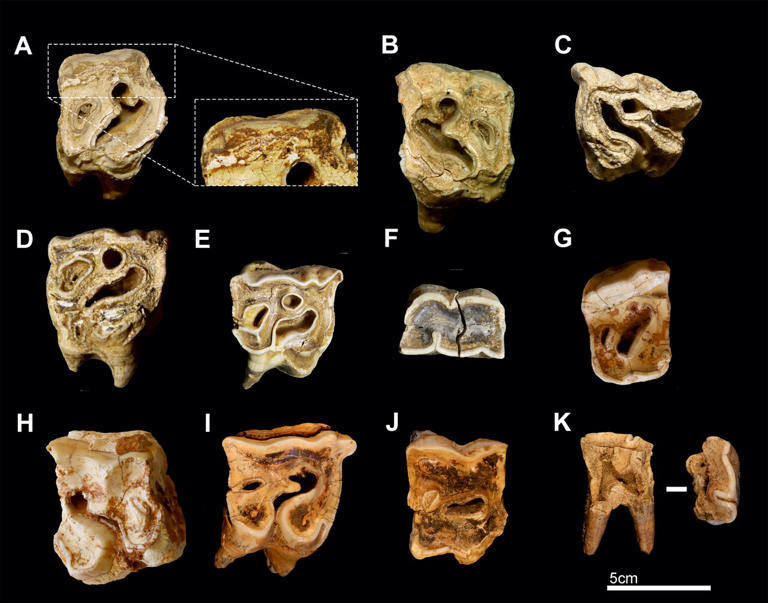
The research team, led by Alicia Sanz-Royo of the University of Aberdeen and Juan Marín of UNED in Madrid, focused on a puzzling discovery from Neanderthal sites including Payre in France.
In one particular layer at Payre, archaeologists found that while most animal remains were broken bones, nearly 91% of the rhinoceros fossils were isolated teeth.
That number stood out. Teeth are strong, but they are not usually the most common leftovers in a site dominated by food waste and fragmented skeletal remains. The imbalance suggested something else may have been happening—something intentional.
The researchers suspected that rhino teeth may have served a purpose beyond diet.
Marks That Didn’t Look Natural
To explore the mystery, the team searched through several archaeological and paleontological collections for rhinoceros teeth. When they examined the fossils closely, they found something striking.
The teeth were covered in marks and grooves that did not appear to be caused by chewing or natural decay.
Instead, the surface damage looked more consistent with repeated contact—like something being struck, scraped, or pressed against the enamel.
This raised the possibility that Neanderthals may have been using rhino teeth the way they used stone, bone, and other durable materials: as tools.
But the fossil record alone could not prove that. The researchers needed experimental evidence.
Testing the Idea With Modern Rhino Teeth
To find out whether rhino teeth could realistically function as tools, the researchers carried out experiments using teeth from modern rhinoceroses.
The team obtained the teeth from animals that had died of natural causes in zoos. Then they used those teeth to perform tasks Neanderthals would likely have needed in daily life.
These activities included retouching flint and quartz tools, shaping stone scrapers, and using the teeth as small anvils while cutting organic materials.
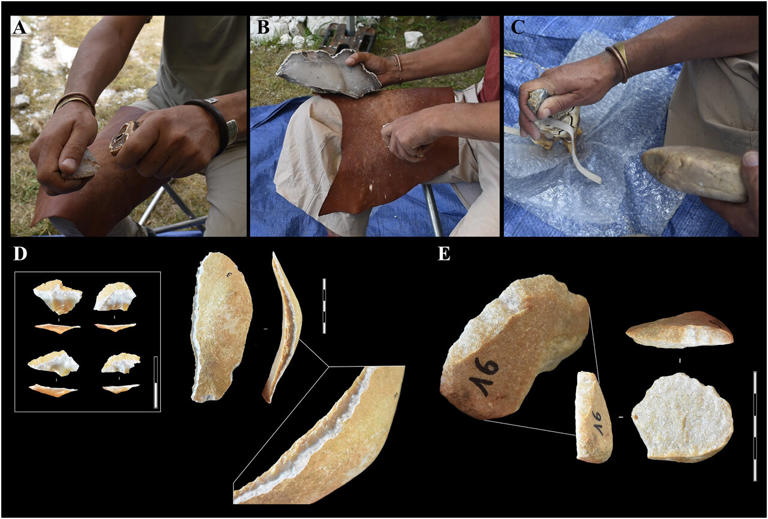
The goal was not to guess what Neanderthals might have done in theory, but to physically recreate wear patterns and compare them to the fossil evidence.
Their study was published in the Journal of Human Evolution.
The Damage Patterns Matched the Fossils
After completing the experimental tasks, the team compared the wear on modern rhino teeth with fossilized teeth recovered from several Neanderthal sites, including El Castillo in Spain and Pech-de-l’Azé in France.
The comparison revealed a strong match.
The marks formed during the experiments—especially linear grooves, pits, and microfractures—closely resembled those found on the fossil specimens.
This mattered because it provided a clear link between human tool use and the damage patterns seen in ancient teeth. It also suggested the fossil marks were unlikely to have formed simply through natural burial pressure, erosion, or accidental breakage.
The experimental work also showed that rhino tooth enamel was strong enough to endure repeated impacts during stoneworking.
That durability may have made rhino teeth an attractive material for Neanderthals, particularly for tasks requiring repeated force.
Evidence for Human Activity, Not Just Burial Damage
The researchers emphasized that their experiments help separate human-made wear from natural processes.
As the study authors explained, human activities, rather than natural compaction and abrasion, could create traces similar to those seen on fossil teeth.
That distinction is critical in archaeology, where many markings on ancient objects can be difficult to interpret. By replicating the marks in controlled experiments, the team strengthened the case that Neanderthals intentionally used rhino teeth rather than simply leaving them behind as food scraps.
A Durable Resource Worth Keeping
Rhino teeth are unusually dense and tough, and the researchers argue this physical advantage likely influenced Neanderthal behavior.
Instead of discarding teeth after eating, Neanderthals may have recognized their usefulness. The team suggests the teeth may have been deliberately selected and transported for reuse.
That idea fits with the evidence: isolated teeth appearing in high proportions, concentrated in specific layers, and marked in ways consistent with repeated impact.
If Neanderthals were carrying rhino teeth from kill sites or scavenging locations to their living spaces, it would indicate a deliberate strategy—choosing specific animal materials not only for food, but also for their mechanical properties.
Expanding the Neanderthal Toolkit
The findings add a new dimension to how researchers understand Neanderthal technical behavior.
Rather than relying only on stone and bone, Neanderthals may have expanded their toolkit to include highly specialized animal parts with unique physical advantages.
The researchers argue that this behavior reveals more about Neanderthal technical decision-making and their ability to exploit animal resources beyond basic consumption.
As the authors noted, their results provide insights into Neanderthal behavior, technical choices, and capabilities, while also broadening the known range of raw materials they collected and used.
Why This Matters
This research strengthens the idea that Neanderthals were deliberate problem-solvers who recognized the functional value of specific materials. If rhino teeth were collected and reused for stoneworking, it suggests Neanderthals weren’t simply using whatever was nearby—they were selecting tools based on durability and performance.
It also changes how archaeologists may interpret animal remains at ancient sites. A concentration of teeth may no longer signal only hunting or eating, but could point to toolmaking strategies and material reuse.
Ultimately, the study highlights a more complex picture of Neanderthal life: one where rhinoceroses were not just prey, but also a source of highly durable tools that may have supported everyday survival.
Study Details
Alicia Sanz-Royo et al, Elucidating the use of rhinoceros teeth by Neanderthals: Between experiments and the fossil record, Journal of Human Evolution (2026). DOI: 10.1016/j.jhevol.2026.103829