Archaeologists have identified the earliest scientifically confirmed evidence of prehistoric human occupation in northern Sri Lanka, based on excavations at Velanai Island in the Jaffna Peninsula. The findings challenge long-standing assumptions that the region’s semi-arid landscape and scarce stone resources made it unsuitable for early settlement, revealing evidence of intensive shellfish exploitation, raw material transport, and likely short-distance seafaring.
For decades, northern Sri Lanka was largely absent from the island’s prehistoric story. Now, a dense mound of ancient shells on Velanai Island is reshaping that narrative, offering a rare glimpse into how early foragers lived, traveled, and survived in a landscape once believed to be too harsh for sustained human occupation.
The research, published in the Journal of Island and Coastal Archaeology, points to a thriving prehistoric presence in the region far earlier than previously confirmed—and suggests that missing evidence may reflect what has been lost to rising seas, not what never existed.
A Region Long Considered “Uninhabitable”
Sri Lanka’s earliest known human occupation dates back to around 25,000 years ago, with sites such as Pathirajawela providing evidence of deep prehistory. But much of what researchers know about prehistoric coastal life has come from the wet southern regions of the island, where shell midden sites dating to around 5,300 and 3,400 cal BP are well documented.
In contrast, northern Sri Lanka has long appeared almost empty in the archaeological record.
This absence helped fuel a dominant theory: that northern Sri Lanka’s semi-arid environment, limited vegetation, scarce freshwater sources, and lack of usable stone for toolmaking made it unsuitable for early foragers. Under that assumption, the region was believed to have remained largely unoccupied until the arrival of agro-pastoralist groups from India around the 5th century BCE.
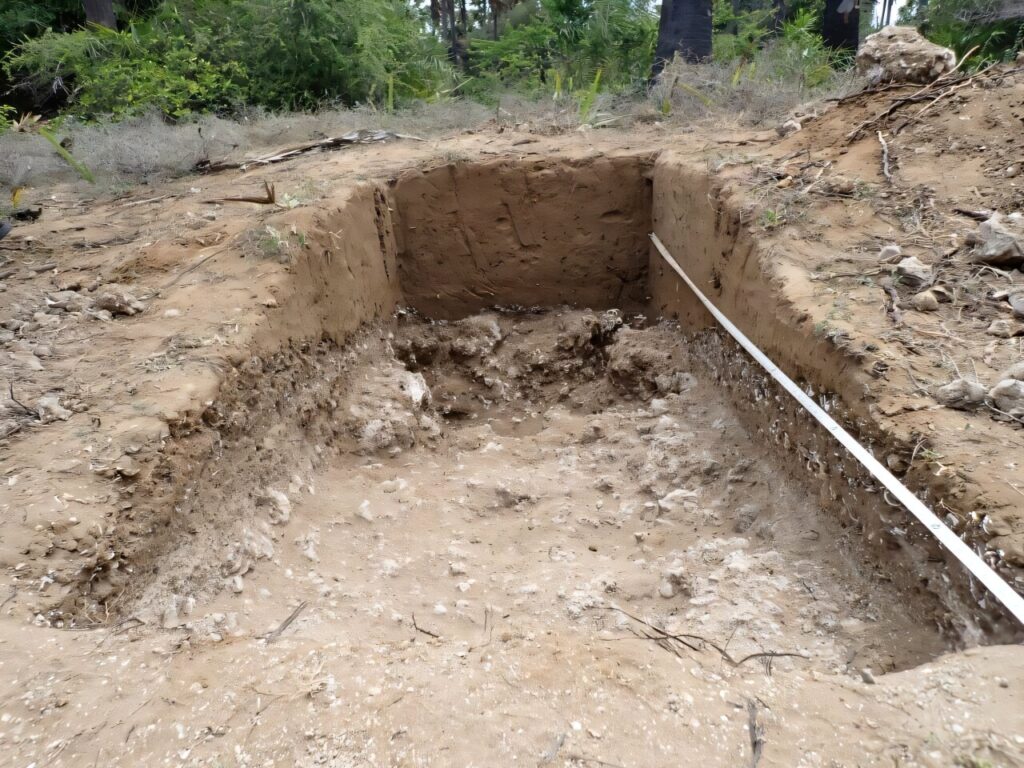
Velanai Island is now challenging that idea directly.
The Velanai Discovery: Shell Midden With Deep Time Layers
Excavations on Velanai Island revealed an extensive shell midden—an archaeological deposit made up largely of discarded shells from repeated human consumption.
The earliest marine deposit at the site has been dated to roughly 6300 to 5970 cal BP, indicating a long history of coastal accumulation. More importantly, the earliest confirmed human occupation at the site dates to around 3460 cal BP, making it the oldest scientifically verified prehistoric occupation yet identified in northern Sri Lanka.
This pushes confirmed human presence in the region much further back than previously documented and establishes Velanai as a critical site for understanding early coastal life in the island’s north.
Rather than reflecting a marginal or temporary stopover, the scale of the shell midden suggests repeated and organized use of coastal resources.
What the Shells Reveal About Diet and Survival
The midden contains strong evidence that Velanai’s prehistoric foragers relied heavily on marine food sources, particularly mollusks.
One species stands out above all others: Gafrarium pectinatum, which made up nearly 60% of the mollusk assemblage. This overwhelming dominance suggests that the foragers repeatedly harvested the same coastal habitats, returning often enough for their refuse to accumulate into a substantial archaeological layer.
But the diet was not limited to shellfish alone. The midden analysis indicates that foragers also consumed seabreams and terrestrial animals such as deer and wild boar. Evidence also points to the exploitation of larger marine animals including dugongs and dolphins.
Together, these remains suggest a flexible subsistence strategy—one that combined intensive shellfish gathering with opportunistic hunting and fishing across both land and sea.
Signs of Intensification—and Shrinking Shell Size
One of the most revealing patterns in the midden comes from changes in shell size over time.
Researchers identified a phase of intensification, known as L4, during which shell harvesting appears to have become so intense that the average size of mollusks declined. The researchers note that this reduction could reflect sustained human pressure on shellfish populations, though it may also indicate a local environmental shift affecting mollusk growth.
Dr. Thilanka Siriwardana, the study’s lead author, also emphasized that similar shell-size reduction patterns were observed elsewhere, including at Punguduthivu. Across these sites, a gradual reduction in the size of Gafrarium pectinatum shells over time—visible from the 4th millennium BCE—may represent a long-term marker of growing exploitation and environmental stress.
If supported by further analysis, this shell evidence could serve as a valuable proxy for tracking long-term human impact on coastal ecosystems.
Transported Stone Tools Suggest Deliberate Travel and Planning
Velanai’s most striking surprise may be what it lacks: natural stone resources suitable for toolmaking.
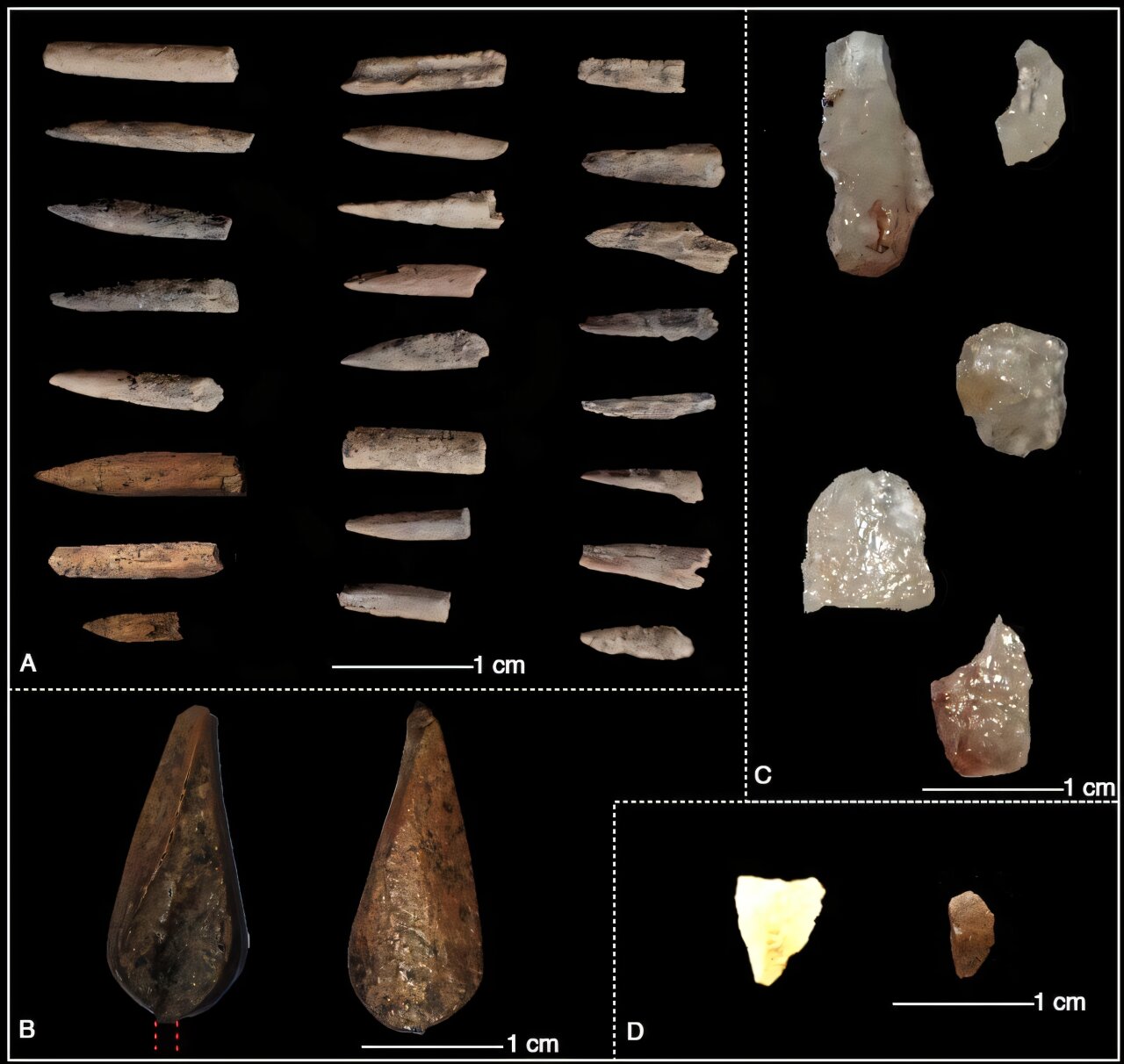
Despite this limitation, excavators recovered non-local quartz and chert flakes, indicating that toolmaking materials were deliberately transported from far beyond the island. According to the study, these materials would have been sourced nearly 60 km away on the mainland.
That level of transport implies planning, mobility, and an understanding of where valuable resources could be obtained.
It also raises another critical point: Velanai is separated from the mainland by over 5 km of sea. Transporting raw lithic material across that distance strongly suggests that prehistoric groups had the capability for short-distance seafaring.
In other words, these were not isolated foragers trapped by geography—they were capable of moving across open water and carrying supplies with them.
Rethinking the “Gap” Between North and South Sri Lanka
The Velanai findings closely resemble patterns documented in southern Sri Lanka’s shell middens, where researchers have identified adaptable foraging strategies combining intensive shellfish collection with terrestrial and nearshore resource use.
This similarity suggests that northern Sri Lanka was not fundamentally different in its suitability for human life.
Instead, Dr. Siriwardana argues that the apparent lack of northern sites may be due to preservational bias, rather than true absence of prehistoric settlement.
He explains that during the Late Pleistocene, lower sea levels would have exposed extensive coastal plains. In semi-arid northern Sri Lanka, populations likely lived near these ancient shorelines. As sea levels rose during the Holocene, many of those landscapes would have been submerged, effectively erasing earlier sites from the visible archaeological record.
Under this interpretation, Velanai may represent settlement after submergence—communities adjusting to newly established shorelines rather than arriving in the region for the first time.
What Comes Next: Searching for Lost Shorelines
The study also outlines how future research could help fill in the missing chapters of northern Sri Lanka’s prehistoric timeline.
One strategy involves studying uplifted coastal terrains, which preserve ancient shoreline formations and may retain traces of older shell middens. Another approach is examining inland archaeological sites for marine-derived materials, which could signal coastal reliance even when shoreline sites are no longer accessible.
The most difficult—but potentially most revealing—path would be investigating submerged landscapes directly, particularly in lagoons and low-energy coastal environments where archaeological evidence may survive.
Dr. Siriwardana noted that the team does not plan to re-excavate the CB/Ex1 site unless new analytical techniques emerge, emphasizing that preservation is a priority given the region’s limited number of known sites.
Long-term ecological analysis of shell assemblages will remain a major focus, particularly as shell size patterns may reveal sustained exploitation trends across thousands of years.
Why This Matters
The Velanai Island discovery rewrites what archaeologists can confidently say about prehistoric life in northern Sri Lanka. By pushing confirmed occupation back to 3460 cal BP, the findings challenge decades of assumptions that the region was too dry, too resource-poor, or too isolated for early settlement.
Just as importantly, the evidence of transported quartz and chert suggests deliberate planning and likely seafaring ability, highlighting that prehistoric coastal communities were more mobile and adaptable than previously recognized.
Beyond Sri Lanka, the study also reinforces a larger archaeological lesson: missing evidence does not always mean missing people. Rising sea levels and landscape change can erase entire chapters of human history, leaving behind only fragments—like the shell midden at Velanai—that hint at a much deeper and more complex past.
Study Details
Thilanka M. Siriwardana et al, Coastal foragers beyond the mainland: Seafaring and early island settlement on Velanai, Jaffna, Sri Lanka, ca. 3460 cal BP, Journal of Island and Coastal Archaeology (2026). DOI: 10.1080/15564894.2026.2624853