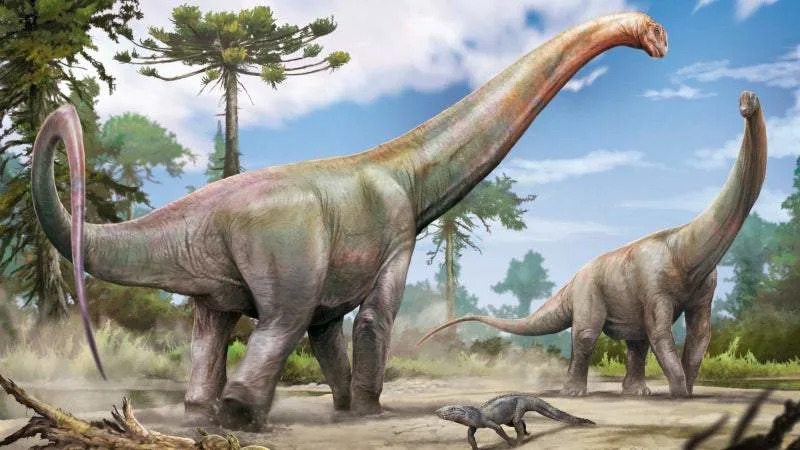
A newly described dinosaur species, Dasosaurus tocantinensis, has been identified from fossils uncovered during construction in Davinópolis, Maranhão, in northeastern Brazil. Measuring about 20 meters long and dating to roughly 120 million years ago, it is the largest dinosaur known from the state and offers evidence of ancient dispersal routes connecting South America with parts of Europe.
- New species: Dasosaurus tocantinensis
- Age: about 120 million years old
- Size: approximately 20 meters long
The discovery didn’t come from a planned fossil expedition or a remote dig site—it came from a construction project cutting deep into the earth. And what initially looked like something far more recent turned out to be a dinosaur unlike any previously known from Maranhão.
Researchers say the find not only adds a major new species to Brazil’s fossil record, but also strengthens evidence that dinosaur populations once moved between regions that today seem impossibly distant.
A Dinosaur Hidden Beneath a Modern Construction Site
The fossils were uncovered during the construction of a road-rail terminal in the city of Davinópolis, located in the state of Maranhão in northeastern Brazil. As required for environmental licensing, archaeologists were monitoring the site when they encountered the bones.
At first, the team believed they had found fossils belonging to megafauna mammals—large prehistoric animals that may have lived alongside early humans.
That interpretation changed when Elver Luiz Mayer, a professor at the Federal University of the São Francisco Valley (UNIVASF), was contacted in 2021 while he was working in São Félix do Xingu in Pará. Mayer specializes in mammals from the Quaternary period, but the depth of the discovery immediately caught his attention.
The fossils were located about eight meters underground.
Mayer recognized that the geological context pointed to something far older than Quaternary megafauna. The age of the formation was already known from earlier studies and placed the material in the transition from the Lower to the Upper Cretaceous, around 120 million years ago.
That meant only one thing: the fossils likely belonged to dinosaurs.
Introducing Dasosaurus tocantinensis
The specimen was later described in a study published in the Journal of Systematic Palaeontology. Researchers identified it as a new species of dinosaur, naming it Dasosaurus tocantinensis.
Based on the fossil material, the animal was estimated to be about 20 meters long.
That makes it the largest dinosaur known from Maranhão, according to Mayer. He notes that the state has yielded other dinosaur species, but none comparable to this one in size.
Maranhão’s known dinosaurs include smaller forms, such as the diplodocid Amazonsaurus maranhensis, which measured around 10 meters long.
The discovery of such a large sauropod-sized dinosaur in the region signals that Maranhão hosted a broader range of dinosaur life than previously documented.
A “Relatively Complete” Fossil With More Still Underground
After Mayer recognized the importance of the find, he contacted other specialists and helped form a multidisciplinary research group to study the specimen.
The fossil preparation process was extensive. Once the bones were ready for study, analyses were carried out in Pará. The specimen was later returned to Maranhão, where it is now housed in the state capital São Luís at the State Center for Natural History and Archaeology Research, an institution that also contributed to the research.
According to Max Langer, a professor at the Ribeirão Preto School of Philosophy, Sciences, and Letters at the University of São Paulo (FFCLRP-USP), the fossil is considered relatively complete.
The specimen includes tail vertebrae, a 1.5-meter femur, ribs, foot bones, and arm and leg bones.
Langer believes additional fossils from the same individual may still be buried at the site and have yet to be excavated. He also coordinates a research initiative called “Exploring the Diversity of South American Cretaceous Dinosaurs and Their Associated Faunas,” which focuses on expanding scientific understanding of dinosaur ecosystems from the continent.
Why the Name Means “Forest Dinosaur”
The name Dasosaurus tocantinensis was chosen to reflect both geography and history.
The term “Daso” means “forest,” referencing the woodlands of Maranhão. Researchers note that the first Portuguese colonizers described the region as a vast tangled woodland—an idea linked to the origin of the name “Maranhão.”
Meanwhile, “tocantinensis” refers to the Tocantins River, since the fossil site lies near its eastern bank.
The name ties the dinosaur directly to the environment and landscape that shaped the region, both in deep time and in recorded history.
Evidence of an Ancient Route Between Europe and South America
One of the most striking conclusions from the study involves the dinosaur’s evolutionary relationships.
Researchers found that the closest known relative of Dasosaurus tocantinensis lived in what is now Spain. That connection suggests that dinosaurs in northeastern Brazil were not isolated, and that ancient dispersal routes once linked the European archipelago of the time with South America.
The researchers propose that the ancestors of the Maranhão dinosaur likely dispersed into South America via North Africa between 140 and 120 million years ago.
During that interval, the relevant landmasses were connected as part of the supercontinent Gondwana, allowing animal groups to move between regions that are now separated by vast oceans.
The presence of this dinosaur in Brazil supports the idea that dinosaur diversity in South America included lineages tied to European relatives, offering new insight into how ancient ecosystems were connected.
Bone Microstructure Reveals an Unexpected Growth Pattern
Beyond its size and geographic importance, Dasosaurus tocantinensis also offers clues about how giant dinosaurs developed.
Researchers Tito Aureliano and Aline Ghilardi of the Federal University of Rio Grande do Norte (UFRN) examined the microstructure of the bones. Their analysis revealed a growth pattern that combines characteristics of older sauropods and titanosaurs, a group closely related to the newly described species.
This finding suggests that certain growth and bone remodeling patterns evolved earlier than previously believed.
That matters because these biological mechanisms may help explain how some dinosaurs were able to reach such enormous body sizes over evolutionary time.
The Construction Paradox That Made the Discovery Possible
The story of Dasosaurus also highlights a reality that paleontologists frequently face.
Large construction projects can destroy fossils before they are recognized. But at the same time, these projects expose deep geological layers that scientists might never access through traditional excavation methods.
Langer points out that Brazil’s tropical environment and dense vegetation make fossil exposure especially difficult. In practice, researchers often depend on human development—highways, quarries, and major infrastructure projects—to reveal rock layers and fossil deposits.
But he emphasizes that these opportunities only lead to discoveries if proper monitoring and recovery efforts are in place.
Both Langer and Mayer stress the need for stronger cooperation between construction stakeholders and scientific institutions, particularly to ensure compliance with federal fossil legislation and prevent the loss of irreplaceable heritage.
More Fossils May Still Be Waiting
The research team is now in negotiations with the construction company to continue excavations at the site. If additional bones from the same specimen are recovered, they could provide even more detailed information about the species and the dinosaur group it belongs to.
Given how much of the skeleton has already been found, further excavation could significantly expand scientific understanding of the animal’s anatomy and its place in dinosaur evolution.
For now, the fossil remains a rare and valuable snapshot of a massive dinosaur that once moved through the forests of ancient Maranhão.
Why This Matters
The discovery of Dasosaurus tocantinensis adds a major new dinosaur to Brazil’s fossil record and establishes the largest dinosaur known from Maranhão at around 20 meters long. Just as importantly, its evolutionary ties to a relative in what is now Spain strengthens evidence that dinosaur lineages once moved across interconnected landmasses, including routes through North Africa between 140 and 120 million years ago.
The fossil’s bone microstructure also reveals that key growth and remodeling patterns linked to extreme dinosaur size may have evolved earlier than scientists previously recognized.
And perhaps most practically, the discovery underscores a modern lesson: without careful fossil monitoring during construction projects, discoveries like this could easily be destroyed before science ever knows they existed.
Study Details
Elver L. Mayer et al, A new titanosauriform with European affinities in the Early Cretaceous of Brazil: insights on Somphospondyli phylogeny, histology and biogeography, Journal of Systematic Palaeontology (2026). DOI: 10.1080/14772019.2025.2601579