For centuries, humans have tried to answer a deceptively simple question: how many species share this planet with us? We have counted feathers and scales, measured skulls and skeletons, cataloged colors and shapes. We have given names, organized family trees, and built vast archives of life on Earth.
And yet, a new study published in Proceedings of the Royal Society B: Biological Sciences suggests something astonishing. There may be twice as many vertebrate species on Earth as we previously believed.
Not because of a grand mistake. Not because scientists miscounted. But because thousands of species have been standing right in front of us—unnoticed, unrecognized, hidden in plain sight.
They are known as cryptic species. To the naked eye, they appear identical. But deep within their cells, their DNA tells a very different story.
The Illusion of Sameness
For generations, species have been identified primarily through morphology—the study of physical form. Scientists have relied on visible traits: body size, bone structure, color patterns, shape of wings or fins. If two animals looked alike, they were usually classified as the same species.
It made sense. After all, what else could we use before the era of genetic technology?
But evolution does not always follow obvious rules. Sometimes it produces creatures that look nearly identical on the outside while diverging significantly on the inside. Separate evolutionary paths can lead to remarkably similar appearances. Nature, it turns out, can be deceptive.
Two animals might share the same silhouette, the same fur or feather patterns, the same skeletal proportions—and yet carry entirely different genetic identities.
Looks, as this new research makes clear, can deceive.
A Deep Dive Into Hidden Diversity
Researchers from the Department of Ecology and Evolutionary Biology at the University of Arizona set out to examine just how widespread this hidden diversity might be. Instead of studying one group of animals, they conducted a sweeping review of 373 separate studies, pulling together data from across the tree of vertebrate life.
Their focus was precise: find cases where animals classified as a single species based on appearance were revealed by genetic analysis to be separate species.
They included representatives from all major vertebrate groups—mammals, birds, fish, and more. Across these groups, they searched for mismatches between what morphology suggested and what DNA revealed.
What they found was striking.
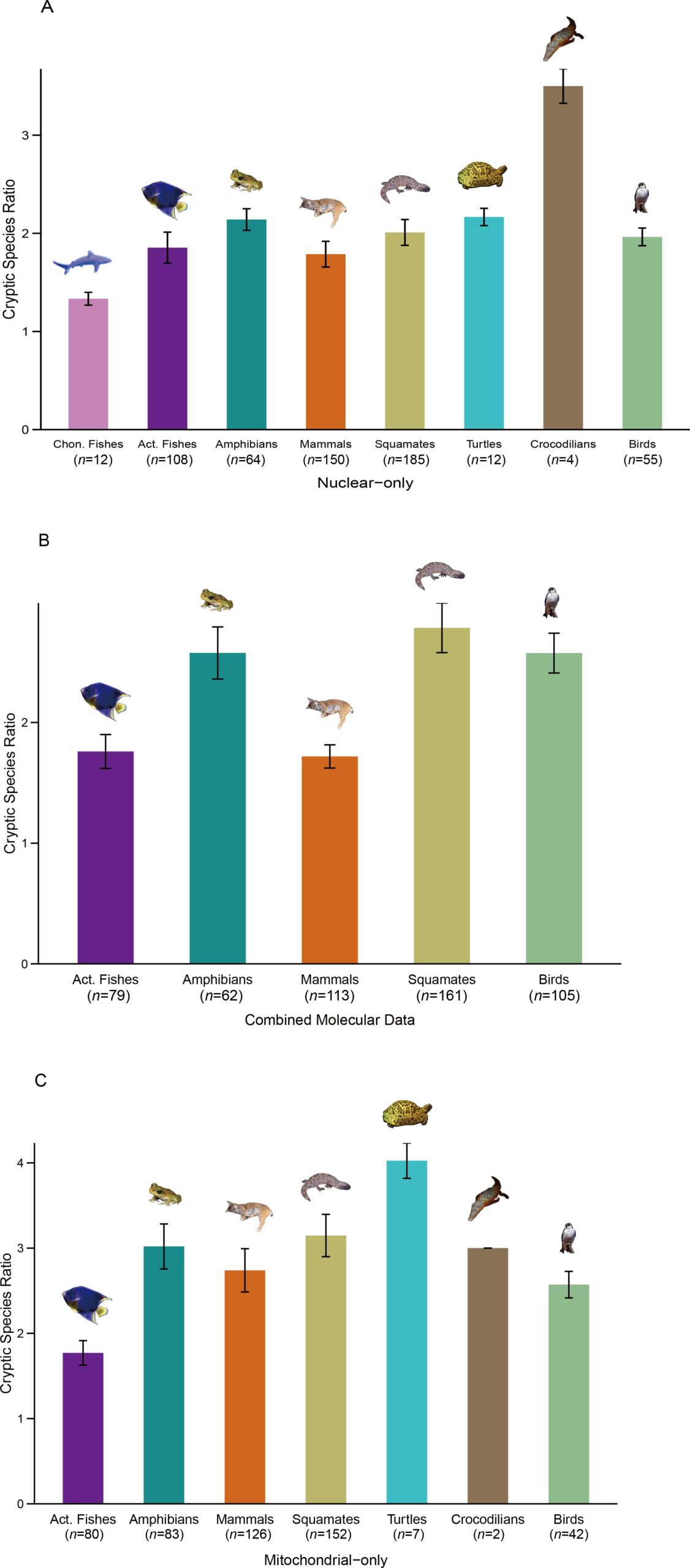
On average, each species identified by physical appearance contained roughly two genetically distinct species. In other words, for every vertebrate species we think we know, there may actually be two.
This 2-to-1 ratio held steady across major vertebrate clades. Whether examining mammals, birds, or fish, the pattern remained remarkably consistent.
The implication is profound. Hidden diversity is not a rare curiosity. It may be a common feature of life on Earth.
As the study’s authors wrote, cryptic species are widespread across vertebrates, and most major groups may contain approximately two molecular-based species per morphology-based species, on average.
The world, it seems, is far more biologically intricate than our eyes alone can perceive.
Listening to the Language of DNA
So how did scientists uncover what centuries of observation had missed?
The answer lies in genetic evidence. The researchers examined multiple types of DNA, including nuclear DNA and mitochondrial DNA (mtDNA).
Nuclear DNA resides in the nucleus of the cell and represents the majority of an organism’s genetic material. It carries information inherited from both parents and changes gradually over generations.
Mitochondrial DNA, however, tells a slightly different story. Found in the cell’s energy-producing structures, mtDNA is inherited solely from the mother. Crucially, it evolves more rapidly than nuclear DNA. Because of this faster rate of change, it can reveal genetic differences that accumulate between groups of animals—even when those animals still appear outwardly identical.
By comparing these genetic markers, researchers could detect evolutionary separations invisible to the human eye. Two populations might share the same physical traits, but their DNA could show they have been evolving independently for long stretches of time.
In essence, scientists began to hear whispers of divergence where previously there had been silence.
What seemed like one species turned out to be two distinct genetic lineages walking side by side.
The Quiet Expansion of the Tree of Life
Imagine opening a field guide to birds, mammals, or fish and realizing that many entries conceal hidden chapters. Each familiar name may represent multiple evolutionary stories, intertwined yet separate.
The idea that there may be twice as many vertebrate species reshapes our understanding of biodiversity. It suggests that the tree of life is more finely branched than we imagined. The gaps between lineages are more numerous, more delicate, more intricate.
And yet, these species have not suddenly appeared. They have always been here. They have simply gone unnoticed because our classification systems relied heavily on visible traits.
DNA sequencing, increasingly powerful and accessible, has become a lens that penetrates beyond appearance. It reveals patterns of divergence that morphology alone cannot capture.
The study does not claim that every species will double overnight. Rather, it demonstrates that when genetic evidence is examined systematically across many groups, a consistent pattern emerges. Hidden diversity is not an exception. It may be the rule.
The Risk of Silent Disappearances
This discovery is not merely academic. It carries urgent consequences.
When multiple species are grouped under a single name, their individual fates become blurred. A decline in one lineage might be masked by the stability of another. An entire genetic heritage could vanish without anyone realizing it was distinct to begin with.
The researchers warn that some cryptic species may already be endangered. If conservation efforts are based on incomplete classifications, vulnerable populations may go unprotected. A species could disappear quietly, its extinction recorded only as a minor fluctuation within a broader category.
This is what scientists fear: silent extinctions.
By identifying hidden species, conservationists can more accurately map where these animals live and understand their ecological needs. Protection strategies can be tailored to distinct populations rather than assuming uniformity where it does not exist.
Recognizing genetic differences is not just a matter of naming. It is a matter of survival.
Rethinking What We See
There is something humbling about this discovery. For centuries, humans have trusted their eyes as primary tools for understanding life. We have described, classified, and organized based on what we could observe.
Now, genetic analysis reveals that beneath familiar forms lies a hidden world of divergence.
Two animals perched on the same branch or swimming through the same waters may share a silhouette but not a destiny. Their evolutionary journeys may have separated long ago, even if their outward forms remained similar.
This does not diminish the power of morphology. Physical traits remain essential for identifying and studying species. But the study reminds us that appearance alone is not enough.
The story of life is written in layers. Some chapters are visible. Others require reading the molecular script within cells.
Why This Research Matters
If the findings hold broadly true, the implications ripple outward in every direction.
First, it means global biodiversity may be far richer than current estimates suggest. The number of vertebrate species—already immense—could be substantially higher. Each newly recognized lineage represents unique evolutionary history, genetic variation, and ecological roles.
Second, it reshapes conservation priorities. Protecting biodiversity requires knowing what exists. If species are hidden within broader classifications, conservation plans may overlook crucial diversity. Recognizing cryptic species allows for more precise protection efforts and prevents the quiet erasure of unique genetic lineages.
Third, it underscores the importance of genetic tools in modern biology. By examining nuclear DNA and mitochondrial DNA, scientists can uncover patterns invisible to traditional methods. The rapid evolution of mtDNA, in particular, makes it a powerful tool for detecting divergence between closely related groups.
Most importantly, this research reminds us that the natural world is more complex than it appears. The Earth is not merely populated by the species we can easily distinguish. It holds hidden branches of life that share our planet, evolving quietly, often unnoticed.
The world did not suddenly double in size. It simply revealed more of itself.
And in that revelation lies both wonder and responsibility.
Study Details
Yinpeng Zhang et al, Cryptic species are widespread across vertebrates, Proceedings of the Royal Society B: Biological Sciences (2026). DOI: 10.1098/rspb.2025.2377