Violent collisions can shatter and rebuild icy moons without fundamentally changing whether they contain underground oceans, according to computer simulations that followed the moons for 4.5 billion years after major impacts.
Many moons around Saturn, Uranus and Neptune are thought to have liquid water buried beneath thick layers of ice. Because water is necessary for life as we know it, those hidden oceans are potential places to search for life beyond Earth.
But these moons may have experienced enormous collisions over their histories. Some could even be remnants of older moons that were broken apart and later assembled again.
Researchers led by Marc Neveu, an astronomy associate research scientist at the University of Maryland, wanted to know what those impacts would do to an existing ocean.
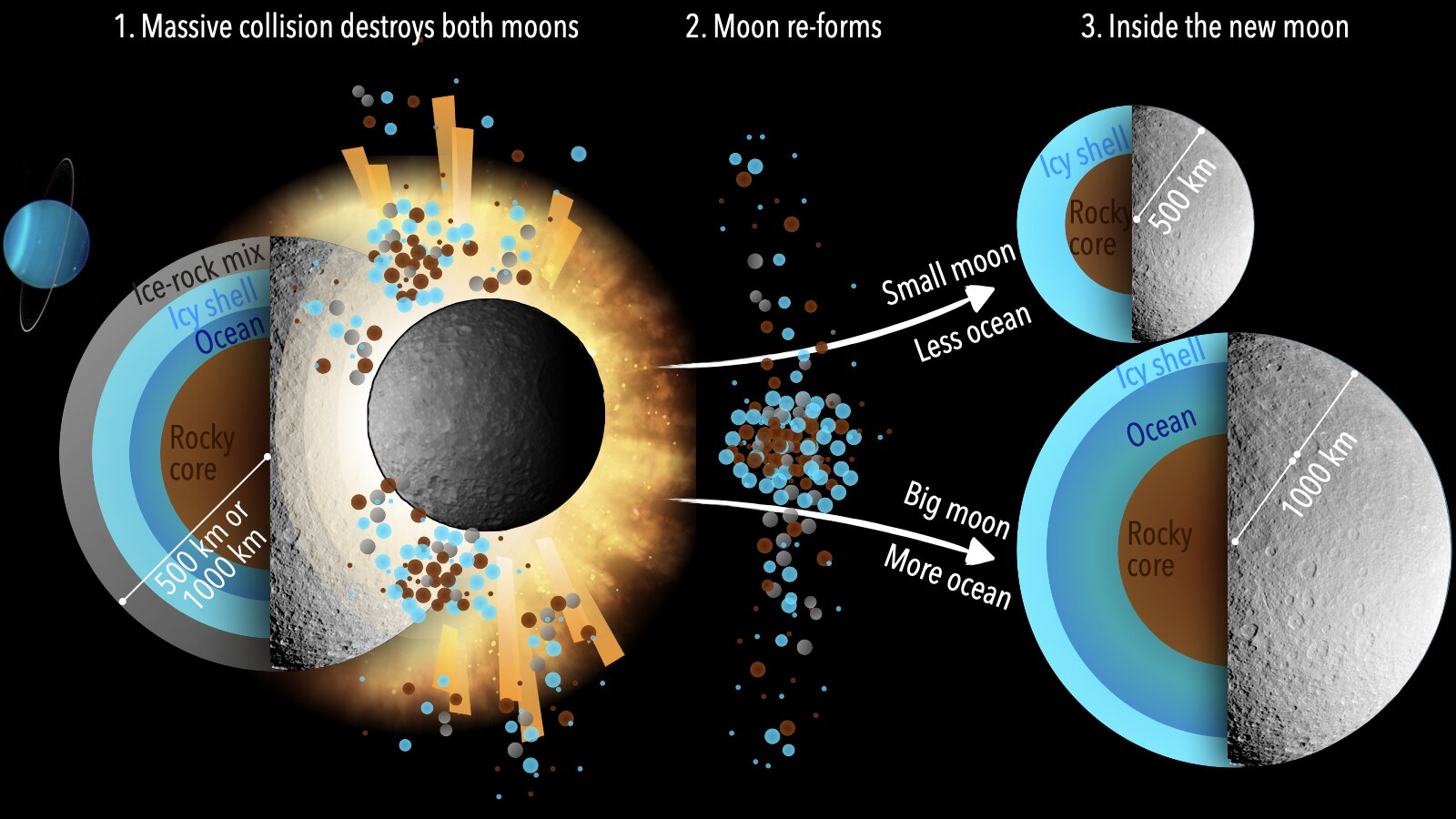
The team linked two kinds of computer models. One recreated the immediate violence of an impact, following millions of pieces of rock and ice as they broke apart, heated up and gathered together again. The other modeled the much slower evolution of a moon’s interior over billions of years, including how heat moves through the interior and whether ice can melt into liquid water.
The researchers tested moons about 500 and 1,000 kilometers in radius. They subjected them to impacts, allowed them to re-form, and then modeled their subsequent evolution for 4.5 billion years.
The result was that even the largest collisions they modeled did not fundamentally determine whether a moon had an ocean.
“If there was an ocean before, there’s likely to be an ocean after and vice versa,” Neveu said.
Moon size changed what happened after impact
The simulations did uncover an important difference between larger and smaller moons.
In the larger moons, energy from a collision became additional heat inside the moon. That heat could make an existing ocean thicker for a couple of billion years.
The smaller moons behaved differently. Before an impact, their outer layers could contain a mixture of ice and rock. That layer helped insulate the moon and retain heat that could sustain an ocean.
A major collision disrupted that arrangement. When the moon re-formed, rock moved toward the center while ice rose toward the surface. Without the mixed outer layer, the smaller moon became less able to retain an ocean.
But the impact still did not create an ocean in a moon that otherwise would have remained frozen.
Neveu said the size effect was unexpected, and the researchers were also surprised that the enormous impacts in their simulations did not substantially alter the presence or absence of an ocean.
“These simulations were pretty much the biggest collisions we could come up with,” he said. “If those didn’t make a difference, it’s unlikely smaller ones would either.”
Rhea may provide a test case
The results could be relevant to moons that NASA and other space agencies plan to investigate, including Saturn’s Mimas, Enceladus, Tethys, Dione and Rhea; Uranus’ Miranda, Ariel, Umbriel, Titania and Oberon; and Neptune’s Triton.
Rhea is of particular interest to the researchers because some of its ancient craters appear unusually smooth and softened. Neveu suggested that heat from below could have contributed to that appearance.
One possible explanation is that an ancient collision increased the heat associated with an interior ocean, helping produce the softened-looking craters.
The researchers described the idea as a possible explanation rather than a demonstrated history of Rhea.
Ocean evidence could guide future missions
The findings also bear on how scientists might investigate these icy moons. Potential signs of a buried ocean include effects on a moon’s gravity, salty material on the surface and icy features known as cryovolcanoes.
The researchers noted that the amount and type of life present, if any, would also affect the design of life-detection instruments. A search for a small number of microbes would require different tools from one aimed at detecting a much larger abundance of life.
Neveu cautioned that a moon’s collision history is only one factor in its potential to host life. Heat produced by tides is another factor that matters at least as much.
The researchers ultimately want to connect the history of collisions with the changing orbits of moons and the heating of their interiors. Neveu said a future model could track an entire moon system over time, including how the moons move, collide and change internally.
The study was published in Nature Astronomy.