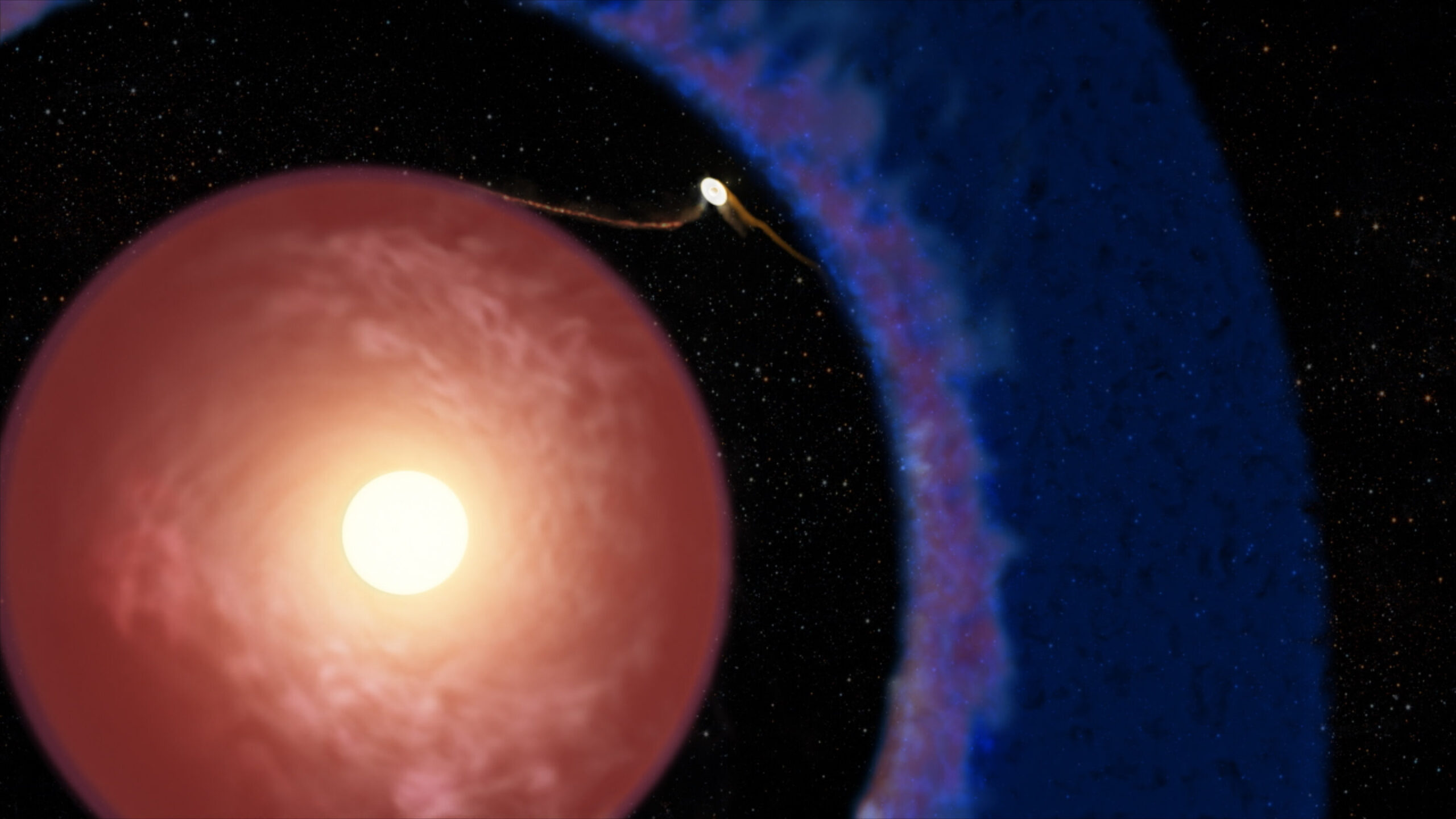
Hidden inside a narrow gap around the young star Elias 2-24, a faint point of light has been independently confirmed as a giant planet, giving astronomers a direct view of a planet still forming around a star less than about 1 million years old.
Elias 2-24 is surrounded by a protoplanetary disk, a rotating reservoir of gas and dust from which planets form. The disk contains a narrow gap centered roughly 55 astronomical units from the star, with a width of about 30 au. One astronomical unit is the average distance between Earth and the Sun.
A point source inside that gap was first reported in 2021 in near-infrared observations. Later observations with the Atacama Large Millimeter/submillimeter Array, or ALMA, found a bright feature near the same location in carbon monoxide emission. Its shape was also consistent with what models predict for emission from a circumplanetary disk.
The new observations provide an independent check. Using the Keck Observatory’s NIRC2 instrument and its vortex coronagraph, the researchers recovered the source in observations made in June 2018. They measured a separation of 394 ± 31 milliarcseconds from Elias 2-24, corresponding to 54.9 ± 4.3 au, and a position angle of 298.8° ± 3.2°.
The position agrees with earlier measurements and places the object within the disk’s narrow gap.
The researchers also recovered it in a separate Keck observation from June 2020, measuring a separation of 351 ± 30 milliarcseconds and a position angle of 294.3° ± 4.8°. The 2020 detection was at lower significance.
Together, the repeated detections provided a way to test whether the object was actually associated with Elias 2-24 or was instead an unrelated background star.
Its motion is difficult for a background star to explain
The researchers compared the object’s measured position in 2020 with where a stationary background source should have appeared as Elias 2-24 moved across the sky.
The observed position was inconsistent with the static-background hypothesis at the 3.2σ confidence level.
They then modeled a population of possible background stars using the Besançon Galaxy Model. The simulated sample contained 668 stars with properties selected to resemble possible background objects near Elias 2-24. Only two fell within the defined region of proper-motion space that could produce a motion compatible with a bound companion. That corresponded to a false-alarm probability of 2.99 × 10⁻³, or a 2.8σ confidence level.
The probability of finding such a background source within the relevant field of view was even lower, with a false-alarm probability of 1.50 × 10⁻⁴, corresponding to 3.6σ.
The researchers therefore conclude that the source is physically bound to Elias 2-24 and designate it Elias 2-24 b.
The individual detections themselves did not reach the standard 5σ threshold. But additional tests strengthened the identification. When the researchers removed a modeled version of the companion from the data and repeated the image processing, the residuals at its position were consistent with the surrounding noise rather than leaving a significant structure. They also injected an artificial companion elsewhere in the data and recovered it successfully.
The combination of those tests, the repeated detections and the common-proper-motion analysis led the researchers to confirm the object’s planetary nature.
Keck searched seven young planetary systems
Elias 2-24 b emerged from a broader search of seven young stars whose disks contain gaps, rings or cavities that could be associated with forming planets.
The observations were obtained between May 25 and June 21, 2018. Six systems were observed in the L band, centered at a wavelength of 3.776 micrometers. PDS 70 was observed in the Ms band, centered at 4.670 micrometers.
The median integration time was 48 minutes, with median seeing of 0.5 arcseconds. The observations were carried out in pupil-tracking mode, allowing the researchers to use angular differential imaging to suppress the bright stellar point-spread function and search for faint nearby companions.
The data were processed with a custom pipeline based on the Vortex Image Processing package. Principal-component analysis was used to remove the stellar signal, and the researchers also used reference differential imaging to investigate possible disk emission.
No clear disk emission was detected in the survey.
Elias 2-24 and PDS 70 were the only systems in which point-like sources appeared in the reductions. The source around PDS 70 was already known to be a background star, rather than one of the system’s planets.
The resulting 5σ contrast curves allowed the researchers to set mass limits on additional planets. For several systems, the observations were sensitive to objects of roughly 1–2 Jupiter masses at suitable separations. Across the survey, the limits reached roughly 1–11 Jupiter masses, depending on the system and separation.
For Elias 2-24 specifically, the observations reached limits of about 1.4–4.9 Jupiter masses between roughly 12 and 370 au.
The planet’s mass is harder to pin down
Confirming the planet’s existence does not mean its mass can be measured precisely.
The researchers derived an L-band contrast of 9.86 magnitudes, with an uncertainty of +0.53 and −0.87 magnitudes. After accounting for the distance of 139.3 parsecs and an estimated visual extinction of 8.7 magnitudes, corresponding to about 0.5 magnitude of extinction in the L band, they obtained an absolute L-band magnitude of 10.08 magnitudes, with the same asymmetric uncertainty.
They then compared that luminosity with several evolutionary models.
Using the ATMO-NEQ-STRONG 2023 models, which assume a nonequilibrium atmosphere and a hot-start formation scenario, they obtained a mass of 2.54 +1.66/−0.66 Jupiter masses and an effective temperature of 1,315 +357/−165 kelvin.
Other model assumptions produced substantially different masses. The AMES-COND model, which assumes a cloud-free atmosphere, gave 3.84 +0.99/−2.03 Jupiter masses. The AMES-DUSTY model, which includes clouds, could provide only upper limits of 3.97 Jupiter masses and 1,608 K because parts of the observed magnitude range fell outside the model grid.
The BEX models demonstrated how strongly the result depends on assumptions about the planet’s initial entropy and luminosity. Coldest-start or warm-start models produced masses around 13 Jupiter masses, whereas hot-start models gave roughly 3.8–4.9 Jupiter masses and hottest-start models gave about 2.9–3.7 Jupiter masses, depending on the atmospheric treatment.
But these numbers have an important qualification.
All of the evolutionary models used for these estimates neglect the luminosity produced by ongoing accretion. At such a young age, the researchers note, accretion luminosity can dominate a planet’s intrinsic luminosity. If so, treating all of the observed light as the planet’s internal luminosity would overestimate its intrinsic luminosity and therefore its evolutionary mass and temperature.
For that reason, the reported model-based values should be treated as upper limits rather than definitive measurements.
Taking the different evidence together, the researchers infer an upper mass range of about 1.9–4.0 Jupiter masses. They argue that nonequilibrium, hot-start, dusty evolutionary models provide a better description of the planet’s properties than the coldest-start alternatives.
The disk structure points to a still-forming planet
The planet’s location is important because it coincides with the disk gap.
Earlier work estimated the mass required to produce the gap using its width and the planet’s Hill radius, initially obtaining a broad range of 1–8 Jupiter masses. Later hydrodynamical modeling narrowed that estimate toward roughly 1 Jupiter mass.
Another set of hydrodynamical models used the observed width, edge ellipticity and asymmetry of the gap and inferred a mass between 0.41 and 1.72 Jupiter masses. According to those models, a planet in that mass range can reproduce the observed disk structure.
The observations also show a bright rim at the outer edge of the gap in millimeter emission. The researchers describe this as consistent with models in which a growing planet creates a pressure bump that traps millimeter-sized dust outside its orbit.
In those models, Elias 2-24 represents a stage in which a planet is rapidly accreting gas into its envelope. The models predict that a relatively narrow gap can be produced by a roughly Jupiter-mass planet, while the corresponding stage of disk evolution lasts on the order of 0.1 million years before the inner disk dissipates and the structure changes.
The observed planet’s luminosity also allowed the researchers to estimate its accretion rate. Using models that assume an inner circumplanetary-disk radius of 2 Jupiter radii, they obtained an estimate of 2.78 × 10⁻⁶ Jupiter masses per year from the observed absolute magnitude. Using the lower and upper masses inferred from the hydrodynamical modeling, 0.41 and 1.72 Jupiter masses, produced accretion rates of 6.77 × 10⁻⁶ and 1.61 × 10⁻⁶ Jupiter masses per year, respectively.
For a 3-Jupiter-mass planet, corresponding approximately to the central evolutionary mass estimate, the inferred accretion rate was 9.26 × 10⁻⁷ Jupiter masses per year.
The researchers caution that strong cloud contamination makes a precise mass determination difficult.
Its extreme youth changes the formation picture
The age of Elias 2-24 is itself uncertain, as ages below 1 million years are difficult to determine reliably. Different estimates cited in the study range from about 0.2 to 0.4 million years, and the researchers adopt an age of no more than about 1 million years.
Other properties of the system are consistent with extreme youth. The star has a high reported accretion rate, and its disk was the brightest in the ODISEA survey at 230 GHz, with a reported flux of 361 millijanskys. A reported bolometric temperature of 980 K also indicates an extremely young T Tauri star.
That makes the confirmed planet unusual among directly imaged planets.
The researchers argue that the observations demonstrate that a Jovian planet can form through core accretion at a separation of about 50 au within no more than roughly 1 million years. They note that this is a shorter formation timescale than inferred for the approximately 5-million-year-old PDS 70 and WISPIT 2 systems.
The connection to core accretion is an interpretation rather than something the imaging observations directly measure. The researchers point to the planet’s location in the narrow gap, the disk morphology and hydrodynamical models of the system as evidence supporting that interpretation.
They also consider an alternative in which a giant planet formed through gravitational instability much farther from the star and then migrated inward along with its gap. The authors state that this possibility cannot strictly be ruled out, but argue that the available disk evidence provides no indication of such gap migration.
The researchers further note that the high luminosity of Elias 2-24 b does not by itself rule out core accretion. A sufficiently massive core, inefficient cooling at the accretion shock, or heat deposited into the accreting gas could allow a planet formed through core accretion to have a luminosity resembling that expected from a hot-start planet.
That helps explain why the disk-based mass estimates and the luminosity-based evolutionary models do not all give the same answer.
The planet should move measurably across the sky
The current observations do not yet provide an orbital measurement.
Assuming a circular orbit in the plane of the disk, the researchers estimate that Elias 2-24 b should move by 6.2° between the 2018 Keck observation and June 2026. That displacement should be large enough to resolve with sufficiently precise observations.
Between the 2018 and 2020 observations, however, the expected motion was only about 1.5°, smaller than the measurement uncertainties.
Future observations could therefore test the predicted orbital motion directly. The researchers note that more precise imaging, potentially with instruments such as VLT/ERIS, could also improve the planet’s mass estimate and help constrain its orbital parameters.
For now, Elias 2-24 b remains a young planet whose position inside a narrow disk gap, repeated detection and motion relative to background-star expectations provide the evidence for its planetary status, while its exact mass remains dependent on how its atmosphere, initial state and ongoing accretion are modeled.
The study was published in The Astrophysical Journal Letters.