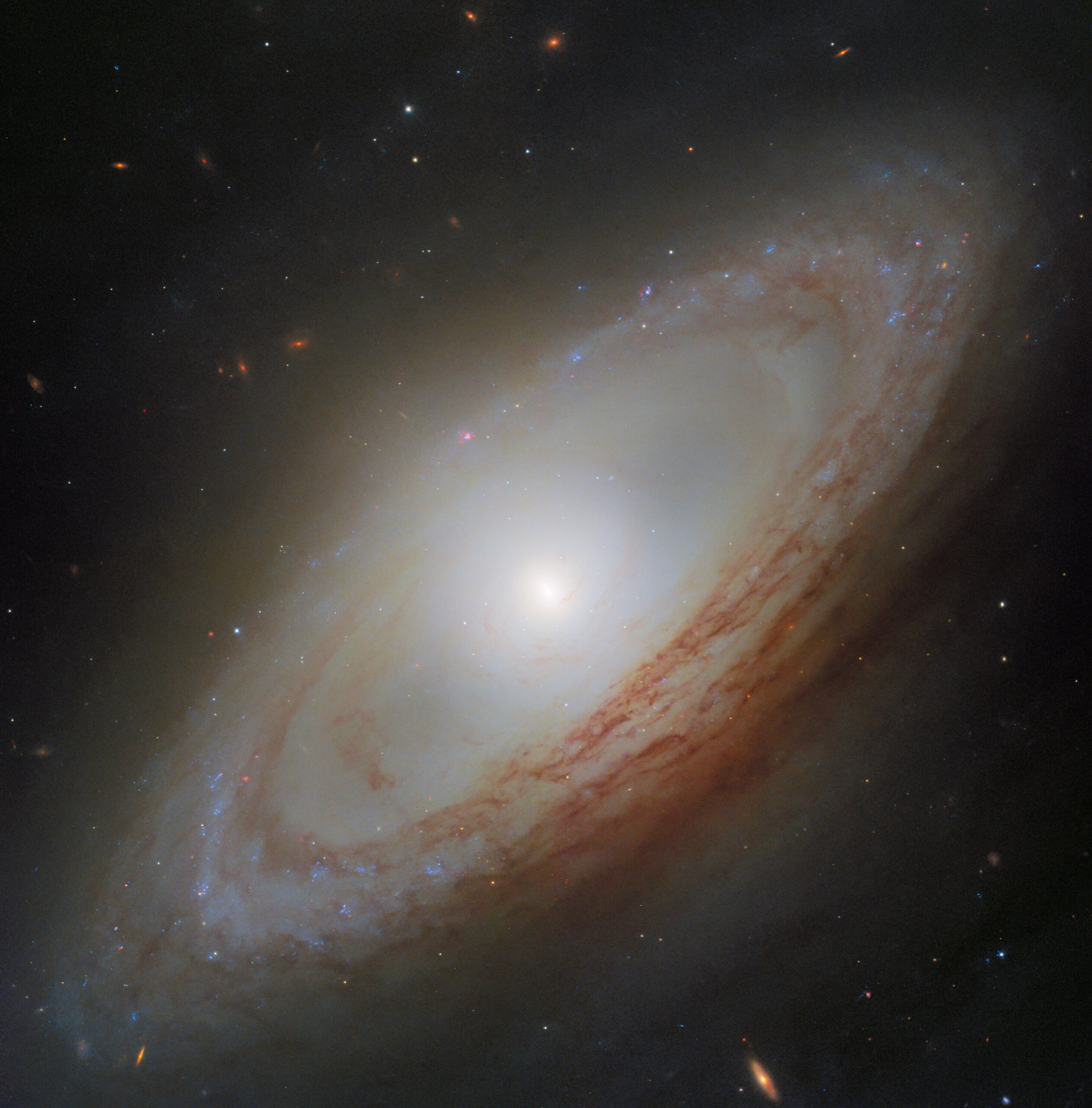
About 55 million light-years away, NGC 4698 looks like a familiar spiral galaxy, but its inner stars and gas rotate in a direction that is perpendicular to the galaxy’s main disk. Astronomers think the unusual structure may have formed after the galaxy took in material from outside.
NGC 4698 sits in the constellation Virgo and is one of more than a thousand galaxies in the Virgo Cluster, the nearest large cluster of galaxies held together by gravity.
Its outer structure looks much like that of a typical spiral galaxy. A thin disk contains stars, gas and dust, with spiral arms curling through the outer parts. Dark clumps of dust mark the arms, along with groups of bright blue stars.
But the arms do not reach inward toward the galaxy’s center as they often do in spiral galaxies. Instead, they form a ringlike structure around the outer part of the disk.
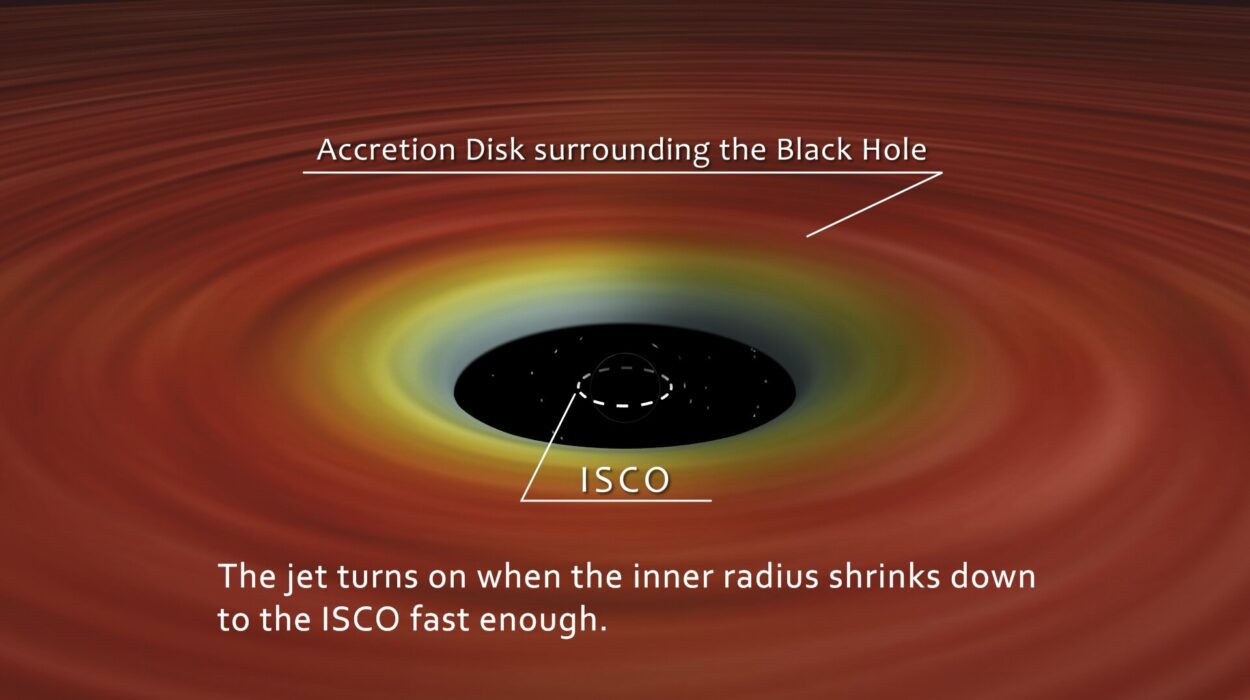
At the center is an elongated bulge made up of smaller, older and cooler stars. Those stars surround a supermassive black hole containing millions of times the Sun’s mass. Signs of active growth suggest that the black hole is drawing gas inward through its gravity.
The most unusual feature, however, is the orientation of the central bulge.
The inner and outer parts are out of alignment
NGC 4698 is one of only a few known spiral galaxies whose bulge extends from the disk at a right angle. In the Hubble image, the faint glow of the bulge can be seen above and below the dusty disk.
The stars and gas near the center also rotate perpendicular to the rest of the galaxy’s disk.
That means the galaxy’s central region is oriented differently from the larger disk surrounding it. Astronomers have looked to the galaxy’s history for a possible explanation.
Material from outside may have changed the center
One possibility is that NGC 4698 acquired gas from an outside source. That gas could have formed a new disk of gas and stars in the galaxy’s center, with the new structure tilted relative to the original disk.
There are also signs that NGC 4698 may once have undergone a minor galactic merger. A short tail of hydrogen extending from one side of the galaxy provides evidence consistent with such an event.
The available evidence therefore points to an external source as a likely cause of the galaxy’s unusual alignment, although the observations do not establish every detail of how the structure formed.
Hubble is studying the galaxy cluster in detail
The image comes from an observing program focused on galaxies in the Virgo Cluster. The program examines nearby galaxies closely enough to study features such as individual star clusters and nebulae.
The same observations are also being used to examine the larger question of how a galaxy’s movement through a cluster affects its evolution and its ability to form new stars.