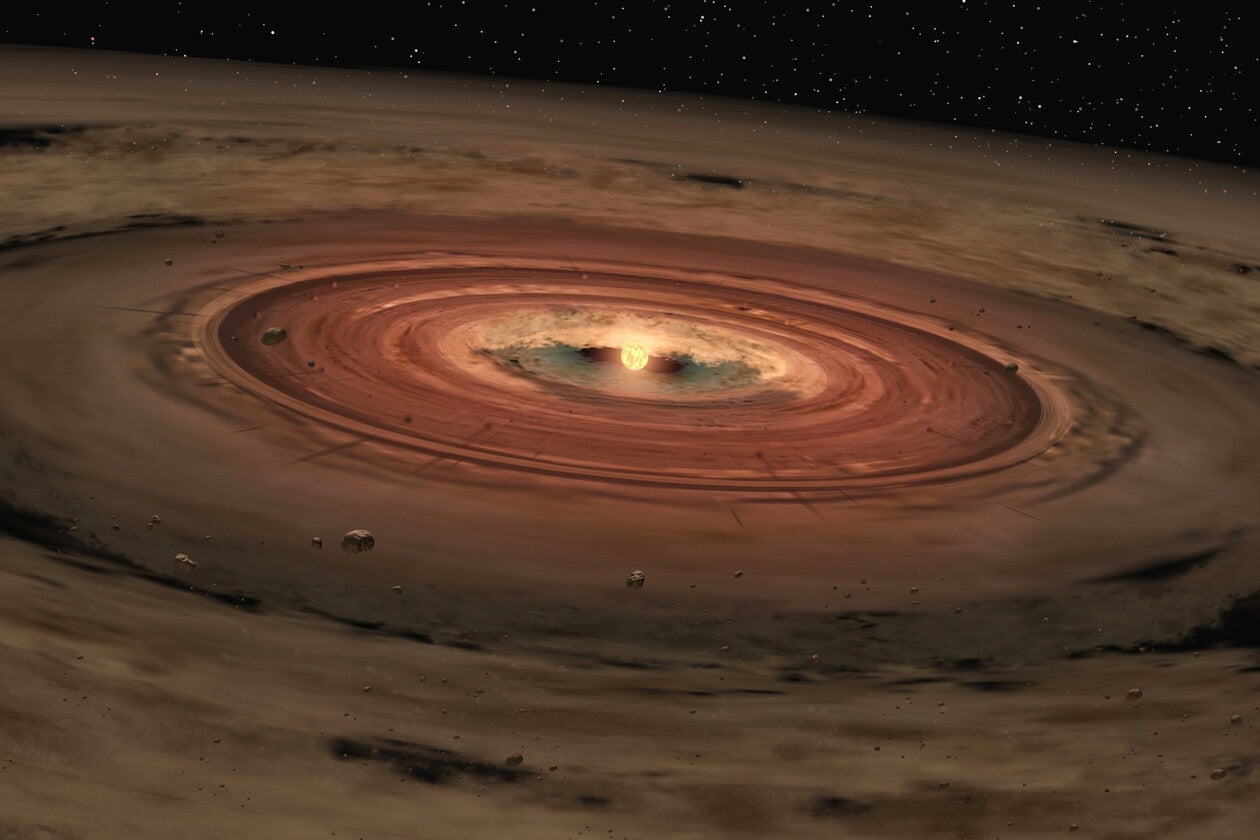
Within the first million years of the solar system’s formation, the earliest solid bodies were already being built mostly from heat-forged rock droplets called chondrules, while much of the cold, icy dust known as matrix was left out.
When the first solid bodies began forming, two basic materials were available. Chondrules were millimeter-sized pieces of rock that had been heated, while matrix was a fine-grained material containing water ice and organic molecules.
A Yale-led study has found geochemical evidence that this separation was happening within the solar system’s first million years. Earlier evidence had documented the same pattern only in objects that formed 2 million to 4 million years after the solar system began.
The researchers examined iron meteorites from the outer solar system for chemical clues about the materials that made up their original parent bodies. Those bodies had contained enough radioactive aluminum-26 to melt completely, so their original physical structures were erased.
The chemical record, however, remained.
Two chemical clues point to the same composition
The researchers used two independent tracers linked to matrix.
One was sulfur, which is concentrated in matrix. The other was the oxidation state of iron, which can indicate how much water ice and oxidized dust had been incorporated into an original body.
Together, the measurements pointed to a surprisingly small amount of matrix. The original bodies represented by the iron meteorites contained only about 8% to 17% matrix.
That result is consistent with the researchers’ conclusion that the earliest outer-solar-system planetesimals were strongly enriched in chondrules. Their estimate puts the chondrule content of these early bodies at about 83% to 92%.
The agreement between the two chemical tracers was important because they provided independent evidence for the same pattern.
Why the earliest physical evidence disappeared
The study also addresses a problem in the meteorite record. Some of the oldest chondrules are scarce because the bodies that incorporated them later melted. That melting destroyed the original physical evidence of how much chondrule and matrix material those bodies contained.
Chondrules themselves are preserved inside chondrites, which are among the most primitive meteorites known. Carbonaceous chondrites from the outer solar system had already provided evidence that earlier-forming examples contained more chondrules and less matrix than later ones.
But no undifferentiated bodies from the solar system’s first million years have survived to provide a direct physical record of their original proportions.
The chemical evidence in the iron meteorites provides another way to reconstruct that lost composition.
The study was published in Nature Astronomy.