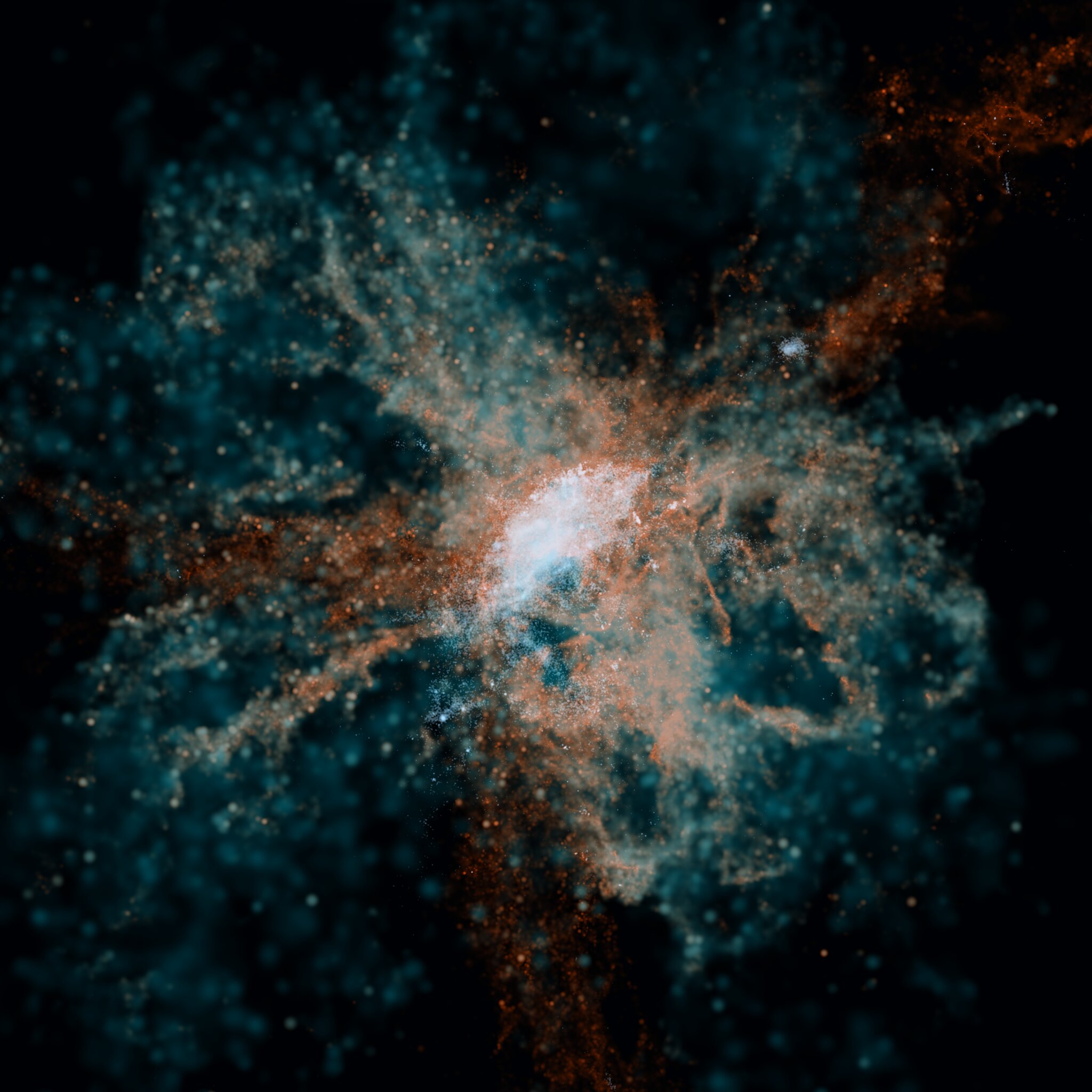
Three young galaxies observed by the James Webb Space Telescope contain evidence of metal-bearing gas moving at speeds of roughly 50–250 kilometers per second relative to the galaxies themselves. The gas includes neutral, low-ionization and high-ionization material, suggesting that the processes that circulate gas and redistribute elements around galaxies were already operating during the early stages of cosmic reionization.
The observations reach back to a time when the Universe was still less than a billion years old. In spectra of three galaxies at redshifts of 7.2 to 9.3, astronomers detected absorption from several chemical elements at wavelengths shifted toward the blue relative to the galaxies’ own reference velocities. The combination of these blueshifts and the overlapping velocity patterns of different ions points to chemically enriched gas with disturbed motions, rather than a single, undisturbed component.
The findings provide direct evidence that at least some luminous galaxies had already begun enriching and redistributing material into their surroundings before the midpoint of reionization. The observations are consistent with outflows, but they do not uniquely establish where the absorbing gas is located or what mechanism set it in motion.
Looking for metals in the galaxies’ own light
Galaxies do not evolve in isolation. Gas can move within them and between a galaxy and the surrounding circumgalactic medium, carrying chemical elements and energy along the way. These exchanges are known collectively as the baryon cycle.
Models predict that metal production and the redistribution of gas can begin soon after star formation gets underway. But directly observing enriched gas around individual galaxies at the earliest cosmic epochs has been difficult. Earlier measurements of metals beyond galaxies largely relied on absorption along quasar sightlines, which generally probe paths through the intergalactic medium rather than gas directly connected to a particular galaxy. Emission lines and broadband observations, meanwhile, primarily reveal properties inside galaxies.
The new work takes a different approach: measuring metal absorption directly against the ultraviolet light emitted by individual galaxies. When gas containing a particular element lies along the line of sight, it can absorb light at characteristic wavelengths. The positions and shapes of those absorption features provide information about the gas’s motion and ionization state.
The team used medium-resolution near-infrared spectroscopy from JWST’s NIRSpec instrument, obtained through the SPectroscopic Ultra-deep Reionization-era Survey, or SPURS, in the Abell 2744 field. The researchers selected galaxies with sufficiently bright ultraviolet continua to make absorption measurements possible, rather than choosing them based on prior knowledge of metal absorption or metallicity.
Of the available JWST data, three galaxies at redshifts above 7 met the study’s requirements. Each had a continuum signal-to-noise ratio greater than 10 near a rest-frame wavelength of 1,450 angstroms and an ultraviolet absolute magnitude brighter than −20.9. Their systemic velocities were established using rest-frame optical nebular emission lines, principally the line at 5008 angstroms.
Five transitions trace different kinds of gas
The spectra revealed absorption from several ions. Neutral oxygen, O I, traces neutral gas; singly ionized silicon, Si II, and singly ionized carbon, C II, trace low-ionization material. The team also detected higher-ionization species: Si IV and C IV.
Galaxy A, at a systemic redshift of 9.3105, showed all five sets of transitions. The two lower-redshift galaxies, B and C, also showed O I, Si II and C II. Si IV was detected in Galaxy B, while C IV was detected in Galaxy C. The presence of absorption from both low- and high-ionization species in the sample allows the researchers to examine gas with different ionization states within the same galaxy-associated absorption systems.
The features were identified at the expected wavelengths of known metal transitions, with detections assessed for significance and consistency across transitions. The researchers also examined two-dimensional spectra to check that the absorption coincided spatially with the galaxies’ continuum traces, rather than arising from detector artifacts or background residuals.
The spectra were obtained at a resolving power of about 1,000. At that resolution, individual narrow components may remain unresolved, so the measured profiles represent effective blends of potentially more complicated absorption structures. In particular, the C II feature can include unresolved fine-structure absorption and weak wing structure that cannot be reliably separated in these data.
The absorption is blueshifted from the galaxies
To measure the gas motions, the researchers compared the absorption-line centroids with the systemic redshifts determined from nebular emission. Across the three galaxies, the absorption features show a common bulk blueshift, with overlapping velocity structures among neutral, low-ionization and high-ionization species.
The fitted centroids are not identical from ion to ion. For example, Galaxy A’s O I absorption is centered at −88 ± 35 kilometers per second, while its Si II absorption is at −116 ± 33 kilometers per second. Its Si IV and C IV doublets are centered farther to the blue, at −178 ± 21 and −176 ± 21 kilometers per second, respectively. In Galaxy B, Si II is centered at −178 ± 70 kilometers per second and Si IV at −261 ± 28 kilometers per second. Galaxy C’s O I, Si II and C II centroids are −29 ± 34, −83 ± 42 and −55 ± 28 kilometers per second, while its C IV doublet is centered at −236 ± 21 kilometers per second.
These measurements show why the authors emphasize the shared overall velocity pattern rather than treating every ion as having precisely the same motion. The higher-ionization absorption may be more blueshifted than the neutral and low-ionization absorption, but the size of that difference varies by galaxy and by which lines are compared. Higher-resolution observations would be needed to establish a detailed ionization-dependent velocity structure.
The observed offsets cannot be explained by Hubble expansion relative to the galaxies’ rest frames. The authors interpret the overlapping profiles and blueshifts as evidence for gas dynamically associated with the host galaxies. They are consistent with outflowing material, but velocity information alone cannot distinguish compact outflows from gas on larger circumgalactic scales, or determine whether all the absorption arises in the same physical location.
The systemic reference itself was checked against Hβ where that line was detected. For Galaxy C, Hβ and agree within about 5 kilometers per second. For Galaxy B, Hβ is offset redward by about 90 kilometers per second; using it instead would increase the inferred absorption blueshift. Hβ is only weakly detected in Galaxy A, so it does not provide a comparably reliable independent centroid there. The researchers report that adopting Hβ where available does not remove the blueshifted absorption signature.
The line widths point to motions beyond simple heating
The researchers also used the absorption-line widths to place upper limits on gas temperature under the assumption that the broadening comes entirely from thermal motion. They corrected approximately for instrumental broadening and converted the resulting widths into thermal-only temperature limits.
Those limits are weak: they exceed the temperatures at which the detected ions would survive in the relevant ionization states. The authors therefore conclude that the measured profiles are probably dominated by non-thermal motions, such as turbulence, bulk flows or unresolved velocity substructure, rather than by thermal broadening alone.
The temperature estimates should not be read as direct measurements. The spectral resolution is moderate, the instrumental line-spread function varies with wavelength, and unresolved components, saturation and blending can affect the fitted widths. The authors use the calculations as a physical consistency check, not as precise determinations of the gas temperature.
The balance between ions varies from galaxy to galaxy
The relative strengths of the absorption lines provide another way to compare the gas. The team measured rest-frame equivalent widths, which quantify the strength of an absorption feature, and examined ratios involving high- and low-ionization species, including Si IV/Si II and C IV/C II, as well as ratios involving neutral oxygen and low-ionization carbon.
Galaxies B and C occupy a relatively narrow region of this equivalent-width-ratio space. Their ratios are broadly similar to one another and comparable to values measured from a composite spectrum of star-forming galaxies at redshift around 3. Galaxy A, at redshift 9.3, spans a wider range, with lower O I/C II and Si II/C II ratios and a higher Si IV/Si II ratio.
The comparison does not mean the three systems have identical gas conditions, nor does it establish a unique physical explanation for their differences. Lower-redshift galaxies themselves show substantial object-to-object scatter, particularly in ratios involving O I. The range seen in this small high-redshift sample does not obviously exceed that lower-redshift scatter, although the galaxies clearly differ from one another.
The authors favor equivalent-width ratios as empirical diagnostics because they do not require detailed ionization corrections or an absolute metallicity estimate. They caution, however, that saturation, blending and uncertain covering fractions limit what can be inferred from the line strengths.
The team also estimated lower limits on ionic column densities using the optically thin approximation. These are conservative lower limits because unresolved saturation and partial covering can make the true columns larger. The researchers do not convert these estimates into a total metal mass or a metal-to-stellar-mass ratio, since doing so would require information about the absorber’s area, covering fraction, geometry and ionization correction.
A separate comparison of carbon ions, C II and C IV, was used only as a qualitative check. The inferred ratios fall within the broad range reported for quasar-selected absorbers at redshifts of roughly 2–6, but the study says the data do not permit robust constraints on the gas’s ionization state from those carbon ratios alone. Simple photoionization models provide qualitative guidance, not the basis for the main conclusions.
Enrichment was already underway in blue, luminous galaxies
The host-galaxy measurements add context to the absorption. The three galaxies have stellar masses of approximately 109.8010^{9.80}109.80, 109.1110^{9.11}109.11 and 109.4810^{9.48}109.48 solar masses for A, B and C, respectively. Their observed ultraviolet slopes are −2.19, −2.12 and −2.26, and their spectral-energy-distribution fits favor subsolar but non-negligible gas-phase metallicities.
These properties indicate that detectable metal-bearing gas can coexist with relatively blue ultraviolet continua in these systems. The authors note that the data do not provide a quantitative dust-to-metal constraint: that would require independent measurements of the total gas-phase metal and dust content.
The inferred recent star-formation rates in the youngest age bins of the spectral-energy-distribution fits are 19, 39 and 29 solar masses per year for Galaxies A, B and C. The combination of metals already present by redshift 9.3 and the host galaxies’ properties places constraints on how rapidly early star formation could produce and distribute elements. But the study does not determine a unique enrichment history or stellar population from these measurements.
The authors compare approximate relative-abundance indicators with measurements of other high-redshift absorbers and with chemical-evolution model regions. Because the strong low-ionization lines may be affected by unresolved saturation and non-uniform covering, these indicators are best understood as line-strength ratios mapped into abundance space for rough comparison. The three galaxies overlap regions occupied by previously studied absorbers and do not show extreme offsets relative to lower-redshift systems. The comparison is not used to identify a particular nucleosynthetic channel or stellar population.
The authors discuss theoretical models in which rapid enrichment can occur without a dominant contribution from Population III stars. Such models are a possible context for the observations, not a conclusion established by the absorption measurements themselves.
What the observations establish—and what remains uncertain
Taken together, the detections establish that metal-enriched gas with multiple ionic phases and disturbed kinematics was already associated with at least some luminous galaxies during reionization. The simultaneous presence of low- and high-ionization absorption, including C II and C IV in the same blueshifted complexes, is difficult to reconcile with a single quiescent component. It is consistent with multiphase gas such as material in outflows, inner circumgalactic structures, or a combination of both.
The data do not resolve the gas spatially, identify a unique acceleration mechanism, or establish whether the absorbing material is escaping the galaxies or may include recycled gas. A weak or obscured active galactic nucleus cannot be excluded in every case, although the spectra show no direct AGN signatures such as broad emission lines, and the available nebular measurements do not require an AGN explanation.
The sample also has an important limitation: continuum absorption measurements at these redshifts are feasible only for galaxies bright enough to provide sufficiently high signal-to-noise ultraviolet spectra. The three targets therefore demonstrate that early baryon-cycle signatures existed in a subset of luminous galaxies, not how common those conditions were across the entire galaxy population. The authors also stress that the observations do not directly constrain the sources or timing of reionization.
The study was published in Nature Astronomy.