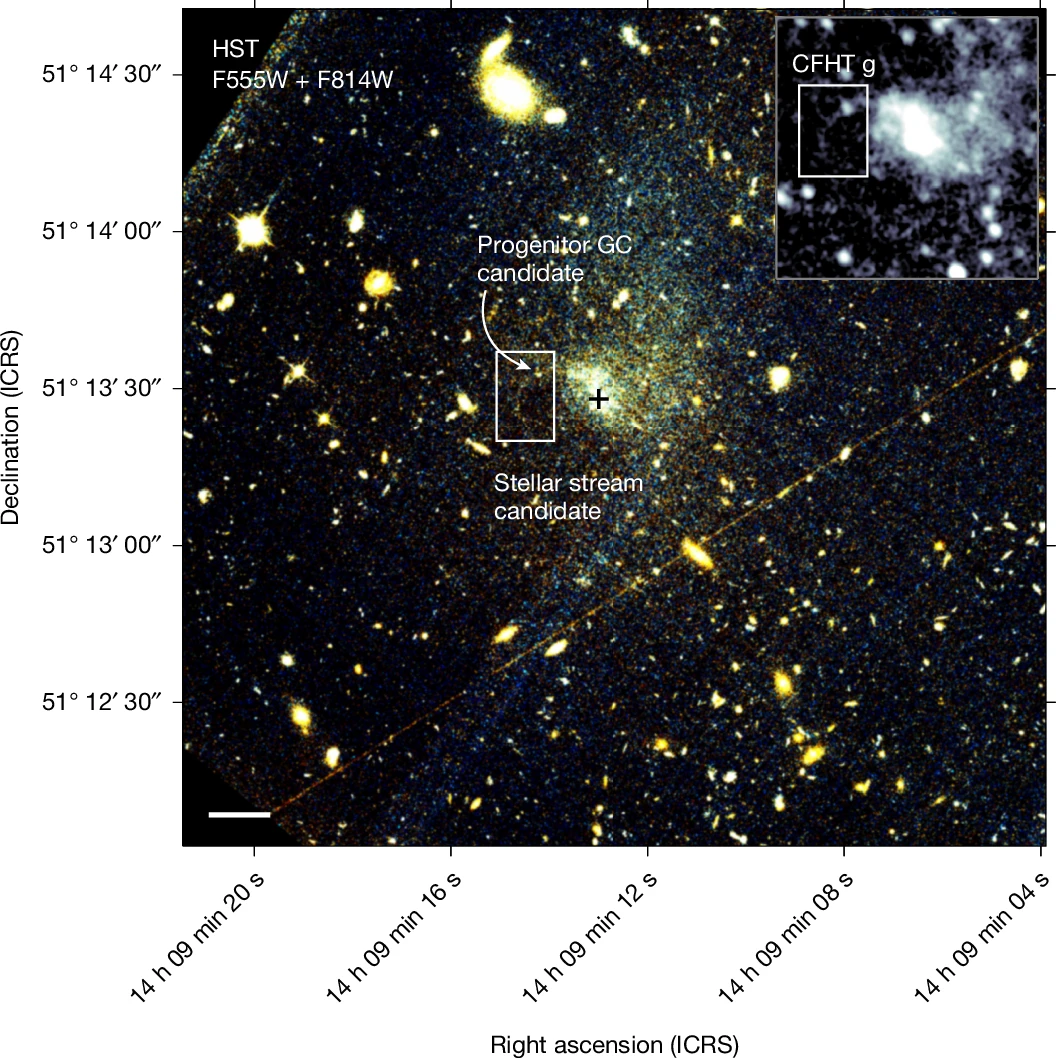
Faint, narrow stars extend from a compact object in the ultra-diffuse galaxy UGC 9050-Dw1, forming a feature that may be a globular cluster being torn apart outside the Milky Way. Named Oyashio, the feature appears in independent Hubble Space Telescope and Canada–France–Hawaii Telescope images, and its shape, color and dynamical modeling are consistent with a globular-cluster origin. If that interpretation holds, the stream would provide a new way to measure the dark matter halo of an ultra-diffuse galaxy.
UGC 9050-Dw1 is an ultra-diffuse galaxy, a type of galaxy with a relatively small stellar mass spread over a much larger area. Its faintness makes conventional measurements of its mass distribution difficult.
The candidate stream lies about 2.5 kiloparsecs in projection from the center of UGC 9050-Dw1. The galaxy is at a distance of 35.2 ± 2.5 megaparsecs and is probably associated with the low-surface-brightness spiral galaxy UGC 9050. The stream-like feature extends roughly 2 kiloparsecs from a compact source identified as a globular-cluster candidate.
The researchers call the feature Oyashio. It was initially identified by eye in Hubble imaging, but a rolling Hough-transform analysis independently recovered both its location and curvature. More importantly, the structure appears in Hubble and CFHT data, making an imaging or data-processing artifact an unlikely explanation.
In the combined Hubble image, the stream’s signal has a measured prominence of 7.34 relative to the background standard deviation. A Gaussian fit gives a width of 72.3 ± 8.9 parsecs, while the fitted amplitude corresponds to a signal-to-noise ratio of 5.2. Comparable fits to CFHT images give signal-to-noise ratios between 2.3 and 3.9 in the g, r and i bands. The feature is not confidently detected in the u and z bands.
The authors emphasize that this quoted statistical significance refers only to the significance of the signal in the data. It does not by itself establish that the feature is a stellar stream or account for the probability of finding such a feature in the first place.
The narrowness of the structure is one reason the researchers considered a globular cluster as its possible source. Globular-cluster streams in the Milky Way range from a few tens to a few hundred parsecs in width, whereas streams produced by dwarf-galaxy progenitors can be substantially wider. The authors note, for example, that the Milky Way’s Orphan–Chenab stream has a width greater than 200 parsecs.
The stream and its possible parent have matching colors
A second clue comes from the light itself.
Because individual stars cannot be resolved in the distant system as they can in nearby Milky Way streams, the researchers compared the integrated colors of Oyashio and the compact source beside it. The candidate cluster has an F555W−F814W color of 1.1 ± 0.1, while the stream has a color of 1.0 ± 0.2. Both fall within the color-selection region used for globular-cluster candidates in UGC 9050-Dw1.
That similarity is what would be expected if the two objects share the same stellar population. The researchers also found that both are consistent with the colors of the galaxy’s other globular-cluster candidates. The relatively blue colors of the system’s clusters are consistent with the possibility that they formed more recently than typical Milky Way globular clusters.
The color comparison does not by itself prove that the compact source is the stream’s parent. But combined with the spatial alignment and narrow morphology, it provides another piece of evidence for the proposed association.
Modeling the stream’s shape
The researchers next asked whether a globular cluster could actually produce a stream with the observed shape and location.
They used the X-Stream sampler, a generative stream-modeling method that compares observed stream morphology with simulated tidal streams. The models varied the properties of both the possible globular-cluster progenitor and the dark matter halo of UGC 9050-Dw1.
The analysis used ten free parameters with uniform priors. The researchers fixed the progenitor’s position in the plane of the sky and tested two dark matter halo concentrations, c = 2 and c = 5. Their fiducial models used c = 5. They also repeated the analysis with a broader stream mask to test whether the assumed width substantially changed the result.
For each model, the simulated stream was compared with control points representing the observed feature. The comparison used a kernel-density estimate and a Kullback–Leibler divergence to determine how closely the model reproduced the observed morphology. Models that were too straight, too curved, displaced from the observed feature or too wide were disfavored.
The resulting models put an upper limit of 2.5 × 10⁶ solar masses on the initial mass of the possible progenitor at 95% confidence. The result is consistent with a globular-cluster progenitor.
The stream’s measured surface brightness provides another constraint. In the Hubble images, it is 27.0 ± 0.1 magnitudes per square arcsecond in F555W and 26.1 ± 0.1 magnitudes per square arcsecond in F814W.
The researchers compared those measurements with simulated stellar populations modeled on the Milky Way globular-cluster stream Palomar 5. A population with the same age, metallicity and degree of disruption as Palomar 5 would require an initial cluster mass of about 2 × 10⁶ solar masses, or roughly 20 times the mass used for the Palomar 5 comparison. But when the researchers explored a grid of stellar ages, younger populations could reproduce the observed brightness with substantially less mass. The brightest isochrone required a progenitor mass of 1.65 × 10⁵ solar masses.
Both that lower-mass model and the 20-times-Palomar-5 model fall within the 95% confidence regions of the dynamical modeling.
The stream also constrains the galaxy’s dark matter halo
The same stream morphology can be used to infer properties of the galaxy through the gravitational field in which the stream is moving.
The X-Stream analysis gives a halo scale mass of log₁₀(Mh/M☉) = 11.31, with −0.71 and +0.67 uncertainties at the 68% level and −1.30 and +1.03 at the 95% level. Using Planck cosmological parameters, this corresponds to log₁₀(M200/M☉) = 11.63, with −0.83 and +0.71 uncertainties at 68% confidence. The inferred inner density slope is γ = 0.92, with −0.58 and +0.57 uncertainties at 68% confidence and −0.87 and +0.92 at 95% confidence.
These measurements constitute the study’s first stream-based constraint on the dark matter halo mass and density slope of an ultra-diffuse galaxy. The modeling strongly constrains the possible line-of-sight position of the progenitor and its orbit, while the halo scale radius and outer density slope remain unconstrained.
The inferred total mass, expressed as M200 = 1.56 × 10¹¹ solar masses, is consistent within the stated uncertainties with previous halo-mass estimates for UGC 9050-Dw1 based on its globular-cluster population. The authors also find that the modeled tidal radius is compatible with a globular cluster losing stars into a stream. For one representative model, the present-day tidal radius is 133 parsecs and the minimum tidal radius is 95 parsecs.
One representative model has a present-day galactocentric radius of 2.52 kiloparsecs and an enclosed galaxy mass of 1.36 × 10¹⁰ solar masses.
The modeled stream also helps explain why only one arm is readily visible. In the simulations, the opposite arm extends toward the brighter central part of the galaxy and passes behind it, where it could be hidden in the galaxy’s light.
Other structures could resemble the feature
The researchers considered several alternatives to a globular-cluster stream.
A stream produced by a small dwarf galaxy could potentially look similar, but its expected width and the dynamical mass constraints point toward a globular-cluster progenitor. The authors also simulated a dwarf-like stream containing dark matter. For such a stream to be visible at the observed surface brightness, they estimate that it would require roughly five times more stellar mass than their upper limit for the proposed progenitor, while also appearing wider than Oyashio in the Hubble data.
Other possible explanations include tidal tails produced by mergers of globular clusters or nuclear star clusters, tidal shells from collisions between stellar systems, gravitational lensing and dust-related brightness fluctuations. The merger-tail scenario is difficult to reconcile with the feature’s position more than 2 kiloparsecs from the center of the galaxy, while the curvature of Oyashio is offset from the host’s center in a way the authors say is not expected for a tidal shell. They also find no other arcs or plausible lensing objects in the relevant region.
The possibility of a chance alignment of unresolved stars within UGC 9050-Dw1, or a chance projection of stars unrelated to the galaxy, cannot be entirely ruled out. The authors point to the matching colors, the dynamical modeling, agreement with independent halo-mass estimates and the mock observations as evidence supporting the globular-cluster-stream interpretation.
The observations themselves also have important limitations. The measured width can be affected by nearby objects and by the fact that the observations may reveal only the brightest central portion of the stream. Restricting the width measurement to avoid a brighter neighboring object gives a smaller width of 52 parsecs. The authors therefore test broader masks in their modeling rather than relying on a single width estimate.
The simulated stellar populations likewise depend on assumptions about the stellar isochrones, the amount of disruption and the stream model. The authors describe their mock observations as a zeroth-order test of which parts of the modeled streams could be detected in the Hubble data.
Deeper observations could provide a more decisive test. The researchers say that deeper Hubble or James Webb Space Telescope observations could distinguish the feature more clearly from the background and determine its origin with greater certainty. Spectroscopic observations could also compare the stellar populations in the stream with those of the presumed parent cluster.
For now, the evidence from the narrow morphology, matching colors, surface-brightness modeling and dynamical fits collectively supports the interpretation that Oyashio is a globular-cluster stellar stream associated with UGC 9050-Dw1. The authors describe it as evidence for the first globular-cluster stream identified beyond the Milky Way, while retaining the qualifications imposed by the unresolved background and the need for deeper observations to establish its origin with greater certainty.
The study was published in Nature.