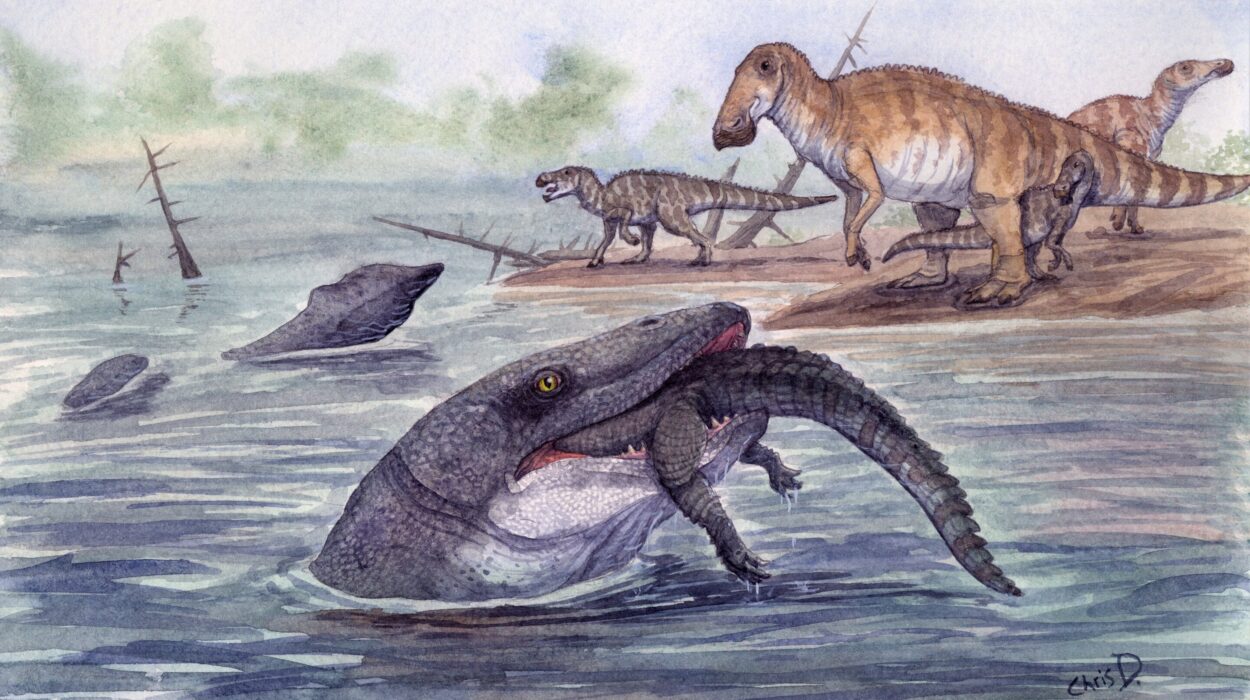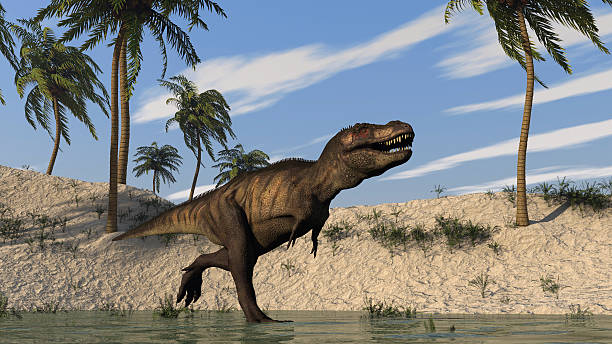
For a dinosaur that lived in a world of changing temperatures, Tyrannosaurus rex appears to have carried its own heat: isotope measurements from three teeth indicate an average body temperature of 36.3°C, substantially warmer than that of crocodilians living in the same Late Cretaceous environment and warmer than the surrounding climate.
The estimate comes from three T. rex teeth recovered from the Hell Creek Formation in Montana. Two belonged to a well-preserved young adult specimen known as Thomas, while the third was an isolated partial tooth. The researchers analyzed the teeth using carbonate clumped isotope thermometry, a method that uses the abundance of particular bonds between carbon-13 and oxygen-18 in mineralized tissue to estimate the temperature at which that tissue formed.
The approach is useful for this question because it does not depend on knowing the composition of the animal’s body water. Earlier isotope studies of T. rex and other tyrannosaurids were affected by uncertainty over body-water composition, making it difficult to translate their isotope measurements directly into body temperature.
The three T. rex teeth produced remarkably similar estimates despite coming from two specimens. The two teeth from Thomas yielded temperatures of 37.3 ± 3.3°C and 35.9 ± 2.8°C, with an average of 36.6 ± 2.8°C. The isolated tooth produced an estimate of 34.7 ± 2.5°C.
Taken together, the three teeth gave an average body temperature of 36.3 ± 2.5°C.
The measurements were based on 13 clumped-isotope analyses in total. The researchers report the uncertainty as one standard error.
That temperature falls within the range measured in several living endothermic animals. The authors note that it is close to reported body temperatures of Indian and African elephants, at 36.0° and 36.2°C, respectively. It is also within the uncertainty of temperatures reported for large flightless birds such as ostriches and emus, although smaller flying birds generally have higher body temperatures.
The comparison does not by itself establish that T. rex had the same metabolism as any particular living animal. The researchers emphasize that body temperature alone is not an unambiguous measure of metabolic rate.
The fossils had to pass several preservation tests
Before treating those temperatures as biological signals, the researchers examined whether the original isotope information had survived fossilization.
That is a significant issue for isotope thermometry because chemical alteration after burial can potentially change the measurements and produce an apparent temperature that was never present in the living animal.
The researchers used several independent tests. They compared carbon isotope values from the T. rex and crocodilian teeth with isotope patterns expected from their diets and with measurements from other Late Cretaceous animals. They also compared enamel with dentin, examined the relationship between oxygen isotopes in carbonate and phosphate from the same teeth, and used Fourier transform infrared spectroscopy to look for chemical alteration.
The enamel and dentin showed distinct isotope compositions, consistent with the greater susceptibility of dentin to alteration while not indicating comparable alteration of the enamel used for the temperature estimates.
The carbonate-phosphate oxygen isotope offsets in the T. rex teeth ranged from 9.8 to 10.4 per mille, within the 6.6 to 10.6 per mille range observed in modern mammals.
The FTIR measurements provided another indication that the fossils retained their original chemical characteristics. The Hell Creek teeth more closely resembled modern alligator teeth than older, chemically altered Jurassic dinosaur enamel. Their carbonate contents ranged from 6.3 to 7.4 weight percent, close to values calculated for modern reptilian enamel.
Taken together, the tests did not reveal clear evidence of post-burial alteration capable of explaining the measured T. rex temperatures.
Crocodilian teeth provide a comparison
The researchers also analyzed five crocodilian teeth from the Hell Creek Formation. Because these animals lived in the same broad Late Cretaceous ecosystem, they provide a useful comparison with T. rex.
The crocodilian measurements were much more variable. Individual teeth produced temperatures ranging from 27.7° to 38.2°C, with an overall average of 30.9 ± 2.6°C.
The difference between the T. rex and crocodilian measurements was statistically significant. A Welch’s t test gave t(22.99) = 2.78, with P = 0.0108.
The crocodilian results also fall within a range that is biologically plausible for living crocodilians. Modern crocodilians can raise their body temperatures above their surroundings through behavioral thermoregulation, such as moving between water and sunlit areas. Their preferred temperatures are generally around 30° to 35°C, while temperatures around 38° to 39°C can become critical.
The authors therefore interpret the difference between the two fossil groups as evidence that they had different thermophysiological strategies.
But the distinction is not presented as proof of a particular metabolic mechanism. A large dinosaur might have maintained a relatively high and stable body temperature partly because of its size, a phenomenon known as inertial homeothermy, without necessarily having the high metabolic rate associated with modern endotherms.
The researchers specifically caution that body temperature should not be used by itself to infer metabolic rate.
T. rex was warmer than its surroundings
The researchers next asked whether the dinosaur’s body temperature could simply have reflected the temperature of its environment.
The answer from several independent environmental estimates was no.
They used high-resolution climate simulations representing the late Maastrichtian, the final interval of the Cretaceous. The atmosphere-only model had a grid resolution of about 60 kilometers and was run using two atmospheric carbon dioxide concentrations, 840 and 1,680 parts per million by volume.
For the Hell Creek region, the simulations produced warm-month air temperatures of 24.9° to 29.5°C under the lower CO2 scenario and 27.7° to 33.4°C under the higher one. Mean annual temperatures were 17.8°C and 20.7°C, respectively.
Both sets of simulated temperatures were below the measured T. rex body temperature.
The researchers also compared the dinosaur measurements with temperatures recorded by fossil unionid bivalves from the Hell Creek Formation. Those clumped-isotope measurements, covering approximately the last 300,000 years of the Maastrichtian, produced environmental temperatures between 22.6° and 30.5°C, with an average of 25.9 ± 1.2°C.
The T. rex temperatures were significantly warmer than the bivalve-derived temperatures, with a Mann-Whitney test producing z = −4.25 and P ≤ 0.0001.
The combined evidence therefore indicates that T. rex maintained a body temperature above the temperature of its surrounding environment.
Its body water also carries a physiological signal
The researchers found another difference between T. rex and the crocodilians when they reconstructed the oxygen-isotope composition of body water.
Body water does not necessarily have exactly the same isotope composition as the water an animal consumes. The difference is influenced by physiology and ecology, so comparing body water with environmental water can provide another indication of how an animal handled water internally.
For the crocodilians, the estimated difference between body water and environmental water was 1.8 ± 0.3 per mille. That is close to the roughly 2 per mille offset measured in modern crocodilians.
For T. rex, the corresponding difference was considerably larger, averaging 4.5 ± 0.7 per mille.
That value is similar to the body-water-to-drinking-water differences reported for living birds, including ostriches and chickens.
The researchers say the contrast is consistent with the expected biological differences between a terrestrial endotherm and a semiaquatic ectotherm. They also acknowledge a limitation: reconstructing environmental water for T. rex required using an oxygen-isotope fractionation relationship established from modern birds, which may not be a perfect model for a tyrannosaur.
Even so, the reconstructed environmental-water values for T. rex broadly agree with those obtained for the contemporary crocodilians.
The temperature does not settle the endothermy question by itself
The isotope results add another piece of evidence to a larger question about how T. rex regulated its body temperature.
The authors argue that several lines of evidence point toward homeothermy and possibly a high-metabolic-rate form of endothermy. Among them is the presence of young tyrannosaurid remains at very high paleolatitudes in what is now northern Alaska. Those animals appear to have persisted there through seasons that included temperatures below freezing.
The researchers say that this distribution implies substantial cold tolerance and is compatible with homeothermic endothermy.
The new temperature measurements fit that interpretation because T. rex maintained a body temperature substantially above the surrounding environment.
But the authors stop short of claiming that the isotope measurements alone demonstrate a specific metabolic strategy. The possibility of inertial homeothermy remains part of the interpretation, and the relationship between dinosaur body temperature and metabolic rate remains debated.
There is also a sampling limitation. The T. rex samples came from restricted areas of the tooth crowns because the researchers sought to minimize damage to the specimens. That creates the possibility that the samples could reflect a particular season of tooth growth.
The two different areas sampled from two separate teeth of Thomas produced statistically indistinguishable temperatures, however, with a Welch’s t test giving P = 0.66. The three teeth also showed no obvious temperature outlier that would indicate a strong seasonal bias.
The researchers nevertheless state that they cannot conclusively rule out seasonal bias because the sample size is small and clumped-isotope analysis requires enough material to limit how finely teeth can be sampled.
A warmer body could have expanded the dinosaur’s range
The temperature estimate was then used to explore what kind of climate T. rex could have tolerated across Late Cretaceous North America.
The researchers constructed a thermal-suitability curve using the measured T. rex temperatures together with thermal limits observed in living homeothermic endotherms. The inferred central thermal range for T. rex extended from 34.7° to 37.3°C, with 36.3°C at its peak.
The modeled curve allowed suitability to decline toward the extreme thermal limits represented in the modern endotherm dataset. The model used −13°C and 43.6°C as the broad lower and upper limits and extended the upper-temperature decline toward approximately 45° to 48°C.
The researchers combined this thermal response with seasonal temperature and precipitation information from the climate simulations. They also considered uncertainty in the position of the Western Interior Seaway, using different coastline configurations rather than assuming a single precise Late Cretaceous shoreline.
The analysis incorporated two CO2 scenarios and alternative highstand and lowstand configurations of the seaway.
The resulting suitability maps indicate that climatically suitable conditions for a T. rex-like thermal niche extended across much of the North American paleocontinent, including regions at colder and higher latitudes.
The model was not intended to reconstruct the exact historical range of every T. rex population. Instead, it represented a hypothetical T. rex-like predator whose thermal response was based on the physiological information inferred in the study, combined with seasonal climate and precipitation.
Heat stress was not the main modeled constraint
The researchers also examined a different aspect of temperature: the combined effects of heat and humidity.
Wet-bulb temperature accounts for both air temperature and moisture and can be more relevant to heat stress than temperature alone. In modern endotherms, sustained wet-bulb temperatures above about 35°C are considered capable of severely compromising survival.
In the Maastrichtian climate simulations used here, that threshold was never exceeded.
The authors therefore conclude that, within these simulations, moist heat stress did not constrain T. rex habitability.
The modeled thermal niche was based partly on a dataset containing more than 2,000 living metazoan animals. The researchers filtered that dataset to focus on avian and mammalian endotherms and obtained a subset of 465 homeothermic endotherms for the thermal-range analysis.
Precipitation was incorporated as a relatively loose constraint. Areas receiving more than 1 millimeter of precipitation per day received higher suitability scores in the model’s precipitation component.
The resulting habitat estimates therefore combine the measured T. rex temperature, thermal limits drawn from living endotherms, simulated Late Cretaceous temperatures, precipitation, and alternative reconstructions of the Western Interior Seaway.
The isotope evidence provides the central measurement: T. rex teeth record an average body temperature of 36.3 ± 2.5°C. That temperature was significantly higher than the average recorded in the contemporaneous crocodilian teeth and higher than both fossil-derived environmental temperatures and the air temperatures produced by the climate simulations.
The authors interpret those differences as evidence that T. rex maintained an elevated body temperature and as an additional line of evidence supporting homeothermy and possibly tachymetabolic endothermy. They also emphasize that body temperature alone cannot conclusively determine thermoregulatory strategy or metabolic rate.
The study was published in Science Advances.