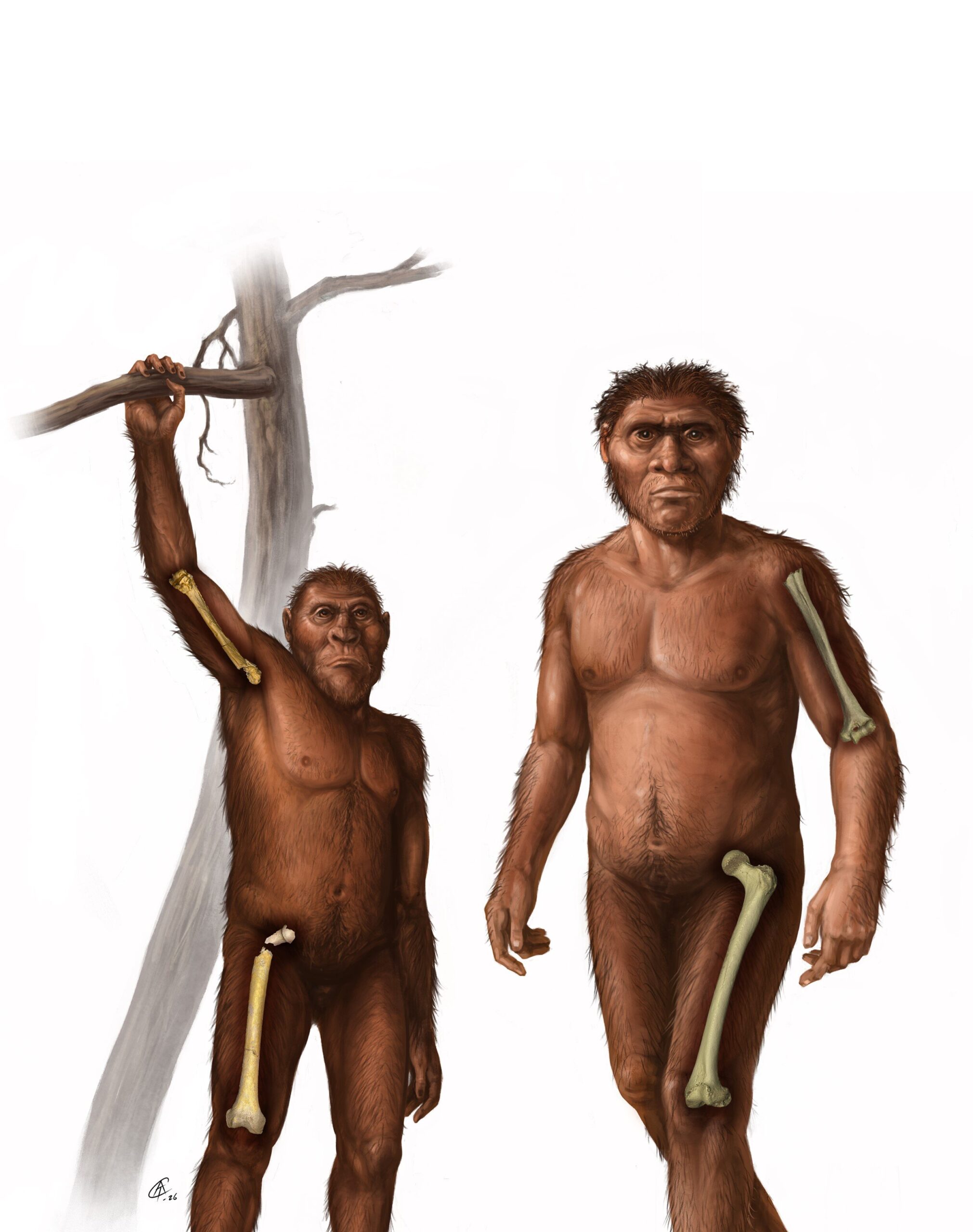
The limb bones of an early human relative called Little Foot carry a mechanical signature that points in two directions at once. At about 3.67 million years old, the Australopithecus prometheus skeleton has forelimb-to-hindlimb strength proportions more like African apes than modern humans, suggesting that arboreal movement remained an important part of its behavioral repertoire. Yet within its hindlimb, the tibia is relatively strong in a pattern closer to modern humans. The same combination appears in other Australopithecus specimens, while the much younger Dmanisi early Homo individual has limb-strength and joint proportions that are broadly modern human-like. Together, the fossil comparisons place a major change in limb loading patterns somewhere between about 3 and 1.8 million years ago, although the available fossils cannot establish the precise timing.
Reconstructing how extinct hominins moved is difficult because many of the skeletal features used for that purpose can have more than one explanation. A relatively long forelimb, for example, might reflect an adaptation to a particular form of locomotion, but it might also persist from an earlier ancestor or have limited functional significance.
The researchers therefore focused on a different kind of evidence: the internal structure of long-bone shafts. The strength of these shafts can change during development in response to the mechanical loads placed on bones during life. In living humans and other hominoids, the relative strength of forelimb and hindlimb bones differs among groups with different locomotor and positional behaviors. The researchers used those relationships as a comparative framework for interpreting fossil hominins.
The main measure was the polar section modulus, or Zp, a geometric measure of the strength of a bone shaft against twisting and average bending. The researchers treated it as an index of overall diaphyseal strength and compared the strength of the femur and tibia with that of the humerus. They also examined the relative breadths of major joint surfaces, including the femoral head, tibial plateau and distal humerus.
Rather than simply dividing one measurement by another, the researchers used reduced major axis regressions on natural-log-transformed measurements. This was important because several of the relationships did not scale proportionally with body size. Fossils were then assessed according to how far they fell from the regression relationships of living comparative groups, measured in standard-error-of-estimate units. None of the pairwise differences in regression slopes was statistically significant, allowing differences in the elevations of the regression lines to be used to compare proportional patterns.
Living apes establish the comparison
The reference sample included modern humans, chimpanzees, two groups of gorillas and orangutans. The human sample contained 1,279 adults, while the chimpanzee sample included 96 individuals. The gorilla comparisons separated 26 Virunga mountain gorillas from 37 other gorillas, and the orangutan sample contained 20 individuals. The animals were free-ranging adults. Only female gorillas were used in most of the quantitative comparisons to keep their body-size range closer to the other groups.
The researchers also compiled behavioral observations to estimate the percentage of observation time each nonhuman group spent in arboreal environments. In the principal femoral-to-humeral strength comparison, the values ranged from 7% for mountain gorillas and 27% for the other gorillas to 51% for chimpanzees and 98% for orangutans. Modern humans were assigned 0% in this comparison.
The living animals showed a striking ordering in femoral-to-humeral shaft strength. Modern humans occupied the highest position, followed by mountain gorillas, other gorillas, chimpanzees and finally orangutans. The sequence broadly ran opposite to the groups’ observed use of arboreal environments. For tibial-to-humeral strength, the separation between humans and the nonhuman groups was even greater, but the nonhuman groups overlapped more and did not form the same orderly sequence. Chimpanzees, for example, could not be distinguished from mountain gorillas in this measure despite spending more time in trees.
The joint measurements told a less straightforward story. Modern humans generally had relatively large lower-limb joint dimensions, particularly when femoral-head breadth was compared with distal humeral breadth. But the nonhuman groups overlapped substantially, and their joint proportions did not track their degree of arboreality as consistently as femoral-to-humeral bone strength did.
This distinction matters because the researchers did not treat every measurement as an equally direct indicator of arboreality. Diaphyseal strength responds to mechanical loading, whereas joint size can also reflect requirements for movement and joint mobility.
Little Foot extends the evidence to a larger Australopithecus
The fossil record has previously provided only a small number of hominin skeletons with enough associated upper- and lower-limb material to make these comparisons. Before this study, only one Australopithecus individual, the approximately 3.2-million-year-old A.L. 288-1, commonly known as Lucy, had been examined for relative limb shaft strength.
Lucy is relatively small, with an estimated body mass of 28.9 kilograms. Her femoral-to-humeral strength proportions fall between modern humans and chimpanzees but closer to the chimpanzee pattern, indicating greater relative loading of the forelimb than in modern humans.
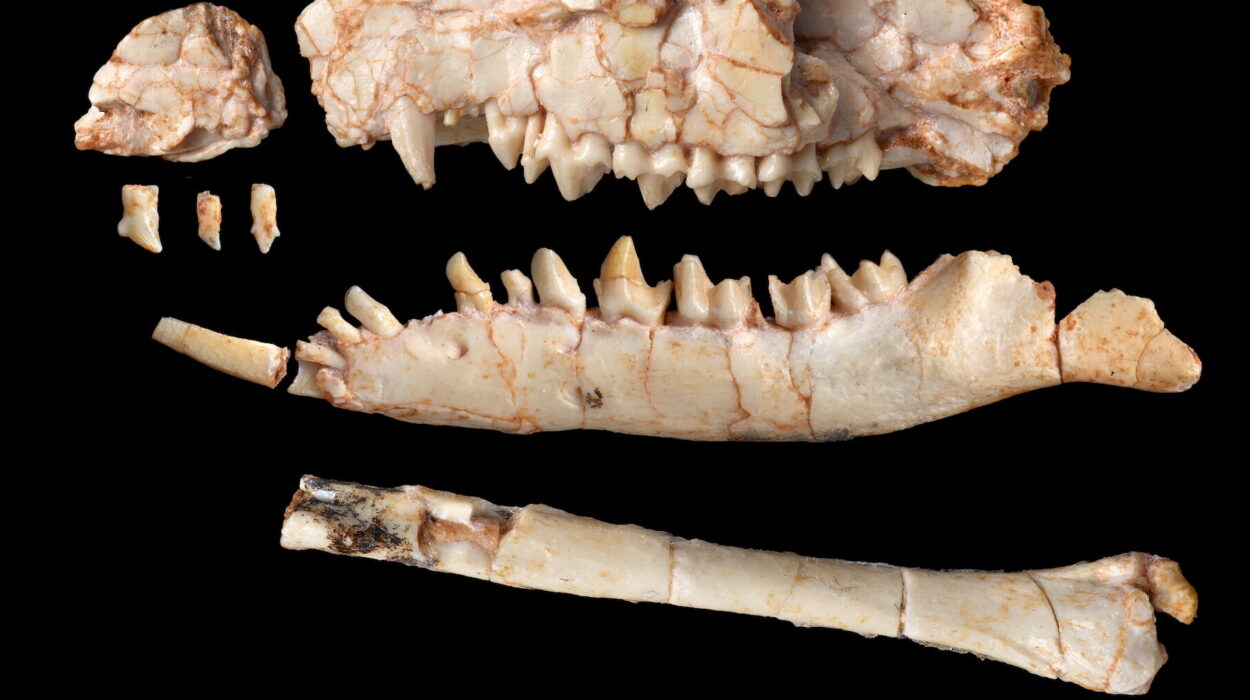
The new analysis added StW 573, the nearly complete skeleton known as Little Foot, from Sterkfontein Cave in South Africa. The specimen is about 3.67 million years old and is attributed to Australopithecus prometheus. Its estimated body mass is 40.2 kilograms, placing it near the middle of the estimated body-mass distribution for 37 Australopithecus individuals. That makes it substantially larger than Lucy and allows the question of arboreality to be examined beyond the smallest-bodied australopiths.
The researchers extracted cross sections from high-resolution imaging of Little Foot’s humeri, femora and tibiae. They examined sections at several positions along the shafts, although the comparisons used for relative strength were standardized to the 35% section of the humerus and the 50% sections of the femur and tibia. The fossil sections were digitally edited to remove adhering matrix and trabecular bone before their geometric properties were measured. A small missing portion of the lateral surface of the humeral 20% section was reconstructed from adjacent preserved contours, but that section was not among those used for the principal strength comparisons.
The resulting numbers are revealing. Little Foot’s femoral 50% polar section modulus was 1,504 mm³, compared with 945 mm³ for its humeral 35% section. Its tibial 50% value was 1,183 mm³. The fossil’s femoral head breadth was estimated at 32.5 millimeters, its tibial plateau mediolateral breadth at 57.1 millimeters and its distal humeral mediolateral breadth at 40.4 millimeters.
Little Foot’s arms still look more like an ape’s
When those measurements were placed against the living comparative groups, Little Foot fell well below the modern human distribution for femoral-to-humeral shaft strength and closest to the gorilla groups.
Its deviation from the modern human regression was −3.206 standard errors of estimate. Its deviation from the mountain gorilla regression was only 0.057, and from the other-gorilla regression it was −1.314. The corresponding deviation from chimpanzees was 1.223.
The pattern was similar for femoral-head breadth relative to distal humeral breadth. Little Foot’s deviation from modern humans was −5.157 standard errors, compared with −0.379 from mountain gorillas. Its tibial plateau-to-distal-humeral proportion was also far below the modern human regression, although in that comparison it was closer to the chimpanzee and gorilla groups than to humans.
The researchers interpret the femoral-to-humeral strength pattern as particularly informative because, in living hominoids, greater relative forelimb strength is associated with greater use of the forelimb for body-weight support, especially during arboreal behavior. Little Foot’s ape-like pattern therefore supports the interpretation that substantial arboreal activity remained part of its locomotor repertoire.
Other features of Little Foot point in the same general direction. The authors note that its pectoral girdle and inner ear also show African-ape-like characteristics, which they regard as strengthening the inference of substantial arborealism.
The result is especially significant within the study because Little Foot is not an unusually small australopith. Its estimated 40.2-kilogram body mass places it close to the midpoint of the sample of 37 Australopithecus individuals with body-mass estimates. The researchers also found an African-ape-like femoral-head-to-distal-humeral relationship in the considerably larger KSD-VP-1/1 Australopithecus afarensis, whose estimated body mass is 59.5 kilograms.
That means the ape-like functional signature is not confined to Lucy-sized australopiths in this analysis. The fossils examined here span a substantial range of body sizes, yet their humerus-to-femur relationships retain a broadly similar pattern.
The same leg does not tell the same story
Little Foot’s hindlimb complicates any simple picture of an ape-like animal.
The researchers compared the strength of the tibia with the femur as an intralimb measure. Little Foot falls in the upper half of the modern human distribution for this proportion. Dmanisi and KNM-WT 15000, two early Homo specimens, also fall in that part of the human distribution. More generally, the hominin specimens examined have relatively strong tibiae compared with nonhuman hominoids, although the nonhuman groups vary considerably.
This means Little Foot combines an African-ape-like femur-to-humerus strength relationship with a more human-like tibia-to-femur relationship.
The researchers argue that this may reflect different loading patterns within different portions of the lower limb. They note that the tibia shares load bearing with the fibula, and that the relative contribution of the two bones varies among living hominoids and early Homo. They therefore regard the tibia-to-femur relationship as a less consistent indicator of arboreality than the femur-to-humerus relationship. The authors also say that future analysis of Little Foot’s fibulae could help clarify the pattern.
The joint measurements add another layer. Little Foot’s femoral head is relatively small compared with those of Homo. The researchers derived a new femoral-head breadth of 32.5 millimeters from reconstructed high-resolution CT data, substantially below the previously estimated 35.2 millimeters. They found that Little Foot follows the same general femoral-head pattern as other Australopithecus specimens.
The authors caution that joint proportions are harder to interpret as direct indicators of arboreality because joint dimensions can reflect not only loading but also joint excursion, mobility and joint-specific mechanics.
Dmanisi provides the contrasting early Homo pattern
The second major addition to the study is a composite individual from Dmanisi in Georgia, represented by specimens D3901, D4167 and D4507. The remains date to roughly 1.8 million years ago and are attributed to early Homo.
This individual provides an important comparison because the skeleton is associated, relatively large and not affected by the particular complications that surround some other early Homo fossils. The researchers estimate its body mass at 55.1 kilograms. Its femoral 50% polar section modulus is 2,531 mm³, its tibial value is 1,703 mm³ and its humeral 35% value is 760 mm³. Its femoral head measures 40.2 millimeters across, its tibial plateau 68.2 millimeters and its distal humerus 36.8 millimeters.
Unlike Little Foot and Lucy, the Dmanisi individual falls securely within the modern human distributions for the principal lower-to-upper limb strength and articular proportions. Its femoral-to-humeral strength deviation from the human regression is 1.153 standard errors, compared with 8.477 for chimpanzees and more than 4 standard errors for both gorilla groups. Its tibial-to-humeral deviation from humans is 1.253, while its deviations from the two gorilla groups are 8.281 and 9.746.
The joint proportions show the same general pattern. The Dmanisi femoral-head-to-distal-humeral deviation is only 0.515 standard errors from the human regression, while its deviation from chimpanzees is 6.569. Its tibial-plateau-to-distal-humeral deviation is 1.759 from humans and more than 4.8 standard errors from either gorilla group.
Two Homo erectus individuals provide a similar comparison. KNM-ER 1808, dated to about 1.6 million years ago, has a modern human-like femoral-to-humeral strength relationship. KNM-WT 15000, dated to about 1.47 million years ago, also falls within the modern human distribution for the principal interlimb strength measures. Its relatively lower position in the femur-to-humerus comparison is attributed in the paper to its juvenile status.
The Dmanisi individual also has a modern human-like tibia-to-femur strength relationship. In that respect, it resembles Little Foot, but its forelimb-to-hindlimb proportions are fundamentally different.
A second joint comparison separates Australopithecus from Homo
The researchers also examined femoral-head breadth directly against tibial-plateau breadth. This comparison included two additional early Homo femora, KNM-ER 1472 and KNM-ER 1481a.
African apes have significantly smaller femoral heads relative to proximal tibial breadth than modern humans, with a reported P value below 0.0001. Their relationship is nearly isometric, with an RMA slope of 1.031 ± 0.015. Modern humans show positive allometry, with a slope of 1.126 ± 0.012.
The three Australopithecus individuals fall slightly below the African-ape regression and also show an almost perfectly isometric relationship among themselves, with an RMA slope of 0.9996 ± 0.0010 and a correlation coefficient of 1.0. The other Homo individuals fall near or above the modern human regression and at or above the upper limit of the African-ape 95% prediction interval. Dmanisi sits between the Australopithecus and modern human patterns.
The researchers interpret this pattern as evidence that the relative size of the hip joint compared with the knee changed across these groups. They note, however, that joint size has multiple functional determinants, so the measurement does not provide a simple behavioral readout by itself.
The fossil record leaves a gap in the timing
Taken together, the fossils produce a clear contrast between the Australopithecus and early Homo samples, but they do not identify the precise moment when the transition occurred.
The new Australopithecus specimen is about 3.67 million years old, while the Dmanisi individual is about 1.8 million years old. There is therefore a roughly 1.2-million-year interval in which the study has no new specimen with the necessary combination of preserved limb bones. The authors explicitly state that the present sample cannot pinpoint the timing of the proposed adaptive shift more precisely.
One fossil in particular prevents the transition from being treated as a simple taxonomic boundary. OH 62, dated to about 1.8 million years ago, has African-ape-like relative limb strength, similar to Little Foot and Lucy. It has historically been assigned to Homo habilis, but has also been attributed to Australopithecus cf. africanus. Its incomplete femoral and humeral shafts also make the placement of its target cross sections less secure than in some of the other fossils.
The authors therefore treat OH 62 as an outlier relative to the early Homo pattern represented by Dmanisi and the two H. erectus individuals. They suggest that its ape-like relative limb strength warrants further consideration of whether it represents an australopith-grade pattern of arboreality, particularly because the traits analyzed here are developmentally plastic rather than relying solely on more conserved external proportions.
Another potentially informative fossil, Australopithecus sediba, is dated to about 1.97 million years ago. But its currently known partial skeletons do not preserve the combination of material needed to calculate relative limb strengths in the way used here. The authors therefore cannot use it to fill the gap directly.
The proposed shift involves more than simply leaving the trees
The authors interpret the contrast as evidence for a major change in the realized ecological niche between Australopithecus and early Homo.
Their interpretation is that Australopithecus retained an African-ape-like degree of arboreal behavior while also using its lower limbs for terrestrial bipedalism. The evidence does not fit a model in which Australopithecus can simply be assigned to either an ape-like or human-like locomotor category. The relatively human-like tibial and some articular proportions indicate substantial lower-limb loading, while the femoral-to-humeral strength relationship points to continued forelimb loading unlike that of modern humans.
The researchers propose that the subsequent Homo pattern reflects a reduction in arborealism alongside a stronger commitment to habitual terrestrial bipedalism. They discuss several possible selective pressures but do not establish one as the demonstrated cause.
In particular, they note that stone-tool knapping predates 3 million years ago, so increased manual demands associated specifically with the manufacture of stone tools would not neatly explain the timing of the proposed shift. They also regard enhanced dexterity associated simply with tool use as an uncertain explanation because other primates can use tools. Expanded ranging, potentially associated with increased meat consumption, is presented as another possibility. The authors further suggest that changes in foraging strategies, cognitive demands and increased use of the lower limbs could have been related to both locomotor and brain-size changes during the transition to Homo. These are proposed explanations rather than results directly demonstrated by the bone measurements.
The study therefore identifies the change in relative limb strength patterns more securely than it identifies the evolutionary forces that produced it.
The analyses also do not imply that every member of Homo immediately became behaviorally identical to a modern human. The Dmanisi individual has some lower-limb joint proportions that are intermediate between modern humans and African apes, and the authors note primitive features elsewhere in the Dmanisi lower limb, particularly the foot. They suggest this could indicate some differences in bipedal gait mechanics from later H. erectus, but that interpretation remains distinct from the broader finding that Dmanisi’s relative limb strengths are modern human-like.
The statistical analysis included an additional check because some fossil comparisons required extrapolating the living-group regressions beyond the size ranges represented by some comparative samples. The researchers plotted common-slope RMA lines through the extant groups as an alternative visual assessment. They report that this procedure did not change their conclusions about the relative strengths or articular proportions of the extant and fossil groups.
What emerges from the fossil measurements is therefore not a single clean progression from ape to human. Instead, the evidence points to a mosaic pattern in Australopithecus: an upper-limb loading signature associated with substantial arboreal activity alongside lower-limb strength characteristics associated with terrestrial bipedal loading. By about 1.8 million years ago, the Dmanisi individual and later Homo erectus specimens show a different combination, with interlimb strength and articular proportions broadly aligned with modern humans.
The study was published in Science Advances.