An international team of astronomers has identified a remarkably persistent optical quasi-periodic oscillation, or QPO, in the bright quasar 3C 454.3 after analyzing nearly two decades of observational data. The repeating signal, with a period of 433 days, remained consistently visible from 2009 to 2018, making it one of the longest-lasting optical QPOs ever detected.
For years, astronomers have watched the distant blazar 3C 454.3 flicker and flare across the cosmos. Now, after carefully studying 19 years of observations, researchers believe they have uncovered one of the clearest repeating optical patterns ever seen from such an extreme object.
The discovery emerged from a large international effort using archival data from the Whole Earth Blazar Telescope, or WEBT. The findings were described in a paper published April 30 on the arXiv preprint server.
A Blazar With a History of Violent Activity
Blazars are among the most energetic objects in the universe. They belong to a broader class of active galaxies powered by supermassive black holes at their centers. What makes blazars particularly striking is the orientation of their relativistic jets, which are aimed almost directly toward Earth.
These objects are known for rapid brightness changes and intense emissions across the electromagnetic spectrum. Some also display repeating fluctuations in brightness known as quasi-periodic oscillations, or QPOs.
Historically, QPOs have been studied mainly in X-ray observations. Scientists believe those signals are linked to activity near the inner edge of an accretion disk, where matter spirals inward toward a compact object such as a black hole or neutron star.
Optical QPOs are less understood. Researchers suspect they may originate from the outer regions of an accretion disk or represent X-ray light that has been reprocessed into optical wavelengths.
Why 3C 454.3 Stands Out
The object at the center of the new study, 3C 454.3, is already one of the best-known flat-spectrum radio quasars, or FSRQs. Located at a redshift of 0.86, it is exceptionally bright and highly variable.
Astronomers have long been interested in this blazar because of its strong optical polarization and powerful non-thermal emission. Estimates place the mass of its supermassive black hole between 0.5 billion and 2.3 billion times the mass of the Sun.
Previous studies had hinted that 3C 454.3 might contain signs of periodic behavior. To investigate further, researchers led by Karan Dogra of the Aryabhatta Research Institute of Observational Sciences in India examined data spanning nearly two decades.
The team relied primarily on records from WEBT, while also incorporating observations from the Small and Medium Aperture Research Telescope System and the Steward Observatory.
A Repeating Signal Lasting Nearly a Decade
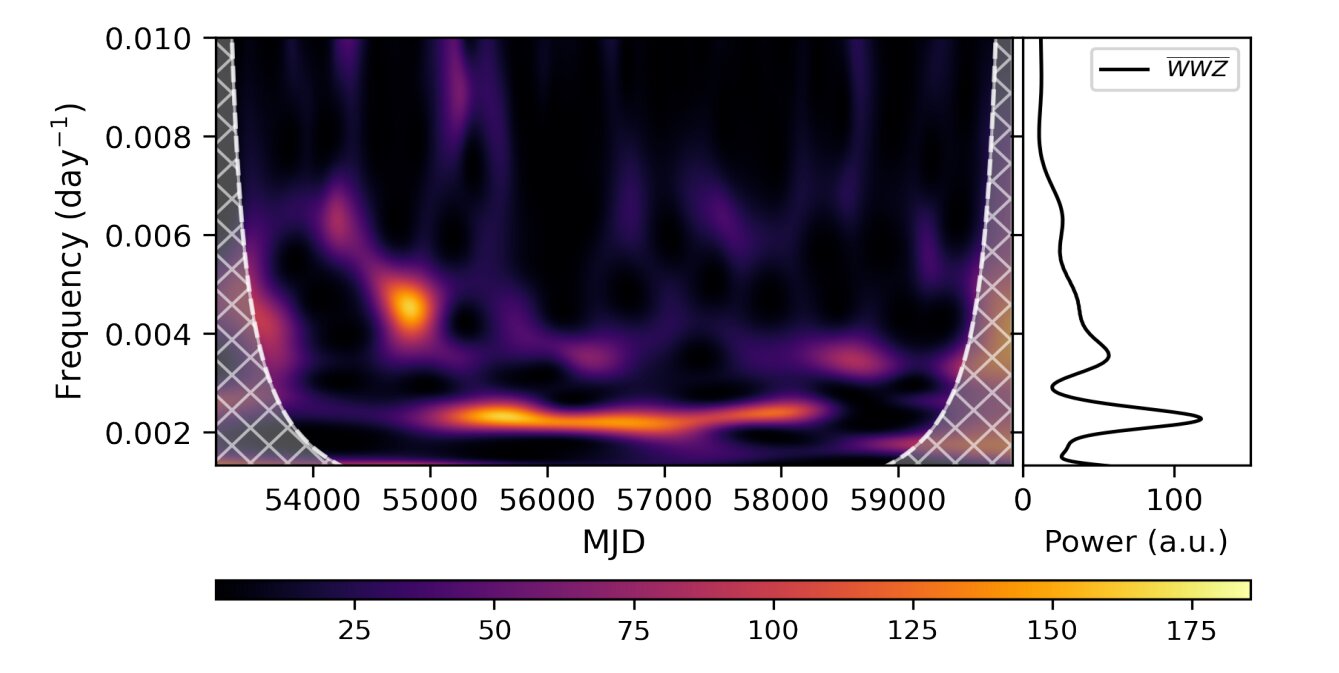
After analyzing the extensive dataset, the researchers identified a repeating optical signal with a period of 433 days.
More importantly, the oscillation did not appear briefly or sporadically. According to the study, the signal remained consistently present between 2009 and 2018.
That persistence makes the finding especially significant. While optical QPOs have been reported before, many are short-lived or difficult to confirm. The newly detected signal in 3C 454.3 appears unusually stable over time, placing it among the most persistent optical QPOs ever observed.
The result strengthens the case that some blazars may host long-term physical mechanisms capable of producing recurring optical patterns.
Scientists Are Still Debating the Cause
Identifying the oscillation was only part of the challenge. Explaining what produces it remains more difficult.
The research team explored two broad possibilities. One set of models focused on processes occurring in the accretion disk surrounding the supermassive black hole. Another centered on activity inside the blazar’s relativistic jets.
Based on their analysis, the researchers consider jet-related explanations more plausible for the observed behavior in 3C 454.3. Even so, they emphasized that the currently available observations are not sufficient to definitively rule out competing scenarios.
That uncertainty highlights a broader issue in blazar research. Although these objects are intensely studied, the physical origin of many repeating signals remains unresolved.
The researchers noted that future long-term monitoring could help determine whether the newly observed QPO reflects a stable dynamical process or simply a temporary pattern emerging from stochastic variability.
Why This Matters
The discovery adds important evidence to the growing effort to understand how supermassive black holes and relativistic jets behave over long timescales.
Because blazars are powered by some of the most extreme environments in the universe, even subtle repeating patterns can reveal clues about how matter moves around black holes and how energy is launched into space at near-light speeds.
The persistence of the 433-day signal in 3C 454.3 gives astronomers a rare opportunity to study a potentially stable mechanism operating deep inside an active galactic nucleus. Continued observations could eventually help scientists distinguish whether the oscillation originates in the accretion disk, the relativistic jet, or a combination of both.
For now, the study offers one of the strongest pieces of evidence yet that long-lasting optical rhythms can exist in blazars — and that these distant cosmic engines may be more structured and predictable than they first appear.
Study Details
Karan Dogra et al, Detection of optical quasi-periodic oscillation in the blazar 3C 454.3, arXiv (2026). DOI: 10.48550/arxiv.2604.27503