A groundbreaking study reveals that using early orbital data from asteroids can uncover hidden “shortcuts” through the solar system, potentially shaving hundreds of days off a journey to the Red Planet. By aligning spacecraft trajectories with specific celestial planes, researchers identified mission configurations for 2031 that could complete a full Earth-Mars-Earth round-trip in as little as 153 days.
The logistics of sending humans to Mars have long been dictated by a grueling celestial clock. Because the two planets are constantly shifting in their orbits, mission planners traditionally wait for specific windows of alignment to minimize fuel and time. However, even under ideal conditions, a round-trip journey remains an immense undertaking that tests the limits of robotic endurance and human physiology. A new perspective on interplanetary navigation suggests we might not have to wait on the planets alone to find a faster way home.
By looking toward the preliminary paths of small celestial bodies rather than just major planetary data, scientists are finding that the map of our solar system contains high-speed lanes that have previously gone unnoticed. This methodological shift doesn’t just offer a slight improvement in travel time; it proposes a radical reduction that could change the fundamental nature of deep-space exploration.
The Geometry of the Red Planet
To understand how these shortcuts work, one must first look at the traditional bottleneck of Mars exploration: Mars opposition. This phenomenon occurs approximately every 26 months when Earth passes directly between the sun and Mars. At this moment, the two worlds sit on the same side of the solar system, reaching their closest point to one another. While this alignment is the standard starting point for mission planning, it creates a rigid schedule that doesn’t always account for more direct, rapid transfer opportunities.
Interplanetary planners typically rely on incredibly precise planetary data to calculate the fuel and time required for a crossing. While this ensures accuracy, it often overlooks the “early orbital data” of asteroids—approximations of a path based on a relatively short window of observation. Researchers are now finding that these early, preliminary orbits can serve as a guide for identifying planes in space that allow for much more direct transit.
Charting the CA21 Shortcut
In a study published in the journal Acta Astronautica, Marcelo de Oliveira Souza of the State University of Northern Rio de Janeiro (UENF) investigated whether these asteroid-based approximations could reveal “hidden” shortcuts. To test this theory, he focused his analysis on an asteroid designated 2001 CA21. This specific body was chosen because its early predicted path appeared to cross the orbits of both Earth and Mars.
Although the official orbital details for 2001 CA21 were eventually updated, the geometry provided by its initial data offered a unique “anchored plane.” Oliveira Souza looked for trajectories to Mars that remained within five degrees of the tilt identified in that asteroid data. By sticking close to this specific angle, a spacecraft can theoretically maintain a more direct path through the vacuum of space, rather than following the wider, more curved arcs typically used in Hohmann transfer orbits.
The 2031 Alignment
The research involved testing the conditions of multiple upcoming Mars oppositions, specifically looking at windows in 2027, 2029, and 2031. The goal was to see which of these years offered the best geometric alignment between the planets and the plane identified by the asteroid data. The results showed that 2031 stands out as a uniquely favorable year for high-speed travel.
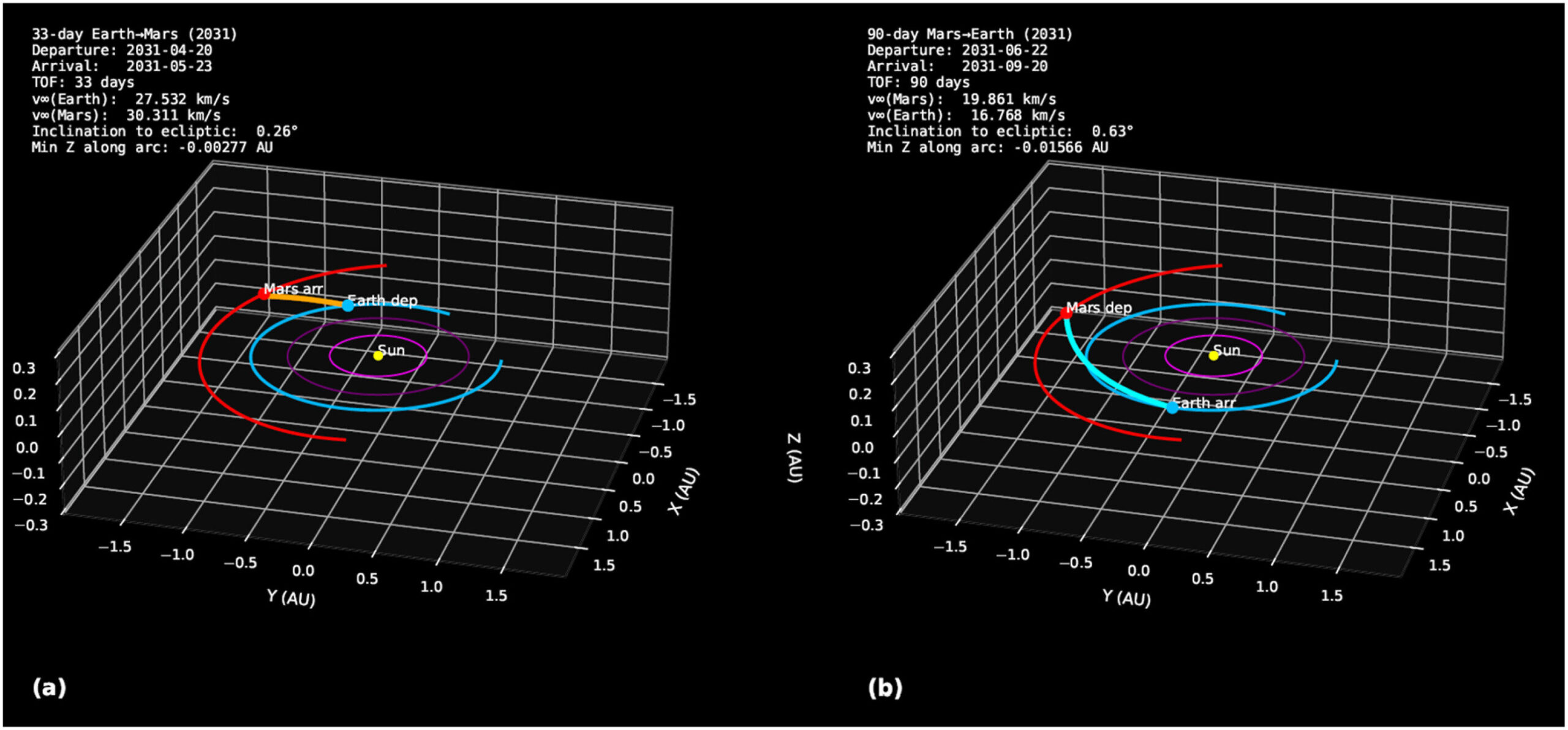
The analysis determined that the Earth-Mars geometry in 2031 aligns perfectly with the orbital plane of the asteroid data. This alignment supports what the study calls “sub-year round-trip missions.” In one extreme case, the data suggested an outbound leg of only 33 days followed by a 90-day return, though the total mission configuration for the most feasible rapid case involved a 56-day outbound trip and a 135-day return journey.
These configurations are significantly faster than traditional models. By utilizing the CA21-anchored plane, a total mission time could be brought down to as low as 153 days. This represents a massive reduction from the hundreds of days usually required for a standard round-trip mission.
A New Screening Tool for Spaceflight
The significance of this study goes beyond a single asteroid or a specific year. Oliveira Souza emphasizes that future missions do not necessarily need to follow 2001 CA21 itself. Instead, the asteroid serves as a proof of concept for a new way of thinking about navigation. The preliminary orbits of small bodies can be used as a “methodological screening tool” to help mission planners identify rapid transfer opportunities that traditional planetary-only models might miss.
By using the well-defined plane geometry of these small bodies, researchers can spot favorable alignments years in advance. This provides a new lens through which to view the solar system—not as a series of distant islands, but as a network of intersecting planes that, when timed correctly, offer high-speed corridors for exploration.
Why This Matters
The ability to reduce a Mars round-trip to under half a year has profound implications for the future of space exploration. Long-duration spaceflight poses significant risks to human health, including radiation exposure and the physical toll of microgravity. Shaving hundreds of days off a mission significantly minimizes these hazards. Furthermore, shorter trips reduce the amount of life support, food, and water a spacecraft must carry, allowing for more scientific equipment or larger crews. By using asteroid data to find these interplanetary shortcuts, we move closer to a reality where a trip to Mars is measured in months rather than years, making the Red Planet more accessible than ever before.
Study Details
Marcelo de Oliveira Souza, Using asteroid early orbital data for rapid mars missions, Acta Astronautica (2026). DOI: 10.1016/j.actaastro.2026.04.018