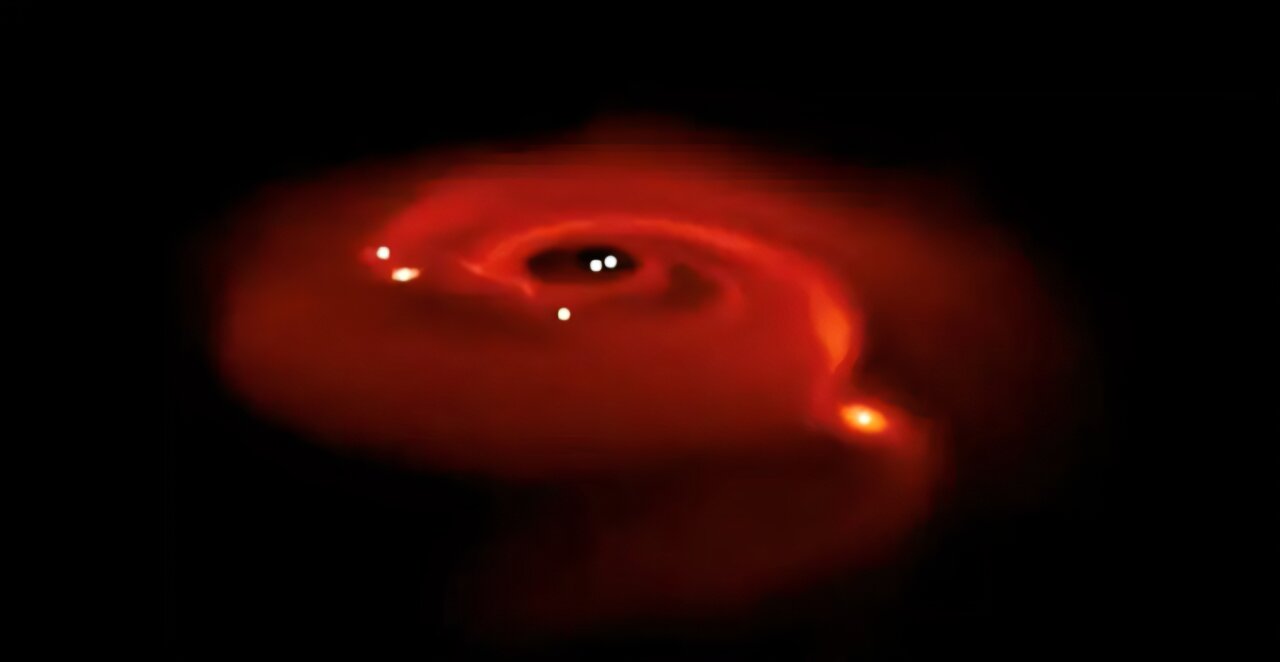
New computer simulations reveal that binary star systems are remarkably efficient at producing large numbers of gas giant planets through a process called gravitational instability. While the immediate vicinity of twin suns remains a “forbidden zone” due to violent gravitational forces, the outer regions of these systems provide an ideal environment for disks to fragment and form planets more easily than around single stars.
For decades, the image of a world orbiting two suns was relegated to the realm of science fiction. The iconic twin sunsets of Tatooine were viewed as a cinematic curiosity—a beautiful but unlikely outcome of cosmic evolution. Astronomers long assumed that the complex gravitational tug-of-war between two stars would create an environment too chaotic and violent for stable worlds to take shape. Conventional wisdom suggested that if you wanted to find a planet, you should look for a solitary star like our own sun.
However, groundbreaking research from astrophysicists at the University of Lancashire is turning that assumption on its head. Far from being hostile to planetary growth, binary star systems—which are incredibly common throughout the Milky Way—might actually be more productive than single-star systems. The study suggests that under the right conditions, the presence of two stars acts as a catalyst rather than a deterrent, leading to the rapid birth of massive worlds in numbers that single-star systems struggle to match.
Navigating the Forbidden Zone
The research team, led by Dr. Matthew Teasdale, utilized state-of-the-art computer simulations to observe how gas disks evolve around young binary stars. These simulations provided a high-resolution look at the delicate balance of gravity and heat within the swirling material that eventually coalesces into planets. The data confirmed that there is indeed a “danger zone” located very close to the binary pair. In this inner region, the gravitational interaction between the two stars is simply too intense, creating a forbidden zone where the gas is too agitated to settle into stable orbits or clump together.
But the story changes dramatically as you move further away from the central stars. The simulations revealed that once the gas disk extends beyond this turbulent inner region, the environment stabilizes and becomes a “fairground” for the formation of massive planets. In these cooler, distant reaches, the disk becomes susceptible to a process known as gravitational instability. This occurs when a massive disk of gas and dust becomes so heavy that it can no longer support its own weight, causing it to fragment into distinct, dense clumps.
The Power of Fragmentation
This process of fragmentation appears to be significantly more effective in binary systems than in the disks surrounding single stars. According to the team’s findings, these fragmented clumps act as the seeds for young planets, forming much more quickly than they would through the slow accumulation of dust and rock. The researchers found that disks around binaries not only produce more planets on average, but a larger fraction of these objects grow into gas giant planets that are even larger than Jupiter.
The dynamics of these systems are incredibly active. Because so many planets are forming in relatively close proximity in the outer disk, the gravitational interactions between the new worlds are frequent and powerful. While many of these planets settle into stable, wide orbits around their twin suns, the “productive” nature of the environment has a secondary effect. Some of these young planets are eventually kicked out of the system entirely by their neighbors, becoming free-floating planets—lone worlds that drift through the dark of interstellar space without a parent star.
Explaining the Real-Life Tatooines
These findings provide a vital theoretical framework for a reality that astronomers are already seeing through their telescopes. To date, over 50 circumbinary exoplanets have been confirmed by various missions. Many of these worlds have been found on wide orbits, far from the central “forbidden zone,” which aligns perfectly with the Lancashire team’s simulations. The research helps explain not just how these planets formed, but why we see so many of them in the outer reaches of their systems.
Dr. Dimitris Stamatellos, who supervised the project, noted that the scientific community’s perspective on these systems is undergoing a major shift. By demonstrating that gravitational instability is a primary pathway for forming these worlds, the research suggests that the galaxy might be far more crowded with twin-sun planets than anyone previously calculated. The study bridges the gap between theoretical modeling and the growing catalog of discovered exoplanets, suggesting that the “Tatooines” of the universe are a routine product of nature.
Why This Matters
This discovery fundamentally alters our understanding of where planets are most likely to exist in the universe. Since binary stars make up a significant portion of the stellar population in our galaxy, the realization that they are highly efficient planet-producers suggests that the total number of planets in the Milky Way could be vastly higher than current estimates.
Furthermore, this research sets the stage for the next generation of astronomical discovery. As powerful new facilities like ALMA, the James Webb Space Telescope, and the upcoming Extremely Large Telescope (ELT) begin to peer deeper into young star systems, they will be looking specifically for the signs of fragmentation and gravitational instability predicted by these simulations. Understanding the “danger zone” and the “fairground” of binary disks allows scientists to target their observations more effectively, bringing us closer to seeing the actual birth of these massive, twin-sun worlds in real-time.
Study Details
Matthew Teasdale et al, The formation of circumbinary planets through disc fragmentation, Monthly Notices of the Royal Astronomical Society (2026). DOI: 10.1093/mnras/stag476