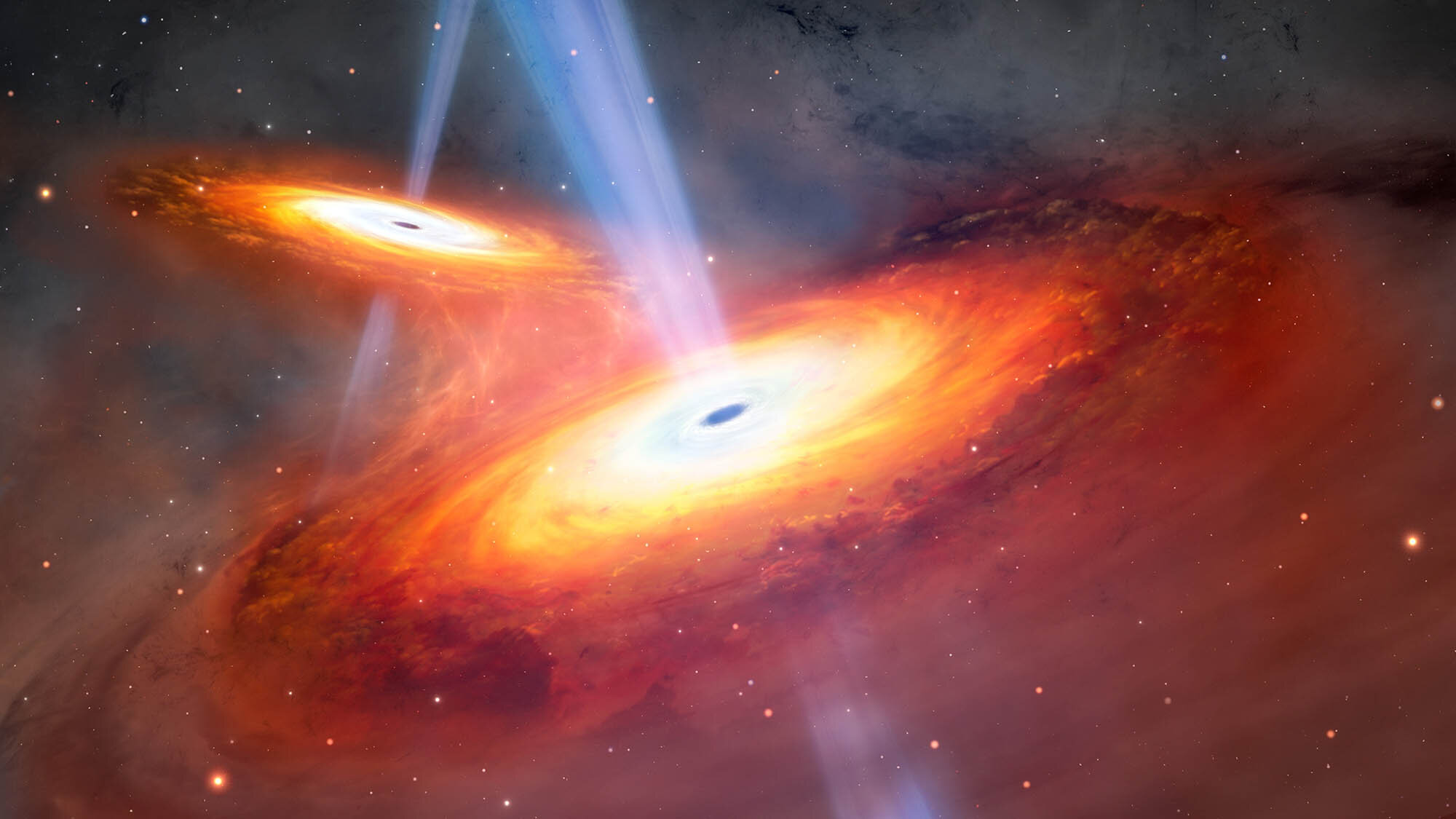
Astronomers have confirmed the existence of a rare pair of twin quasars engaged in a galactic merger just 900 million years after the Big Bang. The discovery of the system J2037–4537, one of only two such pairs ever found in the early universe, provides direct evidence that galactic collisions trigger the ignition of supermassive black holes. These findings offer a potential explanation for the unexpectedly strong gravitational wave background recently detected by Pulsar Timing Arrays.
In the vast, dark expanse of the early universe, two colossal beacons of light have emerged from the shadows of cosmic history. These beacons, known as quasars, are so bright they can outshine entire galaxies, yet they are powered by something far more localized and intense: supermassive black holes. For years, astronomers have theorized that the most violent events in space—the collision of two massive galaxies—could be the spark that ignites these cosmic engines. Now, thanks to the precision of the Atacama Large Millimeter/submillimeter Array (ALMA), researchers have captured a rare “double act” that confirms this theory in the universe’s infancy.
Unmasking a Cosmic Illusion
The system, cataloged as J2037–4537, first caught the attention of the scientific community in 2021 as a candidate for a close quasar pair. Located at a redshift of 5.7, the light we see from these objects began its journey when the universe was less than a billion years old. However, confirming the true nature of such distant objects is notoriously difficult. Astronomers initially faced a frustrating possibility: the “pair” might be an impostor created by a cosmic trick of the light known as gravitational lensing.
In a lensing scenario, the gravity of a massive foreground galaxy acts like a magnifying glass, bending the light of a single distant quasar and splitting it into multiple images. To the observer, one object appears as two. To solve this mystery, a team led by Minghao Yue of the University of Arizona utilized ALMA to peer through the dust and gas of the early universe with unprecedented resolution. They weren’t just looking for the light of the quasars themselves, but for the forensic evidence of a physical connection between them.
The breakthrough came when the team mapped the [CII] (ionized carbon) emission lines. These lines serve as tracers for the cold, star-forming gas that populates galaxies. The ALMA data revealed a faint but distinct tidal bridge of gas and dust stretching between the two objects. This bridge is a telltale sign of a physical interaction; as the two galaxies merge, their mutual gravitational pull drags streams of material out of each other. Because a gravitationally lensed image would never produce a physical bridge of gas between the two “ghost” images, the team was able to officially rule out the lensing theory. J2037–4537 is a real pair of distinct, interacting quasars.
Factories of Stars and Shadows
The confirmation of the pair reveals a system of staggering proportions. Both of the galaxies hosting these quasars are behaving like massive, high-speed manufacturing plants. The team’s analysis shows that each galaxy possesses a dynamical mass of at least 10 billion solar masses. More impressively, they are undergoing intense bursts of growth, with star formation rates exceeding 500 solar masses per year.
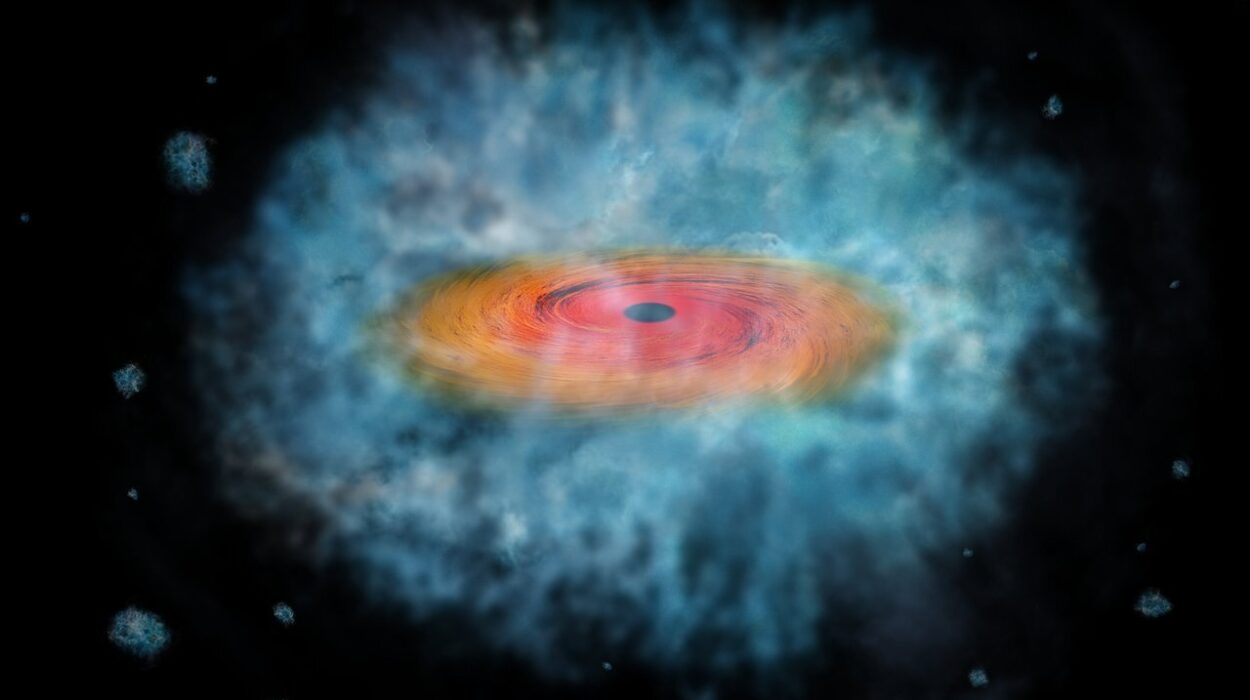
This extreme activity is likely a direct result of the merger process. As the galaxies crash into one another over millions of years, vast clouds of gas are funneled toward their respective centers. This influx of “fuel” serves a dual purpose: it creates the conditions for rapid star birth and provides the necessary material to feed the supermassive black holes at the heart of each galaxy. When these black holes consume this material, they enter an active state, releasing the incredible amounts of energy that we observe as a quasar.
While these figures are compelling, the researchers noted that the star formation estimates include systematic uncertainties. These calculations rely on assumptions regarding dust temperature and emissivity, which can vary in the extreme environments of the early universe. Future observations across multiple frequency bands will be required to refine these numbers and provide a more precise picture of how these ancient galaxies evolved.
A Two-Billion-Year Journey Toward a Merger
Currently, the two supermassive black holes in J2037–4537 are separated by thousands of light-years. While they are interacting, they have not yet become a binary system—a state where they are gravitationally bound in a tight orbital dance. The researchers estimate that it will take approximately 2.1 billion years for the system to transition into a true binary supermassive black hole (SMBH).
According to the team’s projections, this transition will likely occur around a redshift of 2. Once the black holes eventually spiral inward and merge, they will produce a cataclysmic finale. This event will release low-frequency gravitational waves, ripples in the fabric of spacetime that travel across the cosmos. While these waves are too long for detectors like LIGO to catch, they are the primary target for Pulsar Timing Arrays (PTAs), which use the steady signals of spinning stars to detect the subtle stretching of the universe.
Why This Matters
The discovery of J2037–4537 is more than just a rare find for the cosmic record books; it provides a vital piece of a larger astronomical puzzle. Recently, Pulsar Timing Array experiments have detected a gravitational wave background that is significantly stronger than what current models of galaxy evolution predicted. This suggests there are many more merging supermassive black holes in the universe than astronomers originally thought.
If systems like J2037–4537 are more common than previously assumed in the early universe, they could account for this “excess” in the gravitational wave background. By studying these ancient pairs, scientists can better understand the frequency of galactic mergers and how the first generations of supermassive black holes grew into the monsters we see today. This confirmed pair at redshift 5.7 offers a rare window into the violent, high-energy processes that shaped the structure of the modern universe.
Study Details
Minghao Yue et al, A Close Quasar Pair in a Massive Galaxy Merger at $z=5.7$, arXiv (2026). DOI: 10.48550/arxiv.2604.06504