TRAPPIST-1e may be more than three billion years older than Earth, yet a model based on the total amount of carbon fixed by photosynthesis suggests its hypothetical biosphere could still be far behind Earth’s evolutionary history. The same approach applied to 29 potentially habitable exoplanets produced a strikingly different picture for some worlds, with two planets reaching or exceeding Earth’s estimated cumulative carbon fixation under one of the study’s main scenarios.
The study starts with a hypothesis rather than an established biological law: that the rate of biological evolution on a planet might be related to the amount of carbon its organisms collectively fix through photosynthesis.
The authors cannot test that relationship directly because Earth is the only known inhabited planet. Instead, they use Earth as a reference point. They estimate how much carbon has been fixed during major stages of Earth’s biological history and then ask how long a hypothetical exoplanet would need to fix comparable amounts.
The measure they use is net primary production, or NPP, the amount of carbon incorporated into organic matter by photosynthetic organisms.
The underlying idea is that more carbon fixation could provide more opportunities for organisms to reproduce and accumulate genetic changes. The authors connect this reasoning to the evolutionary speed hypothesis, which relates productivity to species richness and evolutionary rates on Earth.
They explicitly do not treat this as a measure of evolutionary “advancement.” Their categories instead refer to whether a planet’s cumulative carbon fixation has reached the approximate levels associated with microbial life, terrestrial and vascular plants, or the emergence of an intelligent species on Earth.
The authors also acknowledge that their central hypothesis is untestable with current knowledge and that major evolutionary transitions on Earth could instead have resulted from the integration of existing biological systems rather than simply accumulating mutations through successive generations.
Still, they use the hypothesis as the basis for the calculations that follow.
Earth provides the carbon benchmark
To establish the benchmark, the researchers estimate Earth’s cumulative carbon fixation across three broad evolutionary stages.
They estimate that microbial photosynthesis dominated the first roughly 3 billion years after the earliest evidence of life. During that period, they assign Earth an NPP of about 2.5 petagrams of carbon per year during the Archean and 10 petagrams per year during the Proterozoic.
That produces an estimated 2.4 × 1025 grams of carbon fixed before terrestrial and vascular plants emerged.
The researchers then estimate that terrestrial and vascular plants fixed about 101 petagrams of carbon per year for roughly 500 million years, adding about 7 × 1025 grams.
Together, those estimates give Earth a cumulative total of about 9.4 × 1025 grams of carbon fixed by the present day.
That number becomes the reference point for the exoplanet calculations.
The researchers define a hypothetical world as having reached the multicellular stage when its cumulative carbon fixation exceeds the amount they estimate Earth had accumulated by the beginning of its terrestrial-plant era. They define the intelligent stage as exceeding Earth’s present cumulative total, corresponding in their framework to the period since the emergence of humans.
These are modeling categories, not observations that multicellular or intelligent organisms actually exist on any of the planets.
TRAPPIST-1e is older, but its modeled productivity is much lower
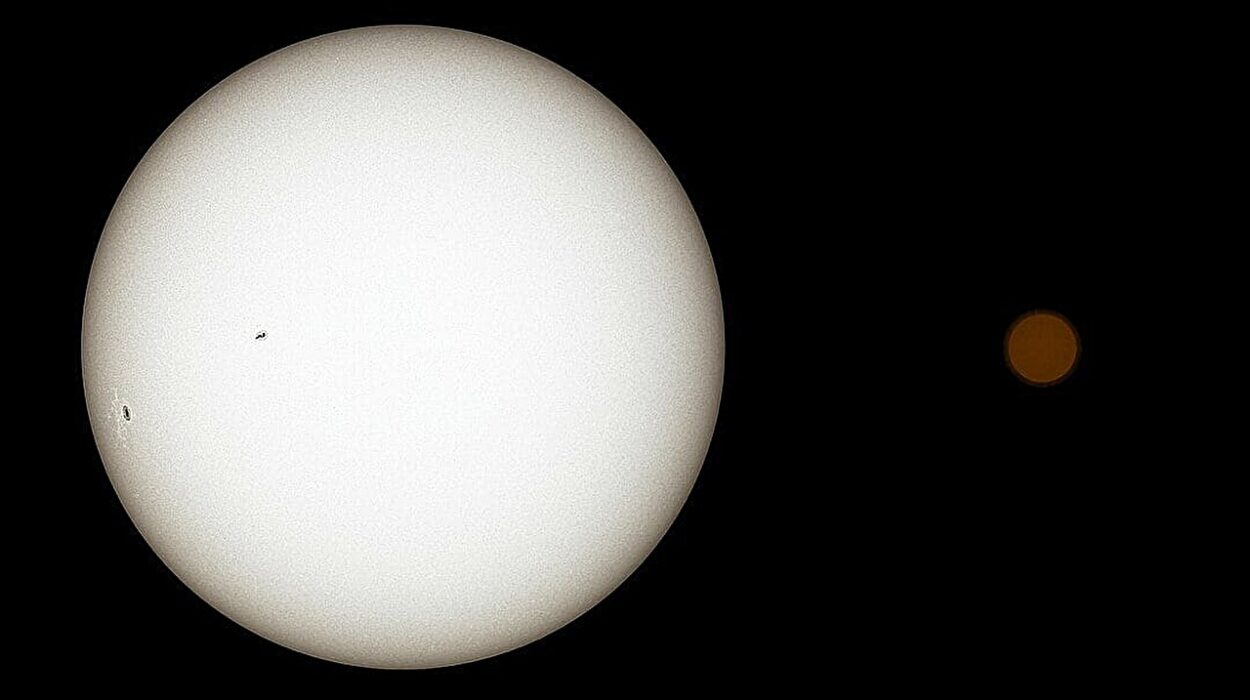
The first detailed test focuses on TRAPPIST-1e, a roughly Earth-sized planet orbiting a red dwarf about 40 light-years away.
The planet is estimated in the study to be about 7.6 billion years old, compared with Earth’s roughly 4.6 billion years. It is also thought to be tidally locked, so one side continually faces its star while the other faces away.
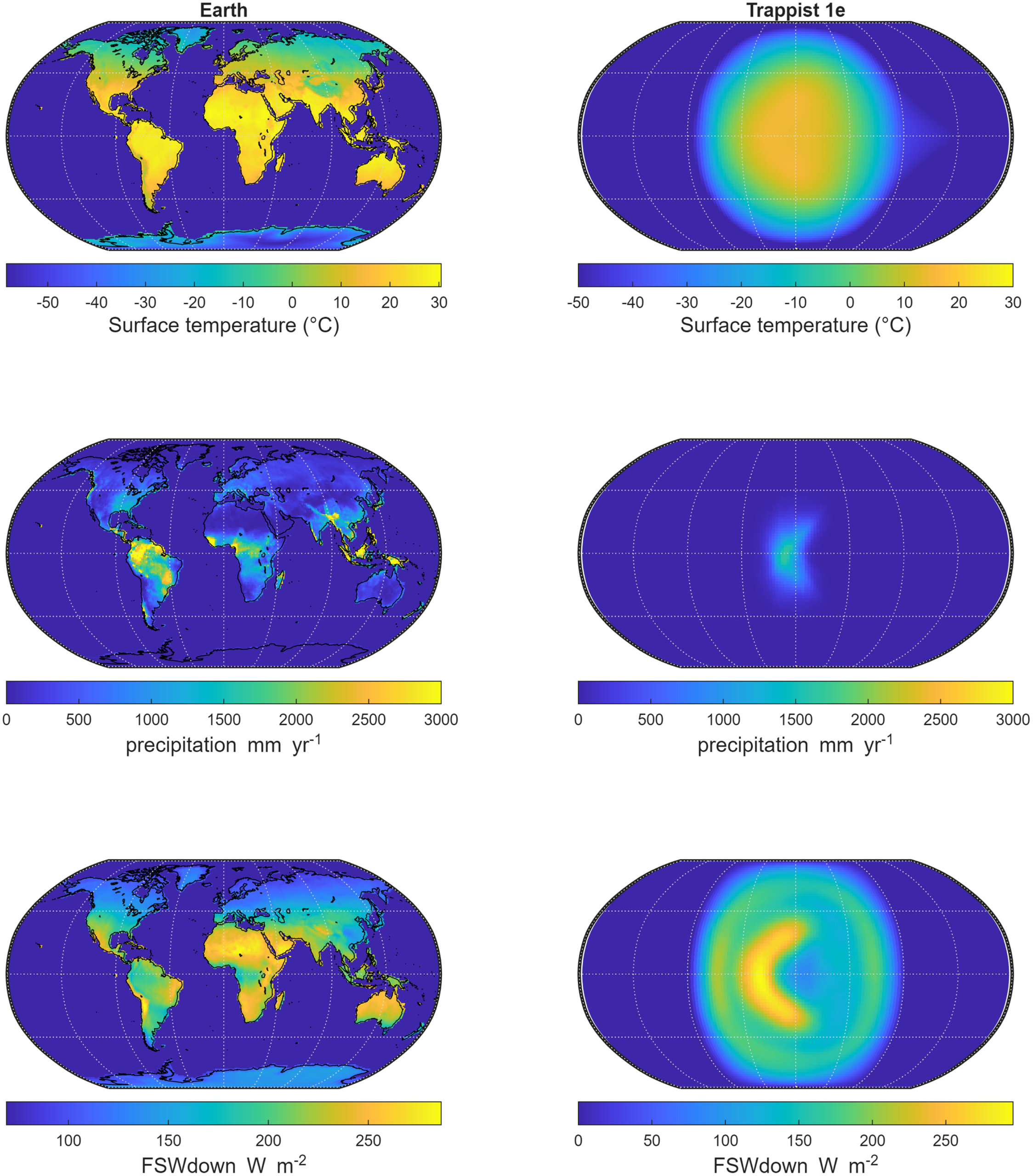
That creates a very different climate pattern from Earth’s.
For the main climate simulations, the researchers use results from the TRAPPIST-1 Habitable Atmosphere Intercomparison project and model TRAPPIST-1e as an ocean world with an atmosphere containing 400 parts per million carbon dioxide. They consider two climate scenarios from the University of Met Office model, along with an ExoCAM simulation, and calculate productivity under different assumptions about the wavelengths that photosynthetic organisms could use.
One major question is whether hypothetical organisms could use near-infrared light.
Earth’s familiar oxygen-producing photosynthesis operates most efficiently at shorter wavelengths, while some anoxygenic photosynthetic organisms can use much longer wavelengths. Because red dwarf stars emit proportionally more near-infrared radiation than the Sun, the authors examine both a 400–700 nanometer range and a broader 400–1100 nanometer range.
The difference is substantial.
In the modeled TRAPPIST-1e climate, the highest local productivity under scenarios allowing wavelengths up to 1100 nanometers is comparable to the highest productivity modeled for Earth. But large parts of the planet are far less productive.
In the main Hab 1 simulation, 62% of TRAPPIST-1e’s surface has zero modeled NPP because continental regions lack precipitation or because regions on the planet’s dark side lack light.
With a 30% continental fraction, the estimated annual NPP of Earth is about 101 petagrams of carbon. The corresponding TRAPPIST-1e estimates are roughly 17 petagrams per year for the main 1100-nanometer scenario, about 3 petagrams when only wavelengths below 700 nanometers are used, 59 petagrams for the warmer Hab 2 scenario, and 26 petagrams for the ExoCAM scenario.
An entirely ocean-covered TRAPPIST-1e is even less productive in the model, with an estimated NPP of about 4 petagrams of carbon per year under the main Hab 1, 1100-nanometer scenario.
The reason is not simply a shortage of stellar energy. Near-infrared light does not penetrate water efficiently, limiting its usefulness to an ocean biosphere.
A very long wait to match Earth’s cumulative carbon
The researchers then integrate modeled NPP over time rather than looking only at a planet’s productivity in a single year.
For Earth, their model estimates roughly 2.4 × 1025 grams of carbon accumulated during the microbial stage and about 9.4 × 10^25 grams in total by the present.
Under the main TRAPPIST-1e scenario, the planet would require roughly 9 billion years to accumulate the amount of carbon Earth fixed during its first 3 billion years of microbial evolution. It would then require roughly another period of higher-productivity photosynthesis to reach Earth’s present cumulative total.
Depending on the climate and wavelength assumptions, the time required for TRAPPIST-1e to reach Earth’s current cumulative carbon fixation ranges from about 7 to 17 billion years for the 1100-nanometer scenarios. The 700-nanometer scenarios take much longer, ranging from about 89 to 227 billion years in the sensitivity cases.
At its estimated current age, the main Hab 1, 1100-nanometer model therefore places TRAPPIST-1e in the study’s microbial category.
The authors estimate that, under that scenario, its hypothetical biosphere would be about 14 billion years behind Earth’s cumulative carbon-fixation trajectory even though the planet itself is older than Earth.
The conclusion is sensitive to the assumed climate. Under the warmer Hab 2, 1100-nanometer scenario, TRAPPIST-1e can accumulate carbon somewhat faster and may be slightly ahead of Earth’s current cumulative total. The paper therefore does not treat a single evolutionary stage for TRAPPIST-1e as established.
The model remained microbial under many changes
The researchers tested how much their TRAPPIST-1e result changed when they varied seven major parameters, including the planet’s age, radius, assumed timing of multicellular evolution on Earth, temperature and precipitation responses in the NPP model, available light and temperature.
For the main Hab 1 scenario using wavelengths up to 1100 nanometers, those changes altered the estimated time difference substantially but did not move TRAPPIST-1e out of the microbial category.
The sensitivity analysis points to two particularly important uncertainties: the planet’s climate and the wavelengths that hypothetical photosynthetic organisms could use.
Changing the assumed planetary radius produced the largest time range among the tested parameters, with an approximately 20-billion-year spread, but it still did not change the modeled life-stage category in the main scenario.
Twenty-nine worlds produce a wider range of outcomes
The researchers next applied the method to 29 Earth-sized rocky planets in the habitable zones of their stars.
Twenty-seven of the 29 orbit red dwarf stars, so the authors use the TRAPPIST-1e climate simulations as a baseline and scale the stellar flux according to each planet’s estimated irradiation. They use data on planetary radius, stellar flux, temperature, age and distance from the Habitable Worlds Catalog.
They calculate five main scenarios: a 1100-nanometer Hab 1 case, a 700-nanometer Hab 1 case, an entirely ocean-covered 1100-nanometer case, and two Hab 2 cases using the two wavelength ranges.
The resulting life-stage counts vary dramatically with those assumptions.
For the 1100-nanometer Hab 1 scenario with 30% continental coverage, seven of the 29 planets reach the study’s multicellular threshold and two reach its intelligent threshold.
With only wavelengths below 700 nanometers, none reach the intelligent threshold and none reach the multicellular threshold in the Hab 1 scenario.
Under the warmer Hab 2 climate with 1100-nanometer light, 18 planets reach the modeled multicellular stage and 11 reach the intelligent threshold. With Hab 2 and wavelengths below 700 nanometers, only two reach the multicellular stage and none reach the intelligent threshold.
These large differences illustrate how strongly the results depend on the assumed climate and photosynthetic capabilities.
K2-3d crosses Earth’s cumulative benchmark
Under the main 1100-nanometer Hab 1 scenario, two planets stand out.
K2-3d reaches an estimated cumulative carbon fixation about 1.74 times Earth’s current total. GJ 1061c reaches about 1.03 times Earth’s total.
The researchers attribute K2-3d’s high modeled productivity mainly to its relatively large radius, old age and warm temperature. The planet has an estimated radius 1.46 times Earth’s, an estimated age of 6.9 billion years and a modeled temperature of 315 K.
GJ 1061c has a radius 1.18 times Earth’s, receives about 1.45 times Earth’s stellar flux in the catalog values used by the researchers, has an estimated temperature of 310 K and an estimated age of 7 billion years.
The study also identifies several planets that fall below Earth’s present cumulative total but above earlier points in Earth’s history.
Teegarden’s Star b, GJ 273b and LP890-9c each reach more than 64% of Earth’s current cumulative NPP in the main scenario. Ross 128b and TOI-715b reach more than 32%.
The modeled cumulative productivity is most strongly associated with stellar flux and temperature. Across the 29 planets, stellar flux accounts for an r² of 0.54 of the variation in the ratio of planetary cumulative NPP to Earth’s current value. Temperature accounts for an r² of 0.35, while age accounts for 0.12 and planetary radius for only 0.02.
These relationships describe the behavior of this particular model. They do not establish that any of those properties directly controls biological evolution on exoplanets.
More productive worlds tend to be precipitation limited
The researchers also examine what limits productivity across the modeled planetary surfaces.
On Earth, most terrestrial regions in their analysis are precipitation limited, meaning additional precipitation would increase NPP. The same is true for all of the modeled exoplanets under the Hab 1 climate.
Under Hab 2, about 35% of the modeled exoplanets instead become temperature limited.
The authors find no light-limited pixels under their Hab 1 criteria. Under Hab 2, an average of 4% of pixels are light limited, compared with 6% for Earth under their analysis.
The planets with the highest cumulative NPP relative to Earth also tend to have larger fractions of precipitation-limited land.
The authors note that precipitation-limited environments on Earth include deserts, drylands and many temperate systems, while tropical regions can be limited by light because extensive cloud cover reduces incoming radiation. Boreal and Arctic regions can instead be temperature limited.
The study therefore proposes, as a hypothesis, that planets with cumulative NPP exceeding Earth’s could have a larger share of temperate or arid ecosystems. The authors emphasize that tropical ecosystems have higher NPP per unit area than temperate or arid ecosystems, so the modeled planetary differences arise from factors such as planetary size, age and overall conditions rather than simply higher productivity at every location.
The apparent advantage of hotter planets has a limit
The high cumulative NPP of K2-3d and GJ 1061c comes with an important qualification.
The model initially allows temperature to increase productivity according to the Miami NPP relationship. But the authors point out that photosynthesis on Earth can decline at high temperatures and that the temperatures and stellar fluxes on some of these planets may be too high for photosynthesis.
When the researchers impose an upper temperature threshold, the cumulative NPP estimates for K2-3d and GJ 1061c fall by more than half at a 35°C threshold. Under that threshold, no planet surpasses Earth’s cumulative NPP. At 40°C and 45°C thresholds, however, some planets still exceed Earth.
K2-3d also has a radius close to the range where it could be considered a mini-Neptune, raising the possibility that it could have a thick atmosphere that would make surface-dwelling life unlikely. The authors further note that planetary masses, and therefore the surface areas used in their calculations, are uncertain because many of the mass estimates come from radial-velocity measurements.
These uncertainties make the apparent productivity advantage of the leading planets conditional on the model assumptions.
Atmospheric composition is the largest uncertainty
The authors identify atmospheric composition, including whether an atmosphere exists at all, as the largest source of uncertainty in their analysis.
Their calculations assume atmospheric conditions based on climate simulations, but actual exoplanet atmospheres are poorly constrained. Planetary mass, volcanic activity, stellar wind and magnetic fields can all affect atmospheric retention and composition. Biological activity itself could also change an atmosphere.
For TRAPPIST-1e specifically, the paper discusses recent observations and models that constrain some possibilities but leave substantial uncertainty.
The authors cite modeling that predicts the planet could have retained more than 1.5 Earth oceans’ worth of water, with liquid surface water possible under certain initial water inventories. Other calculations suggest substantial oxygen could have been generated by water loss. The resulting atmospheric pressure could potentially be high enough to affect habitability, but atmospheric pressure is not included in the NPP model.
Recent observations also disfavor some thick-atmosphere scenarios for TRAPPIST-1e. The study notes that JWST observations rule out a thick, hazy hydrogen-dominated atmosphere, while secondary-atmosphere modeling weakly favors a methane-rich atmosphere with nitrogen as a background gas. Such gases are relatively poor greenhouse gases, so the authors note that more than 1 bar would be required to generate enough warming for liquid water under those assumptions.
The paper therefore treats atmospheric composition as a major unresolved factor in interpreting the calculated evolutionary stages.
Carbon fixation is not the whole planetary carbon cycle
The model also leaves out several processes that could connect carbon fixation to planetary evolution.
On Earth, an estimated 5–15% of NPP becomes buried as organic carbon. That burial affects atmospheric oxygen and the long-term oxidation state of the planet, which in turn has been important during Earth’s biological history.
The model does not include organic carbon burial, continental growth, nutrient supply from geological processes or sedimentation rates.
As a result, its central link between cumulative carbon fixation and evolutionary stage does not directly incorporate the long-term geological and atmospheric changes that occurred alongside Earth’s biological evolution.
The authors say incorporating those processes would be an important improvement to future versions of the model.
Red dwarf planets may use more infrared light, but oceans pose a problem
Another major uncertainty is the kind of photosynthesis that could evolve around red dwarf stars.
Allowing photosynthetic organisms to use wavelengths up to 1100 nanometers greatly increases modeled carbon fixation compared with limiting them to wavelengths below 700 nanometers. The authors note that anoxygenic photosynthesis on Earth can already use wavelengths extending beyond the range efficiently used by oxygenic photosynthesis.
In their model, the most productive pixels on TRAPPIST-1e produce values broadly comparable with experimental measurements of photosynthetic mats under red-dwarf-like illumination.
But near-infrared light has difficulty penetrating water. That creates a disadvantage for ocean-covered planets around red dwarfs in the model. The researchers estimate that a 100% ocean version of TRAPPIST-1e would have substantially lower NPP than their 30%-land scenario.
The study also considers the possibility of more complex photosystems that could harvest longer wavelengths. Such systems have been proposed, but the authors emphasize that whether they could evolve is uncertain.
Several factors remain outside the model
The cumulative-NPP approach also does not include every factor that could affect evolution on a tidally locked planet.
The authors note that red dwarf stars can produce flares and that stellar activity can affect atmospheric loss. Ultraviolet radiation could influence mutation and selection, although the authors argue that productivity and evolutionary-rate relationships on Earth occur across environments with very different UV exposure.
They also note that their model assumes photosynthesis continues whenever light is available. On a tidally locked world, that could mean organisms on the illuminated side are modeled as fixing carbon continuously rather than following Earth’s day-night cycle. If photosynthetic organisms require a period without photosynthesis, the model could overestimate carbon fixation.
Tidally locked planets also lack Earth’s ordinary daily and seasonal cycles, potentially changing the ecological opportunities available to organisms. The authors do not know whether this would increase or decrease evolutionary rates.
Their simple productivity model cannot account for climate feedbacks that could alter the biological trajectory either.
For these reasons, the calculated evolutionary stages should be understood as outcomes of a specific modeling framework rather than direct assessments of what kinds of organisms actually exist on these worlds.
The study’s final analysis points to a broad pattern within that framework. Most of the 29 nearby potentially habitable planets remain below Earth’s cumulative carbon-fixation level under the main 400-ppm CO2 scenarios, even when some are older than Earth. The exceptions and the larger number of potentially multicellular or intelligent worlds arise mainly under particular combinations of warmer climates and the assumption that photosynthesis can use near-infrared light.
The authors conclude that planetary climate, especially precipitation, remains a major uncertainty. They also emphasize that the planets with the greatest modeled cumulative productivity are not simply the ones most similar to Earth. Their calculations suggest that larger, older, warmer and more strongly irradiated planets can accumulate more carbon under some conditions, while excessive temperature can instead reduce modeled productivity.
The study was published in International Journal of Astrobiology.