Just 1.2 billion years after the Big Bang, astronomers identified a compact group of six spectroscopically confirmed galaxies squeezed into a region only about 52,000 light-years across. The unusual system may capture a brief stage in which multiple young galaxies are actively interacting before eventually merging into a single massive galaxy.
Astronomers have identified one of the most compact collections of young galaxies yet observed in the early universe, providing what may be an unusually clear look at how some of the cosmos’s largest galaxies begin to take shape.
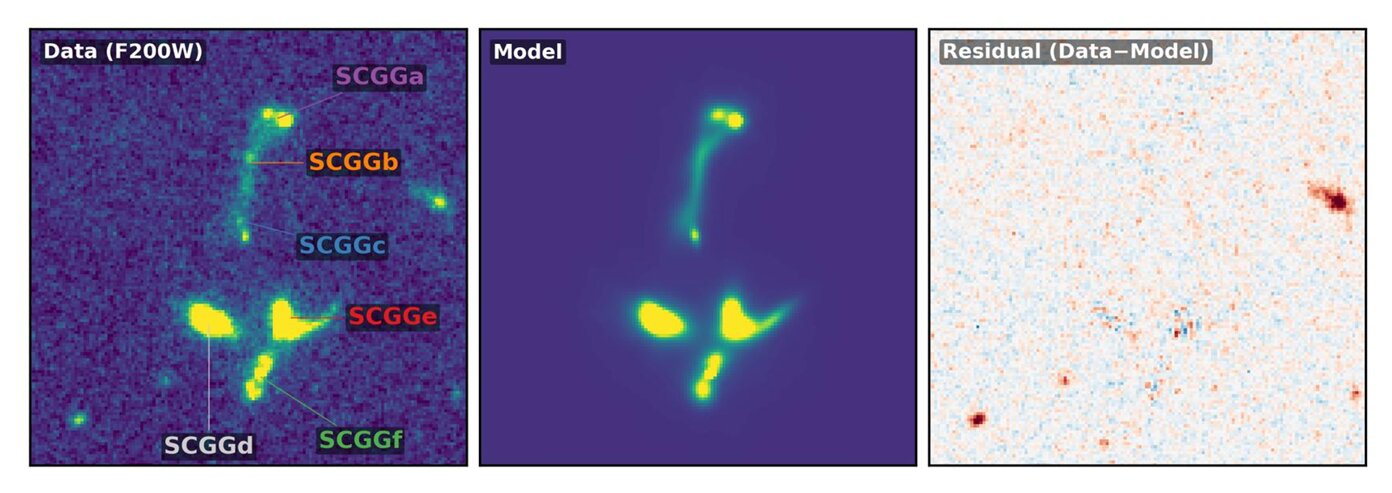
The newly studied system, known as SCGG-z5, contains six young galaxies gathered within an exceptionally small volume of space only 1.2 billion years after the Big Bang. Rather than appearing as isolated objects, the galaxies already show signs that gravity is pulling them into an increasingly complex relationship that could ultimately transform them into one much larger galaxy.
The findings, led by Ronaldo Laishram of the National Astronomical Observatory of Japan, were submitted to the arXiv preprint server on July 13.
A rare laboratory for studying galaxy assembly
The leading cosmological framework, the Lambda Cold Dark Matter model, proposes that galaxies grow gradually through repeated mergers. Instead of forming all at once, large galaxies are thought to emerge as smaller systems collide and combine over billions of years.
Dense regions in the young universe provide valuable opportunities to examine this process while it is still unfolding. These environments, known as proto-groups and proto-clusters, represent an early and short-lived stage of galaxy evolution, where multiple young galaxies occupy an unusually confined region of space.
Finding such systems is difficult. Astronomers need instruments capable of detecting extremely faint, low-mass galaxies at enormous distances while also confirming that the galaxies truly belong to the same physical group rather than simply appearing close together along the line of sight.
For SCGG-z5, every member has been spectroscopically confirmed, meaning researchers determined each galaxy’s distance by measuring distinctive spectral features in its light instead of relying only on estimates based on color and brightness.
Six galaxies inside a remarkably small region
Using deep observations from the James Webb Space Telescope (JWST) together with slitless spectroscopy from the SAPPHIRES survey, the researchers found that all six galaxies occupy a region measuring only 16,000 parsecs, or roughly 52,000 light-years, across.
That span is only about half the diameter of the Milky Way, making the system remarkably compact for containing six separate galaxies.
The close packing offers an opportunity to observe galaxies while they are still strongly influencing one another rather than after they have already merged into a larger structure.
Galaxies already showing different paths
Measurements of the galaxies’ stellar masses and star-forming activity revealed that the members are not evolving identically.
Three of the galaxies are forming stars at or above the typical rate expected for their era of cosmic history. One galaxy stands out by producing stars at a rate noticeably higher than expected.
The observations also reveal that every galaxy in the group has a disturbed, irregular appearance. Such distorted shapes are consistent with galaxies experiencing strong gravitational interactions or already entering the early stages of mergers.
Maps tracing where new stars are forming suggest that gas may be flowing inward toward the centers of some galaxies. This pattern could indicate inside-out growth, in which central regions receive fresh material that fuels continued star formation.
The most massive galaxy appears different. Instead of showing stronger activity in its core, it displays a tentative pattern of relatively quiet central regions while more vigorous star formation occurs toward its outer edges.
According to the researchers, these contrasting behaviors suggest that even before the galaxies merge into one object, the shared environment is already influencing how each member develops.
As the team writes, “the group environment is already differentiating the evolutionary trajectories of its members well before the system coalesces.”
A dynamically active system
The researchers also examined how rapidly the galaxies move relative to one another.
Rather than finding a stable, settled group, they describe SCGG-z5 as a dynamically busy system. The galaxies are traveling quickly enough that they could experience multiple close encounters within approximately 14 million years.
Those repeated gravitational encounters are expected to reshape the galaxies, redistribute gas, and influence where stars continue to form.
The combination of distorted structures, differing star-formation patterns, and rapid motions paints a picture of a system caught during an especially active phase of assembly.
From six galaxies to one
To explore what may happen next, the researchers compared SCGG-z5 with similar systems produced in the EAGLE cosmological simulation.
Those comparisons suggest that all six galaxies could merge into a single galaxy by around z ~ 3–4, approximately 400 million years after the moment at which the system is being observed.
The resulting galaxy would then continue growing over time. By z ~ 1, simulations indicate it could accumulate a stellar mass of roughly 100 billion Suns, potentially becoming the central and brightest galaxy of a future galaxy cluster.
The researchers estimate that the entire sequence—from the beginning of star formation within the group’s members until their final merger—would take about 800 million years.
That timing suggests astronomers have captured SCGG-z5 during an exceptionally brief stage in its evolution, when multiple galaxies remain distinct but are already well on their way toward becoming a much larger system.
Looking ahead
The team describes SCGG-z5 as providing “direct observational constraints on early group assembly” during the universe’s first billion years.
They propose that future observations could test their interpretation in greater detail. Additional JWST spectroscopy could examine how gas moves through the galaxies and reveal its chemical composition, while observations with ALMA could trace the cold gas that fuels star formation.
Together, those measurements could determine whether tidal interactions between the galaxies are responsible for the differences already emerging among the group’s six members, offering an even clearer picture of how massive galaxies first assembled in the young universe.