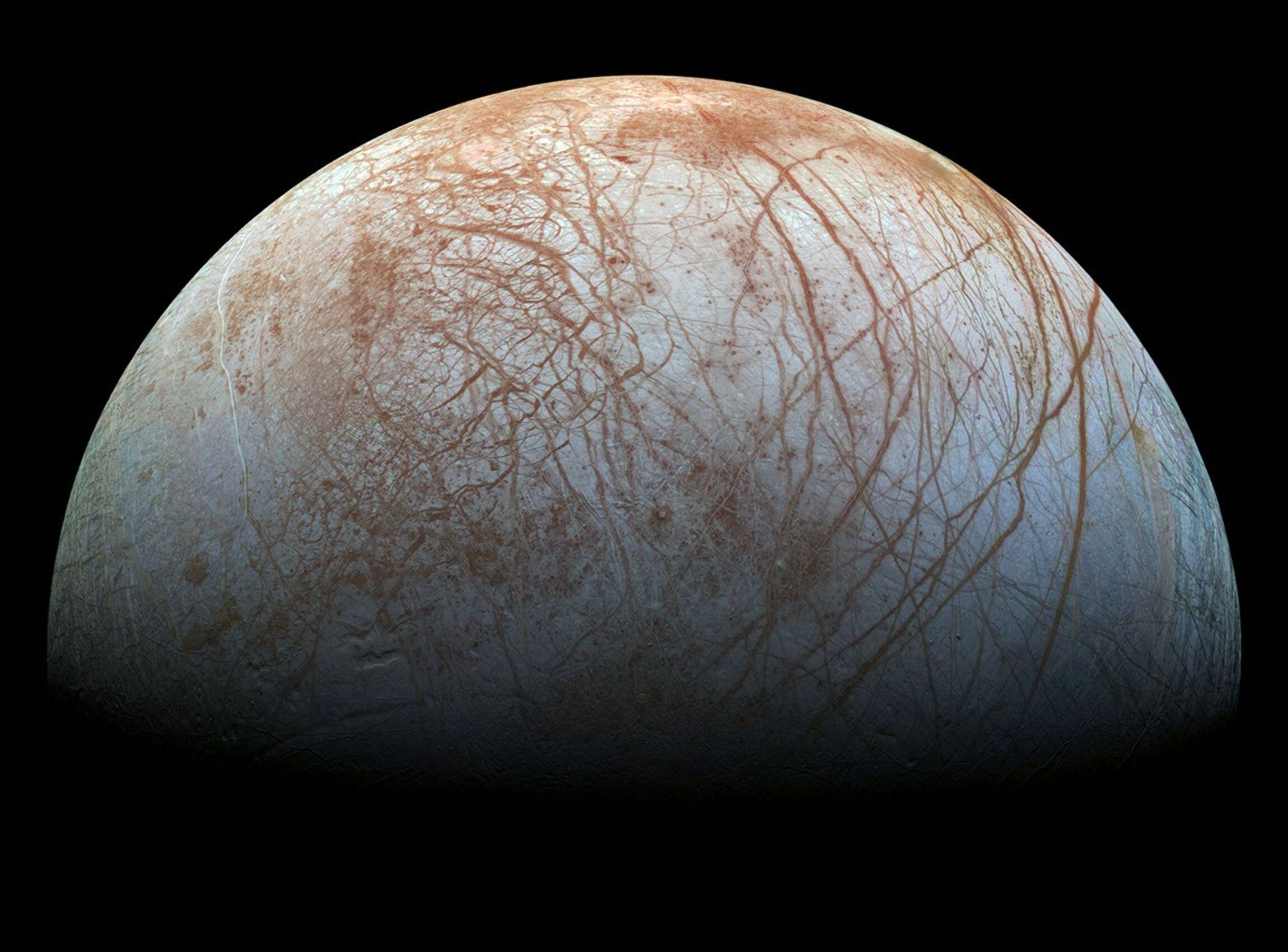
Europa’s buried ocean may be far less connected to its icy surface than scientists previously believed, with new simulations showing that rising water is likely to freeze before reaching shallow layers. The findings suggest that any liquid reservoirs discovered beneath the moon’s ice may have formed locally rather than coming directly from the deep ocean, potentially changing how future missions search for signs of habitability.
Europa has long occupied a special place in planetary science because of what lies beneath its frozen exterior. Hidden below its thick ice shell is what scientists believe to be a global ocean of liquid water, making Jupiter’s icy moon one of the most promising places in the solar system to investigate environments that could potentially support life.
Yet reaching that ocean—or even understanding whether it communicates with the surface—has remained one of the biggest scientific questions about Europa. New research led by Rutgers University scientist Lujendra Ojha suggests the answer may be more complicated than many previous models implied.
Using computer simulations, researchers examined whether liquid water from Europa’s deep ocean could travel upward through fractures in the ice and accumulate in relatively shallow reservoirs. While those reservoirs would be much easier for future spacecraft to study than the deeply buried ocean itself, the simulations indicate that such upward transport is likely far less efficient than previously assumed.
“The mystery we wanted to solve was whether this journey is actually possible,” said Ojha, an associate professor in the Department of Earth and Planetary Sciences at the Rutgers School of Arts and Sciences. “Can liquid water rise from Europa’s deep ocean toward the surface without freezing along the way?”
The team’s conclusion points to a significant obstacle.
“There’s an icy shell, there’s water underneath, and there’s all this speculation about how that water can come from deep underground and make its way all the way up without freezing en route,” Ojha said. “That’s really what we think we disproved.”
Why shallow water may not tell the whole story
The findings carry important implications for scientists preparing to explore Europa over the next decade.
If spacecraft discover pockets of liquid water buried within the moon’s ice shell, those reservoirs might not necessarily contain water transported directly from the deep ocean. Instead, they may have formed much closer to the surface through melting that occurred within the ice itself.
That distinction matters because researchers are particularly interested in Europa’s deep ocean as a potential habitable environment. A shallow reservoir would certainly be easier to investigate, but if it is isolated from the ocean below, it may provide only limited insight into the conditions scientists hope to study.
Rather than assuming shallow water reflects the chemistry or environment of the ocean beneath the ice, future observations may need to determine where that water actually originated.
Upcoming missions will put these ideas to the test
The study arrives as two major missions continue their journeys toward the Jupiter system.
NASA’s Europa Clipper mission launched in October 2024 and is scheduled to reach Jupiter in April 2030. Once there, the spacecraft will orbit the giant planet while making 49 close flybys of Europa, collecting detailed observations of the moon’s surface and interior.
Following behind is the European Space Agency’s Jupiter Icy Moons Explorer, or JUICE, which launched in April 2023 and is expected to arrive at Jupiter in July 2031.
Together, these missions are expected to provide the most detailed examination of Europa ever conducted. Scientists hope to better understand the structure of the moon’s ice shell, analyze its surface composition, and investigate evidence for water beneath the surface. Europa Clipper’s radar instrument, in particular, could help determine whether shallow reservoirs exist and reveal how they are arranged within the ice.
Turbulent water changes the picture
The research focused on dikes—narrow fractures that could potentially allow water from the buried ocean to rise through the ice shell.
The concept has often been compared with the movement of molten rock through cracks beneath Earth’s volcanoes. On icy worlds, however, the equivalent process involves water and ice rather than magma and is known as cryovolcanism.
Ojha said the analogy only goes so far.
“Ice and liquid water are fundamentally different than lava and the volcanoes that we see here on Earth,” he said. “I think there’s some fundamental physics that’s missing here, and so I wanted to explore that.”
One of those overlooked physical processes, according to the new simulations, is turbulence.
Earlier models frequently assumed water would move relatively smoothly through fractures in the ice. The Rutgers-led study instead suggests that water would likely surge turbulently, swirling as it traveled upward. That vigorous motion would increase mixing with the extremely cold walls of the fracture, allowing heat to escape much more rapidly.
“This water that’s going to come up, it’s going to be turbulent,” Ojha said. “It’s going to be left and right, it’s going to be up and down, it’s going to have a swirling motion. And when that happens, that liquid water is going to cool very, very fast as it approaches the surface.”
Ice may block the route before water reaches the surface
Rapid cooling creates another challenge.
As the rising water loses heat, it can become supercooled, remaining liquid despite dropping below its usual freezing temperature. Under those conditions, tiny crystals known as frazil ice begin to form.
Instead of continuing their journey upward, these crystals can accumulate inside the fracture itself, gradually clogging the pathway.
According to the simulations, relatively narrow cracks could freeze shut within hours. Although wider fractures might transport larger amounts of water under idealized circumstances, the effects of turbulence make those scenarios considerably less likely.
The researchers also found that delivering enough water to produce some of Europa’s observed surface features would require fractures that were unrealistically long or present in unusually large numbers.
A stronger barrier between ocean and surface
Taken together, the results portray Europa’s ice shell as a much more effective barrier than many earlier studies suggested.
If shallow liquid reservoirs do exist, the research indicates they are more likely to originate from localized heating and melting within the ice rather than from water rising directly out of the global ocean below.
That conclusion does not diminish the importance of future missions. Instead, it gives scientists a new framework for interpreting whatever Europa Clipper and JUICE ultimately discover beneath the moon’s frozen crust.
“Our work suggests that Europa’s ice shell may be a stronger barrier between the ocean and the surface than previously assumed,” Ojha said. “This helps future missions interpret what they find and better understand where to look for signs of habitability.”
The study was published in Nature Astronomy.