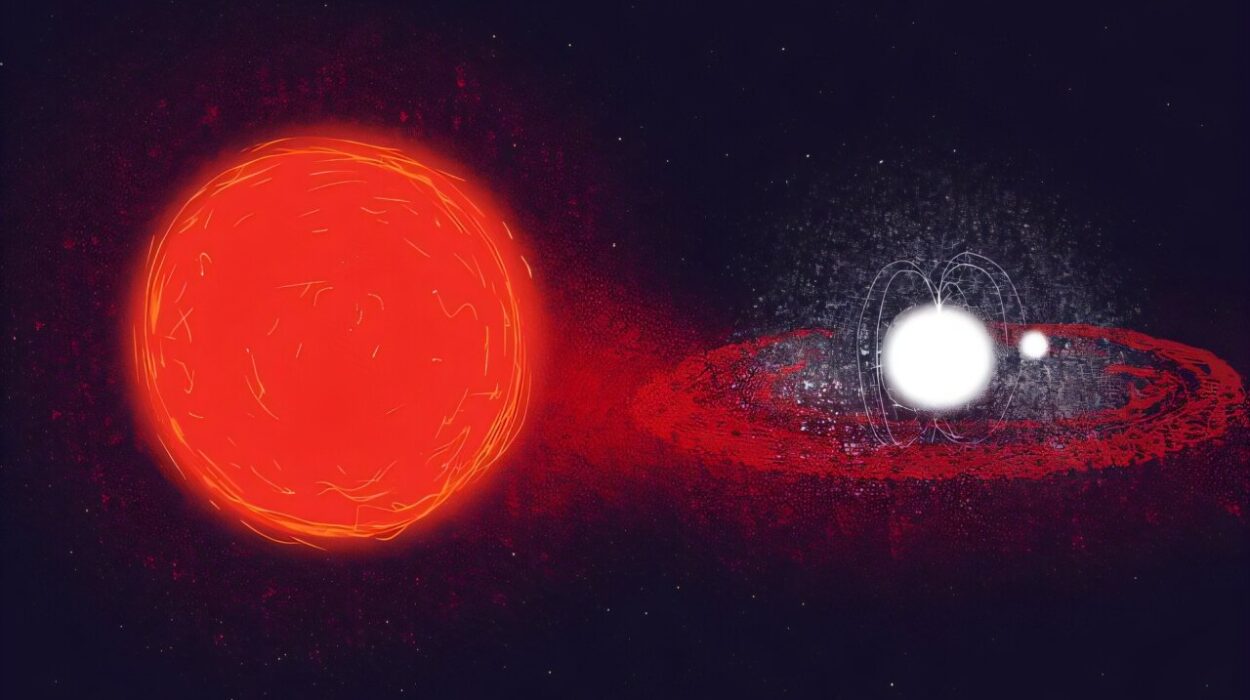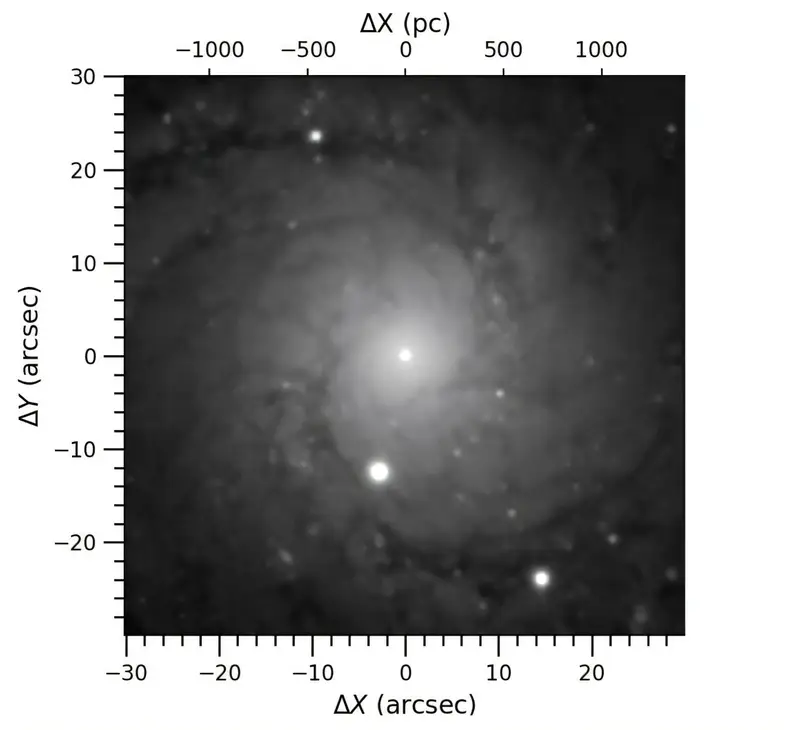
From 32 million light years away, the grand spiral of Messier 74 looks serene, its sweeping arms glowing with fresh star birth. Yet at its center lies something older, quieter and far more mysterious. A small international team of astronomers, led by Francesca Pinna of the University of La Laguna in Spain, decided to look into that heart again. This time, they carried with them the power of the PHANGS-MUSE survey, a tool capable of peeling back layers of cosmic history hidden inside the galaxy’s core.
What they found was not a bustling hub of newborn stars, nor a chaotic churn of gas and dust. Instead, they uncovered a relic. A silent witness. A cluster of ancient stars that has not stirred in billions of years.
Into the Core of Messier 74
Nuclear star clusters are extreme objects by any measure. Packed into volumes only a few dozen light years wide, they can contain anywhere from ten thousand to one hundred million suns. They are found across galaxies of every size, forming the densest stellar systems known in the universe.
Messier 74 itself is a vast, star-forming spiral roughly 85,300 light years across. With a stellar mass of about 22 billion suns and a star-formation rate of 1.74 solar masses per year, it remains alive with creation. Its swirling arms shimmer with the gas and dust from which new stars continue to rise.
But the center is different.
Back in 2009, observations from the Hubble Space Telescope revealed a nuclear star cluster tucked inside this galaxy. With an effective radius of 39 light years and a metallicity below that of the sun, the cluster appeared old, around 8 billion years. Already, this hinted at a curious disconnect. Messier 74 was actively forming stars, yet its core seemed to be a relic of ancient times.
Pinna’s team wanted to know more. What was the true history of this quiet cluster. Why had it not joined the rest of the galaxy in the ongoing celebration of star birth.
To answer these questions, they turned to PHANGS.
Reading Ancient Light Through PHANGS
PHANGS, short for Physics at High Angular resolution in Nearby GalaxieS, is a multiwavelength survey designed to explore the detailed physics of star formation. One of its instruments, the Multi Unit Spectroscopic Explorer or MUSE, sits on the Very Large Telescope in Chile. By combining imaging and spectroscopy, MUSE allows astronomers to capture both the structure and the chemical fingerprints of stars and gas across galaxies with remarkable precision.
Using this dataset, the researchers could dissect the nuclear star cluster’s light, separating it into the stories of the stellar populations within. Each group of stars carries unique signatures of age and composition, allowing astronomers to reconstruct when and how the cluster formed.
What they discovered transformed the earlier picture completely.
A Cluster Forged in the Galaxy’s Dawn
The new analysis revealed that the nuclear star cluster in Messier 74 is even older than previously thought. Its stars date back about 11 billion years, placing their birth near the earliest stages of the galaxy’s formation. Its total metallicity sits at -0.5 dex, reinforcing the idea that it formed from primitive, unenriched material.
The star-formation history is remarkably simple. There are no hints of rejuvenation, no evidence of younger populations sneaking in. The cluster is a monument to the galaxy’s past, built exclusively of ancient stars.
The team put it plainly. “These results indicate that NSC stars formed during the earliest stages of the evolution of Messier 74, probably spanning 2–3 distinct episodes.”
Those episodes, separated by time but united in antiquity, tell us that the cluster formed rapidly and then shut down almost completely. For billions of years, it has remained quiet.
The next finding explained why.
A Silent Cavity in a Busy Galaxy
In a galaxy with ongoing star formation, one might expect its heart to be full of gas and dust. Instead, Pinna’s team discovered that the nuclear star cluster sits inside a vast cavity roughly 1,000 light years wide—a region entirely devoid of the raw materials needed for star birth.
Beyond this empty bubble, the galaxy is alive with intricate filaments of gas and dust. These structures weave through the spiral arms, feeding the ongoing creation of new stars. Messier 74 is not running out of fuel. It simply keeps that fuel far from its core.
Inside the cavity, the nuclear star cluster has lived a long, undisturbed existence. Without gas falling inward, without fresh bursts of star formation, without chemical enrichment, it has remained frozen in time. The cluster’s extreme age and inactivity are not accidents but consequences of its cosmic environment.
And yet one mystery remained.
An Unexpected Poverty of Metals
Even among nuclear star clusters of similar host galaxies, the cluster inside Messier 74 stands out. It is significantly more metal-poor not only compared to the rest of its own galaxy but also compared to nuclear clusters inside early-type galaxies with comparable mass. It is even poorer in metals than the clusters found in slightly lower-mass late-type galaxies.
This scarcity of metals points to a unique evolutionary path. Whatever shaped this cluster long ago set it on a trajectory different from that of its peers. Perhaps early conditions prevented efficient enrichment. Perhaps the long-lasting cavity isolated it before metals from later generations of stars could reach the center. The study does not claim answers beyond what the data show, but the pattern is clear. Something about Messier 74’s earliest days left a permanent imprint on its core.
Why This Ancient Cluster Matters
Discoveries like this one extend far beyond a single galaxy. Nuclear star clusters are keys to understanding how galaxies assemble over cosmic time. They provide snapshots of the earliest periods of star formation, fossil records of environments we can no longer observe directly.
Messier 74’s nuclear star cluster tells a particularly compelling version of that story. It shows what happens when a galaxy’s heart forms early, then becomes sealed away inside a cavity that prevents further growth. It demonstrates that even in galaxies bustling with new stars, their centers can remain untouched ruins of the past. And its extreme metal poverty hints that even clusters formed under similar conditions can diverge dramatically depending on how their galaxies evolve.
This research matters because it sharpens our picture of galactic history. It reminds us that the quietest places in the universe sometimes hold the oldest truths. And it keeps alive one of astronomy’s greatest promises. By studying the light of ancient stars, we move closer to understanding not just where galaxies come from, but how the universe itself built the first structures that would one day give rise to everything we know.
More information: Francesca Pinna et al, The Nuclear Star Cluster of M 74: A fossil record of the very early stages of a star-forming galaxy, arXiv (2025). DOI: 10.48550/arxiv.2512.03999