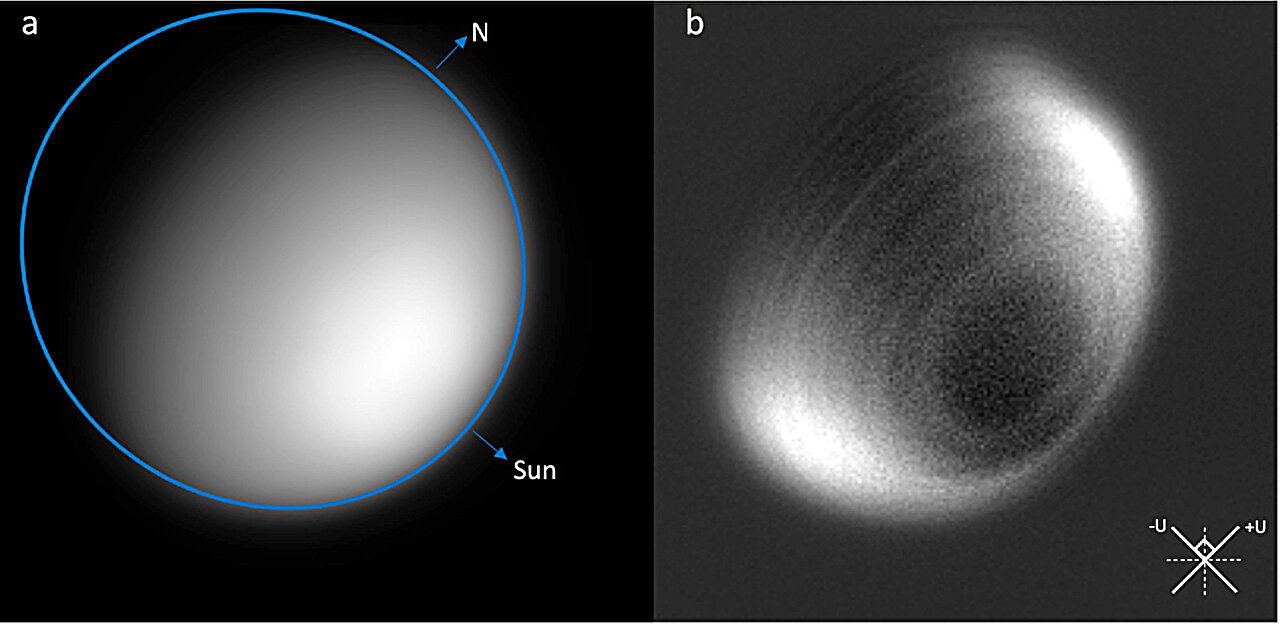
Faint, planet-wide rings unexpectedly emerged in highly sensitive polarized images of Venus even though the planet looked perfectly ordinary in conventional light. If the mysterious pattern is real rather than an instrumental artifact, it could represent enormous atmospheric density waves rippling high above Venus’s cloud tops—an entirely new way of studying the planet’s restless upper atmosphere.
For just 36 minutes on the evening of May 24, 2010, astronomers pointed an experimental instrument at Venus while waiting for darkness to fall before beginning an unrelated observing program. At the time, nothing seemed remarkable about the images they collected.
Years later, when those observations were examined in detail, something astonishing appeared.
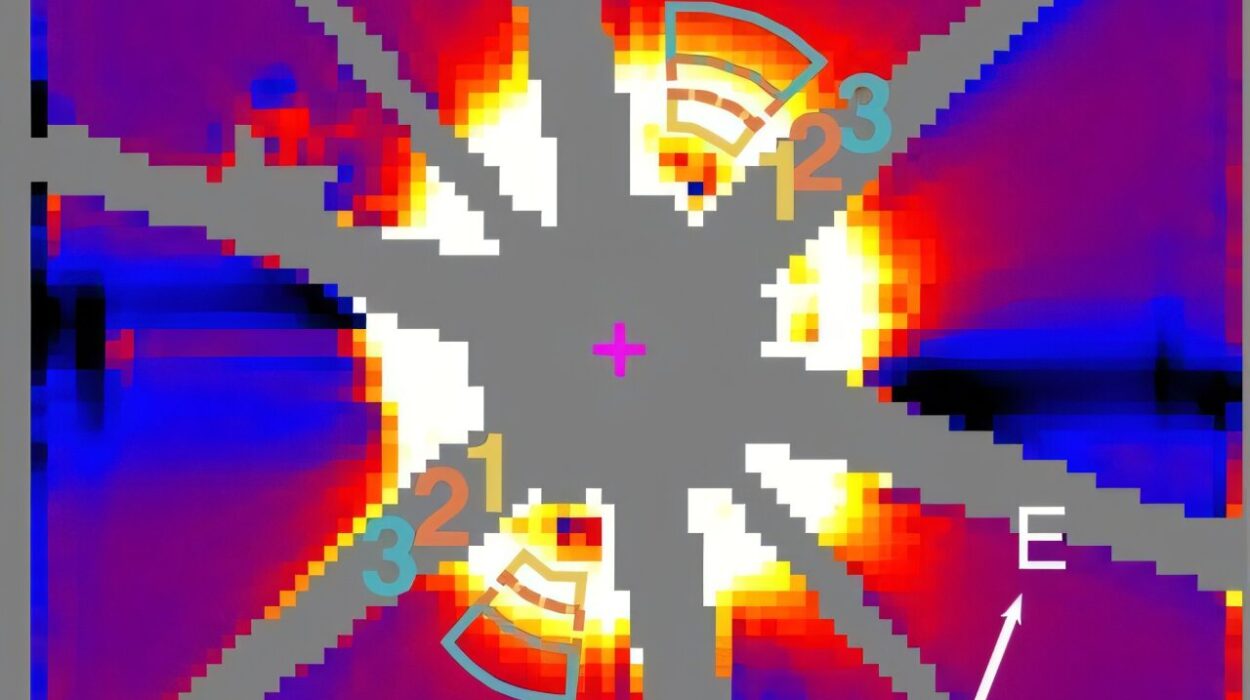
Instead of a smooth disk, Venus displayed a series of faint, concentric rings in polarized light—light whose waves vibrate in a preferred direction after being scattered through the atmosphere. The rings were so subtle that they changed the signal by only about five ten-thousandths of the brightest polarized light measured from the planet. They were invisible in ordinary brightness images and had never been reported before.
Because the observations exist only from that brief, accidental observing run, the scientists are deliberately cautious. They do not claim to have discovered a new atmospheric phenomenon. Instead, they present the unusual observations alongside detailed computer simulations showing that such rings could plausibly be produced by large-scale density variations high above Venus’s clouds, encouraging future missions and telescopes to determine whether the pattern is real.
A planet that looked ordinary suddenly became extraordinary
The observations were made using the Extreme Polarimeter (ExPo) mounted on the 4.2-meter William Herschel Telescope on La Palma in Spain.
ExPo was not designed to study Venus. Its primary purpose was detecting extremely faint polarized light from objects such as exoplanets and circumstellar disks. Its specialized optical design, however, made it exceptionally sensitive to tiny polarization signals—far beyond what earlier Venus polarimeters could routinely detect.
During the short observing sequence, Venus was photographed through six visible-light filters over approximately 36 minutes. The planet’s phase angle was 48.7 degrees, meaning Earth saw Venus as a partially illuminated disk roughly 12.5 arcseconds across.
When the researchers examined the ordinary intensity images, Venus appeared exactly as expected: brightest near the region facing the Sun, with no obvious circular structures.
The polarized images told a very different story.
Three observations, taken through the Hα, Hα continuum, and sodium (Na) filters, contained narrow, ring-like bands extending across much of the illuminated hemisphere. The rings appeared roughly centered slightly downwind from the point directly beneath the Sun rather than precisely on it.
Meanwhile, three later observations taken through different filters showed no comparable rings.
That inconsistency immediately raised an important question: were the rings genuine, or were they simply an artifact?
Polarized light can expose what ordinary images cannot
The reason the rings appeared only in polarized light lies in how sunlight interacts with Venus’s atmosphere.
Ordinary images record the total amount of reflected sunlight. Polarimetry measures something more subtle: how strongly that reflected light becomes polarized after scattering from atmospheric particles and gas molecules.
Venus’s bright cloud deck dominates its visible appearance, making it extremely difficult to detect slight density changes in the thin atmosphere above the clouds using conventional imaging.
Polarized light offers a potential advantage.
Gas molecules scatter sunlight through Rayleigh scattering, the same physical process responsible for Earth’s blue sky. Rayleigh scattering produces strongly polarized light under the right viewing geometry. Even relatively small changes in gas density can therefore alter the polarized signal while producing almost no measurable change in the planet’s overall brightness.
That is exactly what the observations showed.
Along Venus’s equator, the total brightness followed a smooth profile with no obvious oscillations. The polarized signal, however, displayed a clear repeating pattern corresponding to the visible rings.
The instrument was designed to eliminate exactly this kind of error
An unexpected discovery demands skepticism, and the researchers devote considerable attention to the possibility that the rings originated inside the instrument rather than on Venus.
ExPo was specifically engineered to suppress instrumental polarization.
Instead of making a single polarization measurement, it splits incoming light into two orthogonal polarization states and repeatedly swaps them using a rapidly switching liquid crystal modulator operating at 35 frames per second. By combining four separate measurements through a double-differencing technique, the instrument largely cancels first-order systematic errors caused by optics or changing atmospheric conditions.
The researchers searched extensively for possible instrumental explanations.
They considered whether optical filters might have introduced the pattern. They examined whether Earth’s atmosphere, including scattering by thin layers of ice particles, could have generated similar structures. They also noted that comparable rings had never appeared in ExPo observations of other astronomical targets or during controlled laboratory experiments using a white Styrofoam sphere as a Venus substitute.
None of those investigations produced a convincing explanation.
Still, the team stresses that an unknown instrumental artifact cannot be completely ruled out. ExPo was later dismantled, making it impossible to repeat the observations with the identical instrument configuration.
Computer models tested whether the atmosphere could produce the rings
To explore whether the strange pattern could have a physical origin, the researchers built detailed radiative transfer simulations describing how sunlight scatters through Venus’s atmosphere.
Their atmospheric model consisted of four layers of carbon dioxide gas, with cloud and haze layers based on previous measurements of Venus. The calculations fully accounted for multiple scattering and polarization.
Rather than changing the clouds themselves, the researchers altered only the density of gas in the highest atmospheric layer above the cloud tops.
The result closely matched the central mystery.
Changing the upper-atmospheric gas density by roughly 5% to 10% produced noticeable variations in polarization while leaving the total reflected brightness almost unchanged.
In other words, a planet could appear perfectly smooth in ordinary images while simultaneously displaying rings in polarized light.
The simulations also reproduced another important observational detail. The direction of polarization remained nearly unchanged even where the ring pattern appeared, matching what ExPo recorded.
Giant atmospheric waves offer one possible explanation
If the rings truly originated in Venus’s atmosphere, the most plausible explanation proposed in the paper involves planet-wide gravity waves.
Atmospheric gravity waves are not the same as gravitational waves predicted by Einstein’s theory of relativity. Instead, they are oscillations produced when gravity tries to restore disturbed air to equilibrium, much like ripples spreading across water after a stone is thrown into a pond.
Venus is already known to host many kinds of atmospheric gravity waves. Spacecraft including Venus Express, Akatsuki, and Pioneer Venus have observed waves with wavelengths ranging from roughly 100 to 600 kilometers, while theoretical work predicts even broader scales.
The new simulations suggest that density waves extending across much of the planet could generate the observed polarization rings if they existed above the cloud tops.
In the model, wave spacing gradually changes across the disk—from approximately 900 kilometers near the subsolar region to around 100 kilometers near the terminator—consistent with the range of gravity-wave scales previously reported for Venus.
The apparent center of the rings lies about 20 degrees, or roughly 2,100 kilometers, downwind of the subsolar point. The authors suggest this displacement could arise from a combination of delayed atmospheric heating and Venus’s powerful equatorial winds, which can transport cloud material at speeds near 100 meters per second.
The disappearing rings may also make sense
One puzzle remained: why did only half of the observations display the rings?
The answer is probably not a single factor.
The three successful detections occurred earlier in the observing sequence under better viewing conditions. Later observations were made when Venus had dropped lower toward the horizon, increasing the amount of Earth’s atmosphere through which the telescope had to observe.
However, the situation is more complicated than worsening viewing conditions alone.
One later observation using the sodium filter still displayed clear rings despite being taken at a higher air mass than the earlier Hα observations.
The researchers therefore argue that several effects probably acted together.
Rayleigh scattering becomes weaker at longer wavelengths, reducing the polarization response to atmospheric density changes. The broader Sloan filters also average together a wider range of wavelengths, which can blur subtle signals. ExPo additionally lacked an operational atmospheric dispersion corrector during these observations, allowing atmospheric dispersion to smear the images further.
Computer simulations of Earth’s atmospheric turbulence supported this interpretation. Increasing simulated atmospheric seeing progressively weakened the modeled polarization rings, demonstrating how easily such faint structures could disappear.
A discovery that remains deliberately unfinished
The authors repeatedly emphasize that their observations represent a candidate signal, not definitive proof.
Everything rests on a single accidental dataset obtained during one short observing session more than a decade before the rings were recognized.
No second ExPo dataset exists for comparison, and no other instrument has combined imaging capability with comparable polarimetric sensitivity in visible light.
That limitation prevents the researchers from claiming that Venus definitely hosts these enormous concentric density waves.
Instead, they present a carefully balanced case.
The observations cannot yet establish a new atmospheric phenomenon. At the same time, the team found no convincing instrumental explanation, and their physical models demonstrate that realistic density variations above Venus’s clouds could naturally generate the unusual polarization pattern while leaving the planet’s visible appearance almost unchanged.
Future observations will ultimately determine whether the rings were a one-time illusion or the first glimpse of a previously hidden layer of Venusian atmospheric activity.
The paper points to several opportunities ahead. South Korea’s planned CLOVE CubeSat mission will include polarimetric observations of Venus, while the European Space Agency’s EnVision mission, currently scheduled for launch in 2032, will carry the VenSpec-H spectropolarimeter, although it will operate at near-infrared wavelengths where the predicted signal is expected to be much weaker.
If future instruments detect the same faint rings again, an observation once made almost by accident during an otherwise ordinary evening at a telescope could become the first evidence of a planet-wide atmospheric process that has remained hidden in plain sight for decades.
Publication details
Gourav Mahapatra et al, Planet-wide, Concentric Density Waves in Venus’s Upper Atmosphere Revealed through Polarimetry?, The Planetary Science Journal (2026). DOI: 10.3847/psj/ae7e6f