On a quiet field at Val in Bjugn, where the wind usually moves unnoticed across the grass, a single metallic glint changed everything. Earlier this year, Roy Søreng was sweeping his metal detector across the landscape when it caught on something small, oval, and unmistakably old. He had uncovered an oval brooch, the kind worn by Viking Age women more than a thousand years ago. That accidental discovery opened the door to a grave so well-preserved, so unusually furnished, and so symbolically rich that archaeologists chose to investigate it in secret.
What lay beneath the soil was not simply a burial. It was the beginning of a story that challenges what researchers thought they knew about how the people of Viking Age Trøndelag honored their dead.
The Woman Who Wore Her Story
When archaeologists from the NTNU University Museum and the Trøndelag County Council arrived at the find, they were joined by the Norwegian Directorate for Cultural Heritage, which recognized the potential of what Søreng had set in motion. The grave they uncovered belonged to a woman who lived in the 800s, a woman dressed not only for burial but for remembrance.
“The Viking Age grave contains what we believe to be a woman, buried with a typical Viking Age costume and jewelry set from the 800s. This indicates that she was a free and probably married woman, perhaps the mistress of the farm,” says Raymond Sauvage, head engineer at the museum’s Department of Archaeology and Cultural History.
Two oval brooches once fastened the straps of her suspender dress. A small ring buckle closed the neck of her petticoat. One of those brooches—now so critical to understanding the grave—was the very object Søreng found on his walk months before. The excavators worked quietly and quickly, aware that the beauty and completeness of the grave made it a rare target both for looters and for weathering if left exposed. They repeatedly praised both Søreng and landowner Arve Innstrand for giving them the chance to investigate it properly.
Symbols Folded Into Ritual
Viking burials were not simply the end of a life. They were performances. Clothing, jewelry, and goods were selected with care, speaking to identity, family status, and the memories the living wanted to preserve. But this grave held something even more extraordinary.
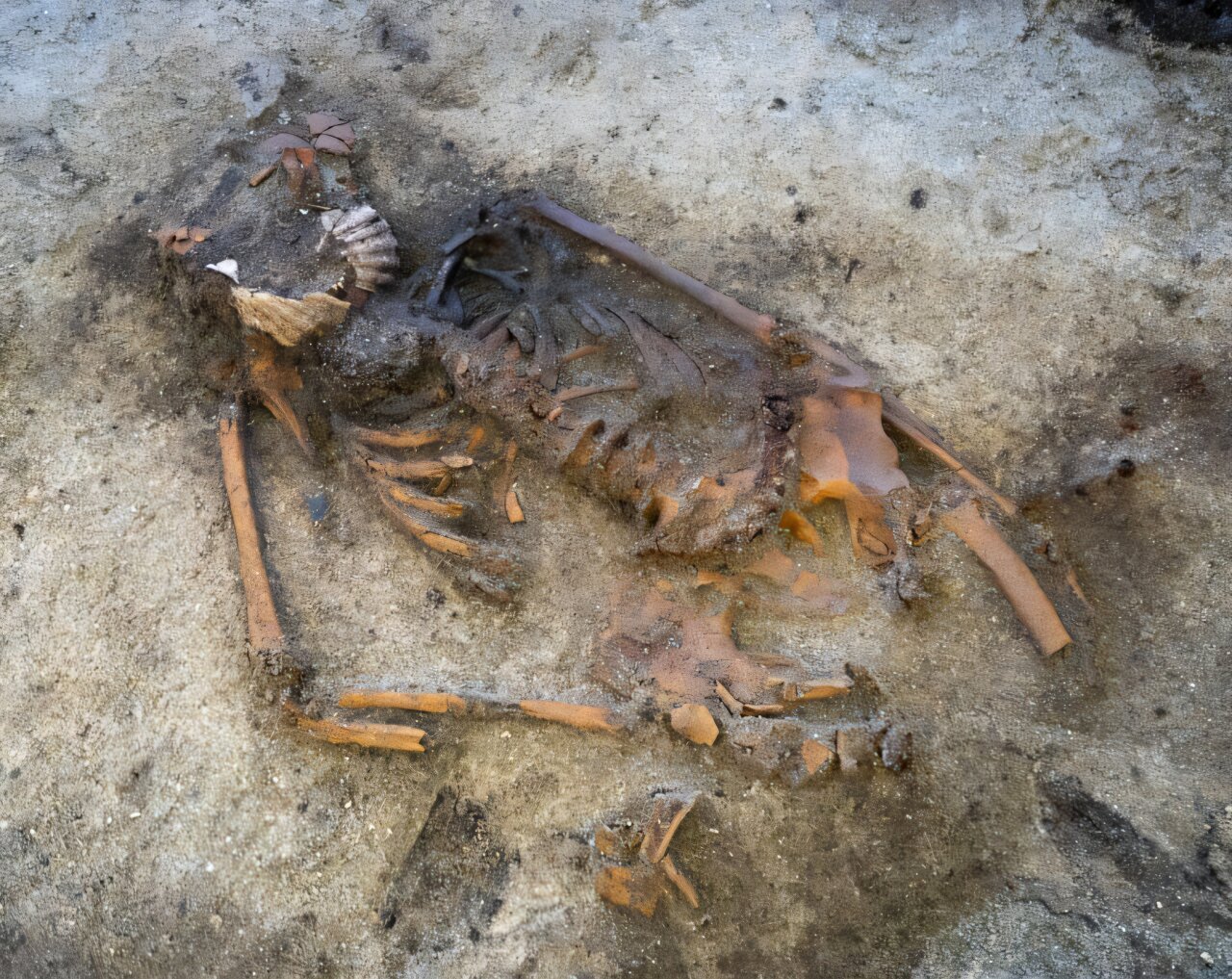
“The most remarkable thing is two scallop shells placed at the dead woman’s mouth. This is a practice that is not previously known from pre-Christian graves in Norway. We don’t yet know what the symbolism means,” says Sauvage, who is also the project manager for the surveys.
The scallop shells had been positioned curved side outward, straight edge up, gently covering her mouth. Around them lay small bird bones—likely from wings—adding yet another layer of mystery. Scallop shells were laden with Christian meaning in the Middle Ages, but their presence here, in a pre-Christian context, raises questions no one has had reason to ask before. Perhaps they were poetic symbols. Perhaps they were protective. Perhaps they marked a transition of some kind. Archaeologists simply don’t know yet.
What they do know is that Viking funerary rites were open to innovation. They were settings where families could explore new symbolic gestures, absorbing elements that carried meaning for them even if they appear unusual today.
A Second Skeleton and a Race Against Time
This was not the first time the field had offered up voices from the distant past. Earlier in the year, researchers had already documented an exceptionally well-preserved skeleton from the 700s just meters away. That older find had prompted continued attention, making Søreng’s brooch discovery even more compelling. If one grave remained in such good shape, perhaps others did too.
The archaeologists realized quickly that they were standing over a burial in danger.
“During the inspection, we quickly realized that we were facing a new skeletal grave that was in acute danger of being damaged during the next plowing,” says field supervisor Hanne Bryn, from the Department of Archaeology and Cultural History.
Plowing would have crushed what centuries had preserved. Instead, landowner Arve Innstrand chose protection over convenience, giving researchers the time they needed. Bryn believes this new grave is “probably one to three generations younger than the previously documented grave at the site,” suggesting a family story stretching across the landscape.
Recognizing the urgency, the Norwegian Directorate for Cultural Heritage provided extra funding for a full security excavation.
“This is an incredibly exciting finding. It is very unusual to find such a well-preserved skeleton in ancient graves. This find has great cultural heritage value and potential. Therefore, it was important for the Directorate for Cultural Heritage to provide funds to ensure this could be studied in the best possible way,” said Hanna Geiran, director general of the Norwegian Directorate for Cultural Heritage.
She added: “I would like to commend both the landowner and the finder for now being able to learn a little more about a fascinating period in our common history. The Viking Age engages many people, and now we look forward to learning more after the further investigations at the NTNU University Museum.”
What the Bones May Tell
With the grave fully excavated and protected, the team is turning toward the next phase. The finds have been kept quiet until now because preserving them required delicate, time-consuming work. At the NTNU University Museum, specialists will begin examining the bones, the jewelry, and the unexpected symbolic objects.
“We will examine the skeleton, preserve the objects and take samples for dating and DNA analysis. The goal is to learn more about the person and about possible kinship to the previous find from the same place,” says Sauvage.
The analysis may reveal height, biological sex, signs of disease, and—most tantalizingly—whether the woman in the 800s was related to the individual buried in the 700s. The field may hold the resting place of an extended family whose story was never meant to be lost.
Why This Discovery Matters
Each artifact, bone, and gesture in this grave offers a thread into the tapestry of the Viking Age, but the scallop shells and bird bones make this find unlike any other known pre-Christian burial in Norway. They may reflect a symbolic language that has never been documented, pushing researchers to reconsider assumptions about early ritual practice. The preservation of the skeleton gives scientists a rare chance to examine a human body that weathered more than a millennium beneath the soil. And the proximity of two well-preserved graves across generations suggests the possibility of family continuity, local power, or a tradition of honoring lineage in ways not previously observed.
Most importantly, this discovery is a reminder that history remains alive beneath our feet, waiting for the right moment—and sometimes the right metal detector—to speak.