A coronal mass ejection that appeared from Earth to be headed safely away instead contained a hidden Earth-directed component that reached spacecraft near Earth, Mars, and beyond. By combining observations from 17 spacecraft, researchers reconstructed the event as a narrow, strongly asymmetric CME with separate fast and slow lobes, revealing a structure that could not have been identified from the Sun-Earth line alone.
Europa Clipper detected an unusual solar wind disturbance
NASA’s Europa Clipper spacecraft was traveling from Earth toward Mars in December 2024 when one of its instruments recorded unusual solar-wind conditions.
On Dec. 19, Europa Clipper was 1.19 astronomical units from the Sun. During a one-hour checkout of its Plasma Instrument for Magnetic Sounding, or PIMS, the instrument detected ions between about 1,450 and 1,700 electron volts. Assuming the ions were protons, that corresponded to solar-wind speeds of roughly 530 to 570 kilometers per second.
The signal also had a broad, low-intensity peak. That indicated plasma with lower density and higher temperature than typical solar wind conditions at that distance from the Sun.
Those measurements were consistent with plasma associated with a coronal mass ejection, or CME. But the measurements alone could not determine what part of the CME Europa Clipper had encountered. The spacecraft could have crossed a CME wake, a flank, or another transient structure.
A much larger set of observations provided the answer.
In December 2024, an unusually well-distributed network of 17 spacecraft was operating across the inner solar system. Their measurements made it possible to follow the same CME from near Mercury through the Earth-Mars region and reconstruct its structure.
The CME began with a large solar filament eruption
The event originated at the Sun on Dec. 14 and 15, 2024.
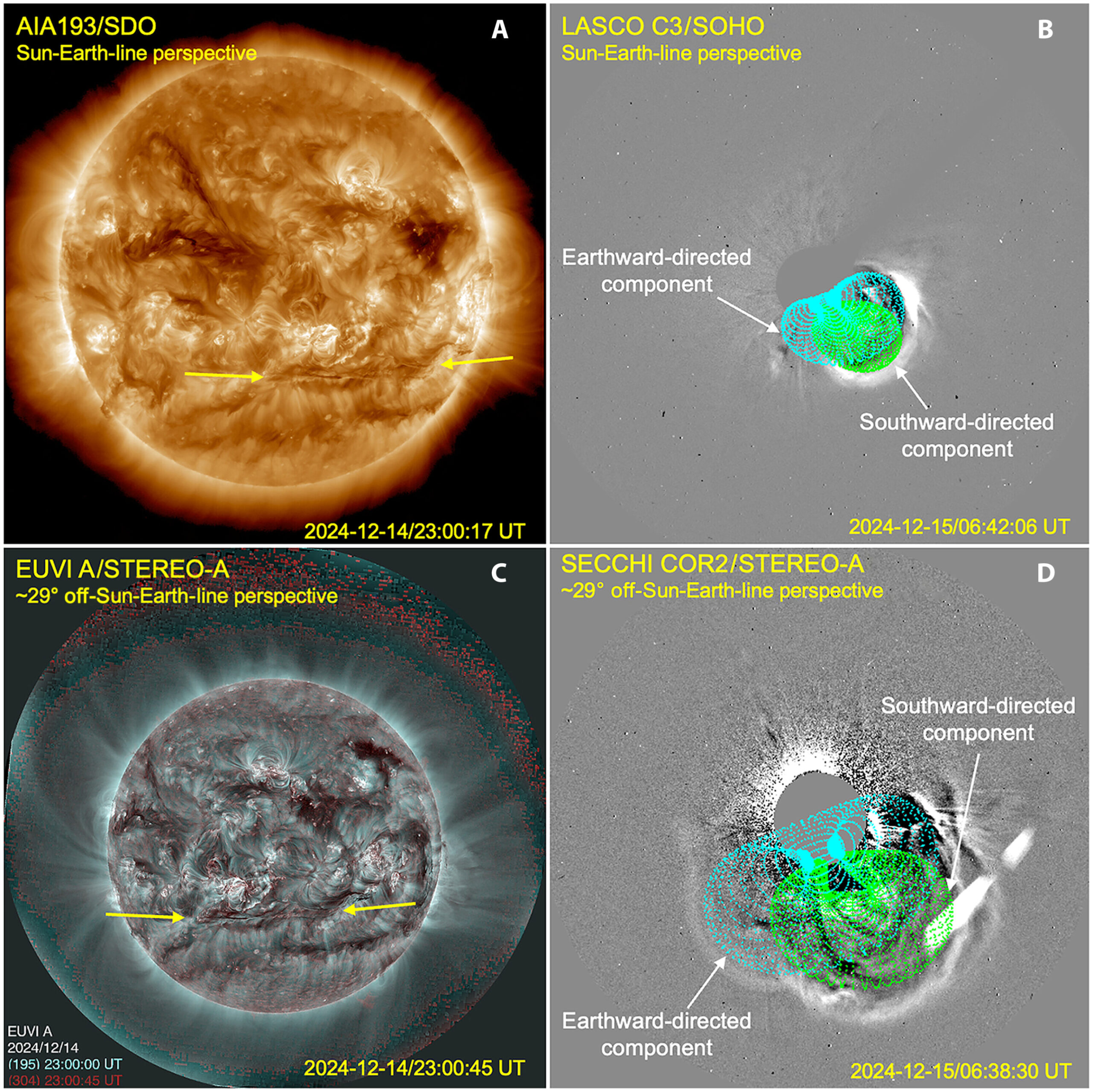
A slow CME was first observed on Dec. 15 at 00:48 Universal Time by the SOHO spacecraft’s LASCO coronagraph and about an hour later by STEREO-A. It was associated with a long, quiet-Sun filament on the Earth-facing side of the Sun near 28 degrees south latitude.
The filament stretched more than 60 degrees in longitude. Its eruption continued for more than four hours, from 22:30 UT on Dec. 14 to 02:30 UT on Dec. 15.
Several nearby active regions also produced low-level C-class flares during the eruption. The activity included C2.6 and C4.2 flares from active region AR3924 and a C2.6 flare from AR3917. These flares occurred at the same time as the filament eruption and were likely associated with the CME’s onset.
The CME itself propagated southward from the ecliptic plane. But it was wide enough that part of it was directed toward Earth.
That component was difficult to see from the usual Sun-Earth viewing direction.
STEREO-A revealed the hidden component
From the Sun-Earth line, the Earth-directed part of the CME was positioned in front of the much more prominent southward-moving portion. The two structures therefore appeared superimposed in images from SOHO.
This made the Earth-directed component effectively invisible in those observations.
STEREO-A had a different view. The spacecraft was about 29 degrees west of the Sun-Earth line, providing a side-on perspective of the CME. Its COR2 coronagraph captured the Earth-directed front at 01:55 UT on Dec. 15.
From that angle, the two components separated clearly.
The observations showed that this was a single CME with distinct directional components, including a previously hidden Earth-directed component. Without the off-Sun-Earth-line view from STEREO-A, that component could not have been forecast from remote sensing observations alone.
The three-dimensional reconstruction required two components of the Graduated Cylindrical Shell model to reproduce the CME’s highly asymmetric geometry.
Seventeen spacecraft followed the CME through the inner solar system
The researchers then compared measurements from spacecraft distributed between 0.35 and 1.6 astronomical units from the Sun.
BepiColombo detected the Earth-directed component near Mercury at about 0.35 astronomical units on Dec. 16. The structure then moved outward through the region between the Sun, Earth, and Mars.
Wind, ACE, and DSCOVR detected its shock near Earth on Dec. 17. Their measurements were followed by signatures of a turbulent, high-speed sheath and a magnetic cloud.
The four spacecraft of NASA’s Magnetospheric Multiscale mission and the two ARTEMIS spacecraft also observed the shock and related magnetic variations within the Earth-Moon system.
Europa Clipper then encountered the same CME during its cruise. Its instruments recorded the magnetic cloud and its turbulent wake.
Farther from the Sun, NASA’s MAVEN spacecraft recorded a sudden increase in dynamic pressure between Dec. 19 and 20, consistent with the passage of the same Earth-directed component near Mars.
Together, these observations showed coherent radial propagation of one CME through the Sun-Earth-Mars region over about 2.3 days.
But another spacecraft revealed that the CME was not moving outward as a uniform front.
STEREO-A arrived about 25 hours after Earth
STEREO-A was nearly the same distance from the Sun as Earth, at about 0.98 astronomical units. But it was about 29 degrees west of the Sun-Earth line.
It detected the CME shock on Dec. 18, roughly 25 hours after the shock reached spacecraft near Earth.
The solar wind speed ahead of the CME at STEREO-A was about 400 kilometers per second, lower than in the region ahead of the faster Earth-directed part.
If the CME had expanded outward as a roughly uniform front, spacecraft at similar distances from the Sun would not be expected to see such a large difference in arrival time.
The measurements instead revealed two distinct parts of the Earth-directed CME. One was a faster lobe that moved through the Sun-Earth-Mars sector. The other was a slower longitudinal lobe that reached STEREO-A later.
Solar Orbiter provided another important constraint. Located about 10 degrees east of the Sun-Earth line and 0.94 astronomical units from the Sun, it did not observe a shock or magnetic cloud associated with the event.
The combination of a CME encounter at Earth, a delayed encounter at STEREO-A to the west, and no clear encounter at Solar Orbiter to the east showed that the Earth-directed component occupied a relatively limited longitudinal sector.
It was not a broad, uniformly expanding front.
The two lobes traveled at very different speeds
The timing of the spacecraft encounters allowed the researchers to estimate average propagation speeds between different locations.
In the Earth-Mars sector, the CME traveled from the corona to Earth at an average speed of about 840 kilometers per second.
In the Mercury-to-STEREO-A sector, its average speed to 1 astronomical unit was only about 534 kilometers per second. Between the corona and BepiColombo in that same sector, the average speed was about 566 kilometers per second.
The difference supports the interpretation of a fast-slow, dual-lobe structure.
The CME also slowed as it moved through the inner solar system and exchanged momentum with the surrounding solar wind.
The researchers found that the faster western segment originated in regions with stronger magnetic fields in the days before the eruption. That difference in the source region may explain why that part of the CME propagated faster, although the low-level flares associated with the eruption did not indicate stronger activity on the western side.
The calculated propagation speeds had an average uncertainty of ±32 kilometers per second.
The event exposed a forecasting problem
The hidden Earth-directed component was not identified in operational forecasts.
The National Oceanic and Atmospheric Administration’s Daily Solar Geophysical Activity Report and Forecast did not mention the CME or its associated filament eruption. A contemporaneous forecast discussion from the Space Weather Prediction Center described a large southward-directed CME that was expected to miss Earth and propagate upstream.
That forecast did not account for the hidden Earth-directed component.
The difference arose because the Earth-directed part was obscured when the eruption was viewed along the Sun-Earth line. The off-angle observations and the later in-situ measurements from multiple spacecraft were needed to reveal its actual geometry.
The event therefore provided a stringent case for testing models that attempt to predict how CMEs propagate through interplanetary space, particularly whether they can reproduce narrow, asymmetric structures with separate fast and slow regions.
The observations also reached beyond Earth
Europa Clipper’s measurements were particularly useful because the spacecraft was between Earth and Mars.
During the event, Europa Clipper encountered the CME while traveling through interplanetary space rather than operating near a planet. Its measurements showed that a planetary spacecraft in cruise can provide information about solar-wind disturbances at locations where dedicated space-weather monitors may not be available.
The study emphasizes that fast CMEs can produce interplanetary shocks capable of accelerating solar energetic particles to high energies. Those particles can penetrate spacecraft shielding and create radiation risks during interplanetary travel or lunar surface operations. Increased dynamic pressure and magnetic disturbances can also affect spacecraft systems and communications.
For this reason, missing an Earth- or Mars-directed CME can affect spacecraft operations and crew-safety planning.
The observations also highlight the value of keeping magnetometers, plasma instruments, and particle instruments operating on planetary spacecraft during their cruise phases. Europa Clipper and BepiColombo were collecting relevant measurements during this event. JUICE, another planetary mission, was not collecting solar-wind data at the time.
Had JUICE been collecting such measurements, its location could have provided another constraint on the slow lobe of the Earth-directed component.
The CME could not be fully reconstructed in three dimensions
Despite the unusually extensive observations, the researchers could not resolve the CME’s complete three-dimensional structure.
The 17 spacecraft and remote-sensing observatories provided dense coverage within the inner heliosphere, but their distribution was uneven. There were gaps in latitude and limited sampling of the magnetic-field orientation.
Because the measurements were concentrated within or near the ecliptic plane, the analysis could not fully determine the CME’s vertical extent or complete three-dimensional structure.
The event nevertheless provided the most detailed coverage described in the study for a CME’s radial and longitudinal evolution within the inner heliosphere, using 17 in-situ and remote-sensing observatories distributed between 0.35 and 1.5 astronomical units.
The observations showed that the CME evolved as a longitudinally structured, dual-lobe system rather than as a uniformly expanding structure. That geometry was not resolvable from observations along the Sun-Earth line alone.
Future observations from spacecraft positioned away from that line, including the planned Vigil mission at the Sun-Earth L5 point, are identified as important for filling these observational gaps and testing whether similarly complex CME structures occur more broadly.
The study was published in Science Advances.