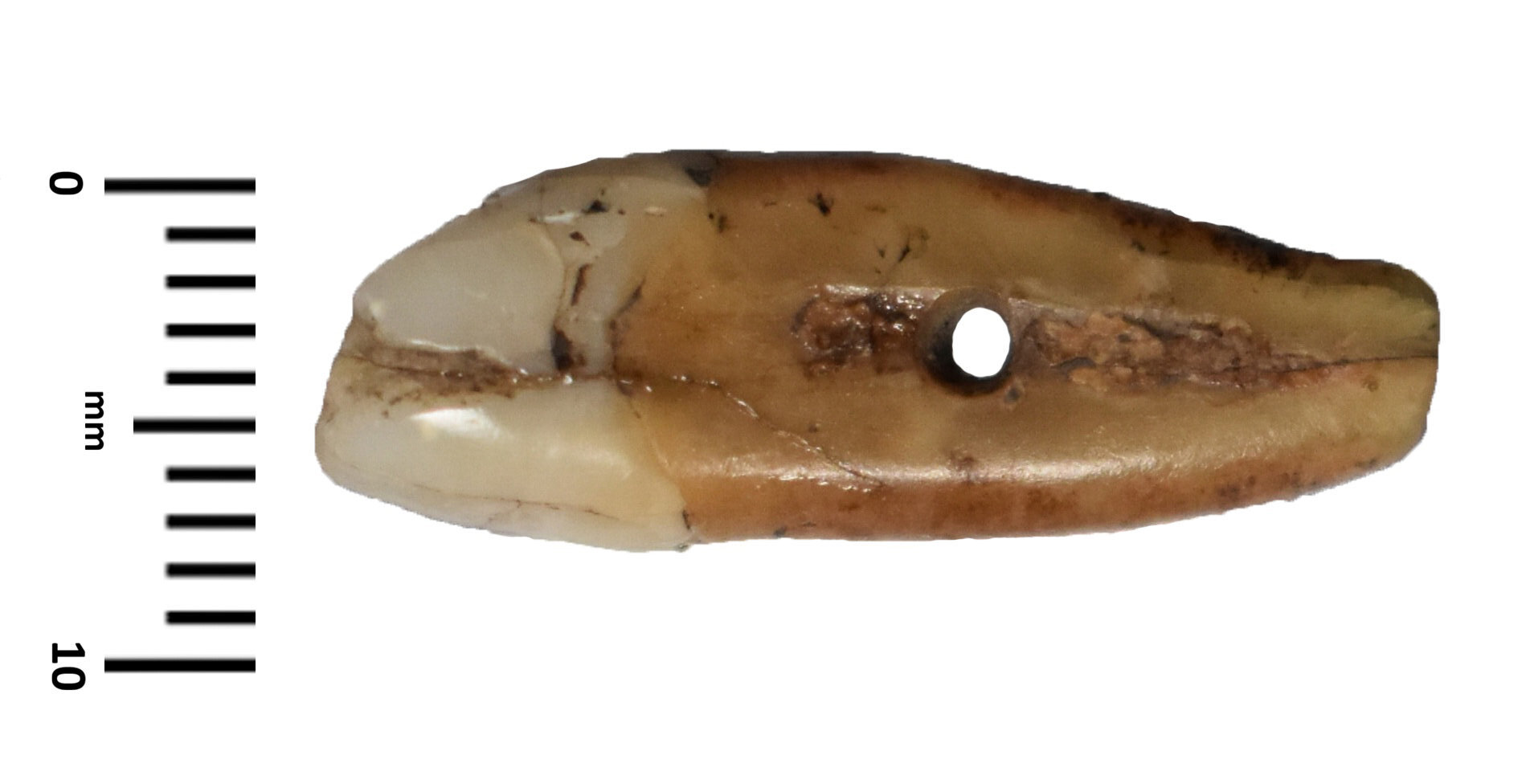
More than 6,500 years ago, someone in what is now Serbia carefully drilled a human canine, turned it into a pendant and likely wore it on a cord. The small object was mistaken for an animal-tooth bead for nearly two decades before archaeologists recognized what it actually was.
A bead that was not a bead
The tooth was found during field surveys at Jablanica, a Neolithic village south of Belgrade that was part of the Vinča culture. It was discovered lying in a field, where years of agricultural activity had damaged it and split its crown into two pieces.
The fragments were taken to the Museum of Mladenovac and labeled as the remains of a bead. They then remained on a shelf for almost 20 years.
Archaeologist Nemanja Marković of the Institute of Archaeology in Belgrade and his colleague Ana Maričić eventually examined the object more closely. Its shape led them to a different identification.
Marković said his first reaction was curiosity rather than surprise. Once he recognized the shape as a human canine, he realized it was considerably more unusual than an ordinary tooth bead.
The tooth is just 23 millimeters long, or slightly less than an inch. Because it had been found as a surface object rather than in a secure archaeological context, determining its age and history required several types of examination.
Signs that the tooth came from a dead person
The researchers used visual inspection, microscopy and X-ray analysis to examine the tooth.
Wear on its chewing surface indicated that it came from a middle-aged adult. The root surface was smooth and undamaged, which suggested that the tooth had not been forcibly removed while its owner was alive.
The researchers therefore concluded that the tooth came from someone who had already died, with the tooth likely taken from skeletal remains.
The object also showed evidence of careful manufacture. Under a microscope, Marković observed precise work that indicated the pendant was not an improvised object. The study describes the tooth as requiring considerable skill to produce and as having been worn for a prolonged period.
Dating the pendant
Establishing when the tooth was turned into an ornament was more difficult.
The researchers compared the drilling marks on the tooth with those on a shell bracelet discovered at Jablanica. The bracelet has a secure date of around 4700 B.C., and the comparison was used to assess whether similar techniques had been used to make the two objects.
The different lines of evidence pointed toward the same period, although Marković emphasized that absolute certainty was not possible because the tooth had been found on the surface.
The researchers therefore identify it as a Neolithic object from the period associated with the Vinča culture.
An unusually rare ornament
Ornaments themselves are uncommon at Jablanica. Before the tooth was recognized, only two other pieces had been found there: a fragment of a shell bracelet and another shell pendant.
Human tooth pendants are also rare elsewhere in Europe. Examples do exist, but the researchers found no human tooth ornament that had been definitively documented in the Neolithic central Balkans.
That makes the Jablanica tooth an unusual example of prehistoric personal ornamentation.
Its recognition also depended on a second examination of an object that had already been identified and stored in a museum collection. Marković hopes the discovery encourages researchers to revisit older collections, where other objects may have been incorrectly identified.
The study also interprets the pendant as evidence that human remains could be transformed into personal objects during prehistory. In the researchers’ view, this provides new perspectives on identity, memory and relationships between living people and the dead in Vinča society and beyond.
The study was published in the International Journal of Osteoarchaeology.